"25% Tariff Announced on Chips Exported to China"
Section 232 of the Trade Expansion Act Cited...
Comprehensive Semiconductor Tariffs Discussed
China Moves to Block H200 Imports
On January 14 (local time), U.S. President Donald Trump signed a proclamation imposing a 25% tariff on semiconductors, including Nvidia's artificial intelligence (AI) chip "H200," that are imported into the United States and then re-exported to other countries. While the U.S. is opening the door for exports in exchange for collecting 25% of the chip sales, China is blocking imports by prohibiting customs clearance. Although there was no mention of other foreign-made semiconductors on this day, President Trump did raise the possibility of introducing comprehensive semiconductor tariffs, fueling speculation that such tariffs may be announced soon.
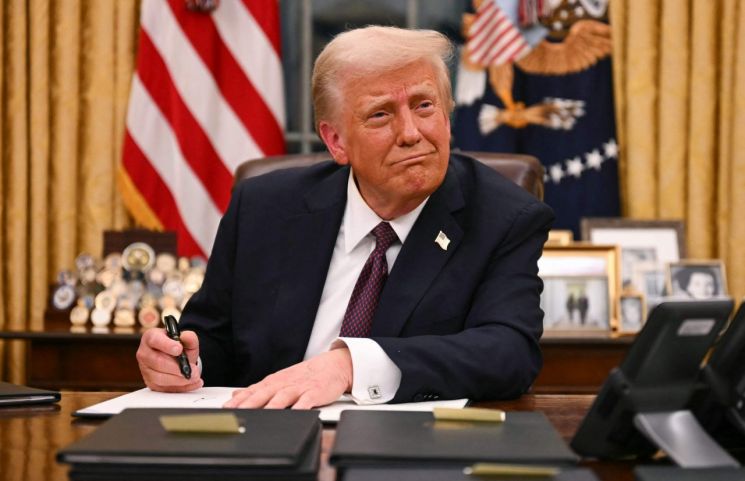
After signing the proclamation at the White House, President Trump stated that the H200 "is not the highest specification, but it is a very good chip, and many countries, including China, want it," adding, "We will earn 25% of the chip sales."
U.S. media outlets interpret this measure as an attempt to allow sales of the H200 to China. The previous day, the U.S. Department of Commerce amended regulations to enable exports of the H200 to China.
The H200 is based on Nvidia's Hopper architecture, which is the generation prior to its flagship Blackwell product. However, it significantly outperforms the H20 chip, which had been sold to China with reduced performance. According to the White House, the 25% tariff will be imposed on products such as Nvidia's H200 and AMD's MI325X. According to the fact sheet, chips imported to support the establishment of the U.S. technology supply chain and to strengthen the domestic manufacturing capacity of semiconductor derivative products will be exempt from this tariff.
On this day, the Trump administration did not impose tariffs on semiconductors from other foreign countries, including South Korea. However, President Trump stated in the proclamation, "Section 232 of the Trade Expansion Act authorizes the president to take action to adjust imports if any article or derivative is being imported into the United States in such quantities or under such circumstances as to threaten to impair national security," adding, "Such actions may include negotiations with foreign trading partners and import adjustment measures, including tariffs."
Additionally, the White House stated in the fact sheet, "In the near future, broader tariffs may be imposed on imports of semiconductors and their derivatives to encourage domestic manufacturing in the United States, and corresponding tariff offset programs may be introduced."
In response, Yeo Han-koo, South Korea's Minister for Trade at the Ministry of Trade, Industry and Energy, who is currently visiting the United States, has extended his stay by one day to assess the potential impact on Korean companies.
Although the U.S. government has conditionally allowed exports of the H200 to China, China is blocking the import of the H200. On this day, Reuters, citing multiple sources, reported that Chinese customs authorities recently instructed staff not to allow the H200 chip to enter China.
The previous day, The Information, citing multiple sources, reported that the Chinese government had notified technology companies that the H200 chip could only be used in special circumstances, such as at university research institutes. Authorities also issued ambiguous guidance instructing these companies to purchase Nvidia chips only "if necessary."
Last month, Reuters reported that Chinese technology companies had ordered more than 2 million H200 chips at $27,000 each, with delivery expected within the year. This would result in $13.5 billion flowing into the U.S. Treasury.
China's actions are seen as a strategy to foster domestic semiconductor companies by reducing dependence on U.S. firms. There is also an interpretation that China is using this as a bargaining chip ahead of the U.S.-China summit scheduled for April.
Opinions are divided on who stands to benefit more from Nvidia's sales of the H200 chip to China. The Trump administration argues that the U.S. government will reap significant profits by collecting 25% of the chip sales and that it will hinder the growth of Chinese semiconductor companies. On the other hand, Matt Pottinger, former Deputy National Security Advisor for Asia in the Trump administration, expressed concerns during a congressional hearing that the sale of the H200 would accelerate the modernization of the Chinese military.
© The Asia Business Daily(www.asiae.co.kr). All rights reserved.
![Clutching a Stolen Dior Bag, Saying "I Hate Being Poor but Real"... The Grotesque Con of a "Human Knockoff" [Slate]](https://cwcontent.asiae.co.kr/asiaresize/183/2026021902243444107_1771435474.jpg)
















