Regular Auctions and Castration Incentives
An Experiment to Develop Alternative Livestock Breeds into a Regional Industry
With the end of dog meat consumption bringing about institutional changes that demand a structural transformation in local livestock industries, efforts to find solutions are gaining momentum in Yecheon, North Gyeongsang Province.
On the morning of January 14, Yecheon County held the "First Goat Auction of the New Year 2026" at the Yecheon Livestock Market, where the county government reviewed its strategy to foster the goat industry as a new source of regional livestock income. Despite the cold wave, the auction was bustling with farmers who brought high-quality goats and buyers, creating a lively atmosphere befitting the first market of the year.
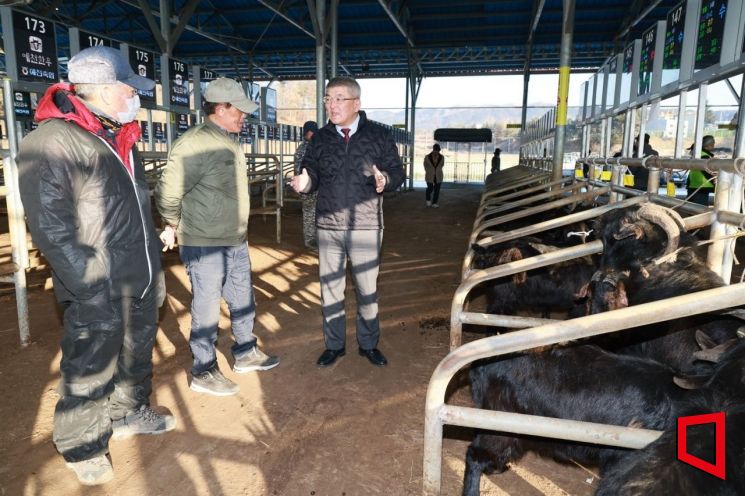 Hakdong Kim, Yecheon County Governor (first on the right), is reporting the situation at the first goat auction of 2026.
The goat auction at the Yecheon Livestock Market is held regularly on the second and fourth Wednesdays of every month. By adopting an open auction system, the process ensures price formation and transaction transparency. As a result, goats are increasingly being recognized as a stable livestock breed that supports farmers' income.
Yecheon County is paying close attention to the fact that, following the enforcement of the "Special Act on Ending Dog Meat Consumption," goats are emerging not simply as a substitute but as a practical alternative livestock breed.
Based on their image as a healthy food and relatively stable consumer demand, goats are seen as a way to supplement income gaps for farmers facing changes in the existing livestock structure. Accordingly, the county is focusing its policy efforts not only on expanding goat farming but also on structuring the industry to include distribution and consumption.
To this end, the county plans to revitalize goat auctions and strengthen connections with local restaurants that serve goat dishes, thereby securing stable sales channels and establishing a virtuous cycle linking production, distribution, and consumption. The vision is to develop the goat industry as a pillar of the region's mid- to long-term livestock strategy, rather than as a short-term response.
In particular, starting this year, the county has introduced a new incentive program to encourage goat castration, aiming to promote the production of high-quality goats. This policy targets both meat quality improvement and enhancement of the industry's image, with the dual goals of boosting farm productivity and strengthening market competitiveness.
Visiting the site, Governor Hakdong Kim closely inspected the goats' growth and the auction process, stating, "We will spare no administrative support to ensure that fair and transparent transactions take root in the field," and emphasized, "We will actively pursue policies to foster the goat industry as a practical alternative for livestock farmers struggling with institutional changes."
The first goat auction in Yecheon, held at a turning point of institutional change, is seen as a symbolic moment that presents the next path for the region's livestock industry, going beyond a simple transaction.
© The Asia Business Daily(www.asiae.co.kr). All rights reserved.

















