Professor Taejin Yoon’s Team at Asan Medical Center Performs Complete Repair Surgery on Premature Infant with Tetralogy of Fallot
"Expected to Grow Up Healthy Without the Pain of Repeat Surgeries"
A premature infant weighing only 1.5 kg, with a heart the size of an adult’s thumb, regained health after surviving a highly complex heart surgery just eight days after birth.
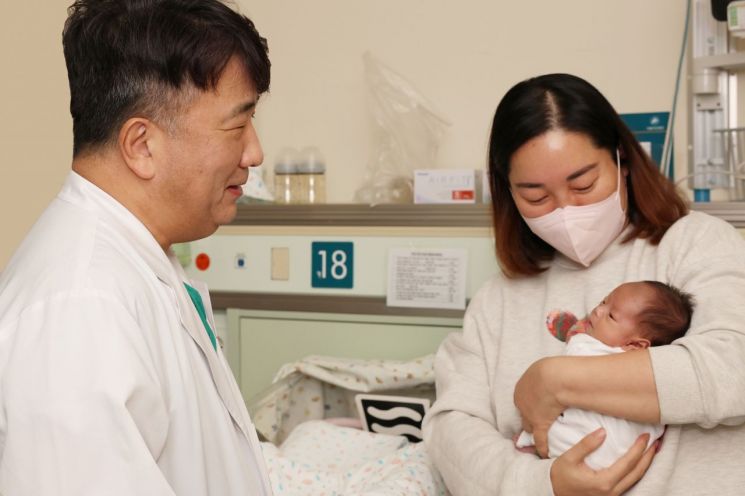 Asan Medical Center in Seoul successfully treated a complex congenital heart disease in a low-birth-weight infant with a heart size as small as a thumb within 8 days after birth. The photo shows Professor Taejin Yoon, Pediatric Cardiac Surgery at Asan Medical Center (left), the mother of Jun Lee, who is about to be discharged, and Jun Lee. Asan Medical Center. Photo by Asan Medical Center
On January 15, Asan Medical Center in Seoul announced that the team led by Professor Taejin Yoon of Pediatric Cardiac Surgery performed a complete repair surgery on Hong Leejun, a premature infant born with Tetralogy of Fallot, a congenital heart disease, and discharged him in healthy condition after 49 days of intensive care.
Lee Jun was a precious child born to his mother at the age of 45 after more than a year of in vitro fertilization treatment. However, prenatal examinations revealed a diagnosis of Tetralogy of Fallot, a complex cardiac malformation. Tetralogy of Fallot is a condition characterized by four structural defects, including a ventricular septal defect and right ventricular outflow tract stenosis, which prevent proper oxygen delivery throughout the body and cause cyanosis. Without timely surgical correction, complications such as growth disorders or heart failure can occur.
The standard surgical method for Tetralogy of Fallot, known as "complete repair," restores the heart’s structure in a single operation. However, because it is a highly complex procedure that involves opening the chest, stopping the heart, closing the ventricular septal defect, and reconstructing the valves, it is usually performed on infants who have gained enough weight, typically after four months of age. For premature or low-birth-weight infants like Lee Jun, temporary shunt or stent procedures that only regulate blood flow are usually performed first to reduce surgical risk, with a second corrective surgery planned for later. However, the stent procedure, which involves placing a mesh in the right ventricular outflow tract, is technically challenging for low-birth-weight infants and has the critical drawback of causing permanent damage to the pulmonary valve after the procedure.
However, in November last year, Lee Jun was born a month early at a low birth weight of 1.5 kg. Within just a few days after birth, his oxygen saturation levels dropped sharply, and he began to show signs of anoxic spells, making it impossible to delay treatment.
For Lee Jun’s long-term prognosis, Professor Yoon opted for a complete repair rather than a temporary measure. During the surgery on November 18, Professor Yoon’s team opened Lee Jun’s heart, which was only the size of a thumb, closed the hole in the ventricle, and removed the narrowed area. In particular, they preserved the pulmonary valve as much as possible to ensure normal blood flow through the heart. Although Lee Jun’s blood vessels were thinner than a needle and his physiological condition was immature, making a lengthy surgery likely, the operation was completed successfully in four hours.
After the surgery, the neonatal intensive care unit team led by Professor Jung Seok of Neonatology managed Lee Jun’s breathing and blood pressure with intensive care. Thanks to the dedicated care of the medical staff, Lee Jun recovered rapidly and was able to start feeding just 11 days after surgery.
Lee Jun’s mother expressed her gratitude, saying, “I was worried from the moment I learned during pregnancy that Lee Jun’s heart was not healthy, but the medical team’s firm and confident assurance that they would fix his heart allowed me to keep hope and focus on giving birth. I am grateful for this miracle and will do my best to raise Lee Jun to be healthy and strong.”
Professor Yoon explained, “Treating Lee Jun, who was born at a low birth weight of 1.5 kg, was a challenge for the medical staff as well. However, I believed that preserving the pulmonary valve and correcting the defect in a single surgery, so that he would not have to undergo repeat operations, was the best gift we could give him.”
Yoo Jeongjin, Director of the Congenital Heart Disease Center at Asan Medical Center, stated, “Children born in this era of ultra-low birth rates are precious gems of our society. Even for premature infants born under difficult circumstances, we will do our utmost to help them grow into healthy members of society through a multidisciplinary collaboration system and specialized medical care, including home monitoring.”
© The Asia Business Daily(www.asiae.co.kr). All rights reserved.

















