Korea Federation of SMEs and Ministry of Climate, Energy and Environment Hold 40th SME Climate, Energy, and Environmental Policy Council
The Korea Federation of SMEs announced that, on January 15, it held the "40th SME Climate, Energy, and Environment Policy Council" at its headquarters in Yeouido, in collaboration with the Ministry of Climate, Energy and Environment. The SME Climate, Energy, and Environment Policy Council is a consultative body jointly organized and operated by the Korea Federation of SMEs and the Ministry of Climate, Energy and Environment every six months. Its purpose is to facilitate smooth communication and cooperation between the government and SMEs, as well as to identify and improve regulations and challenges related to climate and environmental issues affecting SMEs.
The meeting was attended by approximately 30 people, including Oh Kiwoong, Executive Vice President of the Korea Federation of SMEs and co-chair of the council, Geum Hanseung, First Vice Minister of the Ministry of Climate, Energy and Environment, and representatives from various SME industry associations. They shared government policies on climate and environmental issues of high interest to the SME sector and focused on discussing difficulties faced in the industrial field.
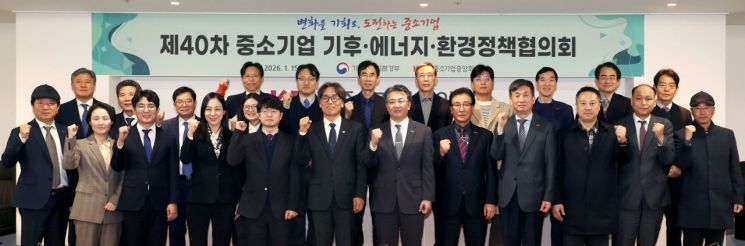 Geum Hanseung, First Vice Minister of the Ministry of Climate, Energy and Environment (sixth from the left in the first row), and Oh Kiwoong, Executive Vice President of the Korea Federation of SMEs, along with other attendees, are posing for a commemorative photo. Korea Federation of SMEs
At the event, Yoo Youngjin, Chairman of the Jeonbuk Automobile Inspection and Maintenance Cooperative Association, proposed improvements to the self-measurement system for air emission and prevention facilities at small-scale workplaces equipped with Internet of Things (IoT) measuring devices. He stated, "Although data measured by devices can be transmitted in real time to the Korea Environment Corporation, enabling scientific and systematic management, business owners are currently required to conduct self-measurement at least once every six months or request measurement by a service provider, and must also fill out a separate form daily, which is an administrative burden." He requested that measures be prepared to reduce the administrative burden on SMEs in line with the technological advancement and automation trends in the industry. In response, the Ministry of Climate, Energy and Environment stated that research on the effectiveness of IoT installation is currently underway, and that they will review whether and to what extent the self-measurement cycle can be relaxed through expert review and stakeholder feedback on field conditions and operational performance by industry.
Next, Jang Yonghwan, Chairman of the Gyeongin Foundry Industrial Complex Cooperative Association, said, "Recently, electricity rates, especially for industrial use, have been raised, increasing the burden on companies," and suggested, "A systematic improvement of the electricity rate system is needed so that time-of-use rates are operated in a way that suits industrial sites." The Ministry of Climate, Energy and Environment responded that it would carefully examine the financial status of Korea Electric Power Corporation (KEPCO) and the actual electricity demand of businesses to rationally reform the rate system.
In addition, representatives of industry-specific cooperatives proposed various suggestions on SME environmental issues, including: ▲expanding support for SMEs' use of renewable energy and improving related regulations; ▲rationalizing the system for confirming exemptions from registration or reporting requirements for chemicals intended exclusively for export; and ▲improving regulations and establishing government support systems related to waste management and disposal. Oh Kiwoong, Executive Vice President of the Korea Federation of SMEs, stated, "Recently, SMEs are facing management difficulties due to various factors such as declining demand caused by increasing domestic and international uncertainties and the strengthening of environmental and ESG regulations. I ask that the Ministry of Climate, Energy and Environment fulfill its role as a 'supporting ministry' rather than a 'regulatory ministry' and spare no effort in providing support so that SMEs can also participate in achieving the government's goals."
In response, Geum Hanseung, First Vice Minister of the Ministry of Climate, Energy and Environment, said, "We will carefully design policies so that SMEs are not left behind in the process of achieving the national greenhouse gas reduction target for 2035, and so that they can use this as an opportunity for technological development and strengthening competitiveness, ultimately growing into strong and medium-sized enterprises. I also ask the SME sector to strengthen competitiveness by transforming into an industrial structure that fits the trends of the times and to cooperate in pioneering new markets and technologies."
© The Asia Business Daily(www.asiae.co.kr). All rights reserved.
![Clutching a Stolen Dior Bag, Saying "I Hate Being Poor but Real"... The Grotesque Con of a "Human Knockoff" [Slate]](https://cwcontent.asiae.co.kr/asiaresize/183/2026021902243444107_1771435474.jpg)
















