National Tax Revenue Up by 39.2 Trillion Won,
Total Expenditure Surges by 54.3 Trillion Won
As of November last year, the national fiscal deficit approached approximately 90 trillion won, marking the third-largest deficit for the same period on record. Although national tax revenue saw a significant increase, the pace of total expenditure growth outstripped it, resulting in a continued deterioration of the fiscal balance.
According to the "Monthly Fiscal Trends: January Edition" published by the Ministry of Economy and Budget on January 15, cumulative total revenue as of the end of November last year was 581.2 trillion won, up 39.2 trillion won from the same period the previous year. The execution rate compared to the budget was 90.5%. During the same period, total expenditure reached 624.4 trillion won, an increase of 54.3 trillion won year-on-year.

As a result, the consolidated fiscal balance, calculated by subtracting total expenditure from total revenue, recorded a deficit of 43.3 trillion won. Excluding the surplus from social security funds such as the National Pension (46.3 trillion won) from the consolidated fiscal balance, the managed fiscal balance deficit amounted to 89.6 trillion won. This is the third-largest deficit on record for the same period, following 2020 (98.3 trillion won) and 2022 (98 trillion won). Compared to the same period last year, the deficit widened by about 8.3 trillion won.
The managed fiscal balance, which reflects the government's actual fiscal status, is gradually approaching this year's budgeted deficit target of 111.6 trillion won. The Ministry of Economy and Budget stated, "As the year-end approaches, the managed fiscal balance is expected to converge toward the budgeted deficit level."
Of the total revenue, national tax revenue amounted to 353.6 trillion won, an increase of 37.9 trillion won compared to the same period last year. By tax category, corporate tax increased by 22.2 trillion won and income tax by 12.3 trillion won, while value-added tax decreased by 500 billion won due to increased refunds and other factors. Securities transaction tax also fell by 1.4 trillion won as a result of a reduced tax rate.
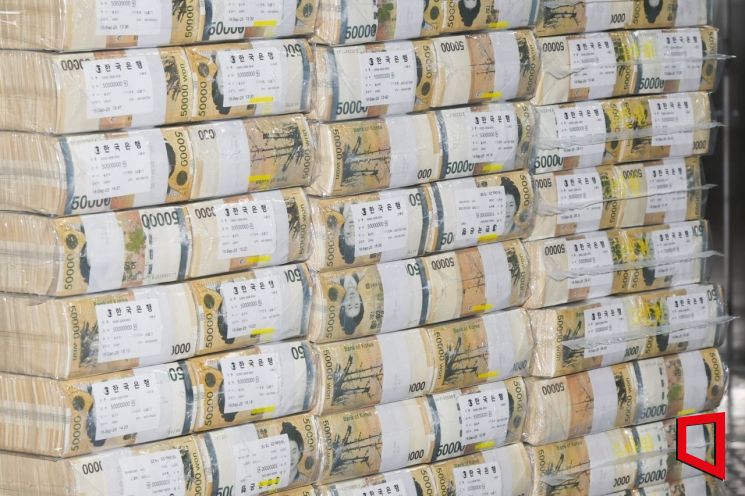 On the 30th, officials are supplying Chuseok currency at the Bank of Korea Currency Receiving Center in Jung-gu, Seoul. September 30, 2025. Photo by Joint Press Corps
Non-tax revenue stood at 28.4 trillion won, up 2.3 trillion won, whereas fund revenue was 199.2 trillion won, a decrease of 800 billion won from the previous year. While overall revenue showed signs of improvement, the rate of increase was limited.
On the expenditure side, budget execution amounted to 431.8 trillion won and fund expenditure to 192.5 trillion won. The budget execution rate was 92.4%, and the fund execution rate was 81.6%. With the rapid pace of fiscal execution, the increase in expenditure (54.3 trillion won) significantly outpaced the increase in revenue (39.2 trillion won), leading to a worsening fiscal balance.
As of the end of November last year, central government debt stood at 1,289.4 trillion won, up 14.1 trillion won from the previous month. Of this, the outstanding balance of government bonds was recorded at 1,287.8 trillion won. The government expects that, on an annual basis, central government debt will remain within the initially projected range.
The issuance of Treasury bonds to cover the fiscal deficit is also progressing rapidly. As of December last year, cumulative Treasury bond issuance amounted to 226.2 trillion won, reaching 97.9% of the annual issuance limit.
Reflecting changes in interest rate trends, Treasury bond rates in December saw short-term rates decline and long-term rates rise, influenced by the U.S. base rate cut and an increase in long-term rates in Japan. As a result, the three-year Treasury bond yield was recorded at 2.952% per annum, and the ten-year yield at 3.385%. The outstanding balance of Treasury bonds held by foreigners increased by 3.7 trillion won over the month, reaching 297.4 trillion won.
© The Asia Business Daily(www.asiae.co.kr). All rights reserved.
![Clutching a Stolen Dior Bag, Saying "I Hate Being Poor but Real"... The Grotesque Con of a "Human Knockoff" [Slate]](https://cwcontent.asiae.co.kr/asiaresize/183/2026021902243444107_1771435474.jpg)

















