Utilizing Private Development Profits to Expand Public Facilities
55% of Sewer Pipelines Over 30 Years Old, Urgent Maintenance Needed
Safety Infrastructure to Be Reviewed from the Initial Planning Stages
#. Ahead of redevelopment, Mido, Eunma, and Seonkyung Apartments near Daechi Station Intersection in Gangnam District agreed last year to jointly install and share the cost of a 119,000-ton capacity detention facility as a form of 'public contribution' linked to the maintenance project. These complexes are regarded as exemplary cases for expanding infrastructure to prevent flooding in residential areas and securing disaster prevention facilities in advance, using profits generated from the development project.
On January 15, Seoul City announced that, as heavy rainfall becomes more frequent due to climate change, it will actively invest the 'public contribution'-the development profit generated from large-scale private development projects-into strengthening sewage facilities and related infrastructure.
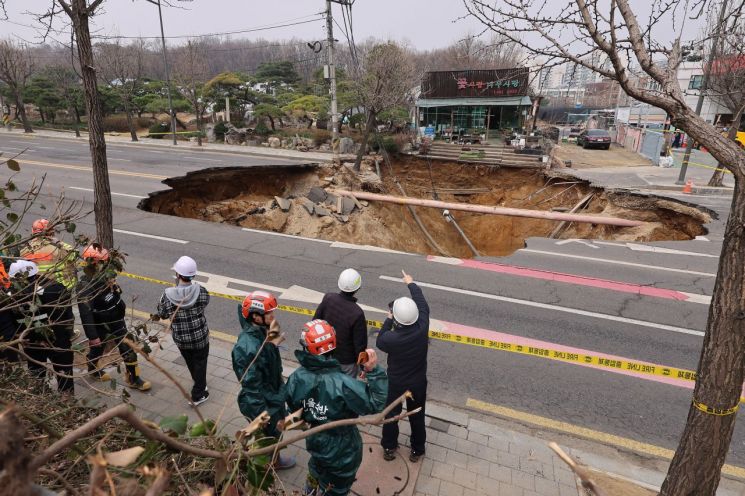 Seoul City will focus on using the 'public contribution,' which is the development profit generated from large-scale private development projects, to strengthen sewage facilities. The photo shows the scene of a large ground subsidence that occurred on the road near Daemyeong Elementary School in Gangdong District. Photo by Yonhap News
The public contribution system, which returns private development profits to society, has mainly been used for public infrastructure such as roads, parks, and cultural facilities. However, the city plans to expand its application, prioritizing safety infrastructure. This decision comes amid repeated flooding in Seoul and the metropolitan area caused by heavy rains exceeding 100mm per hour, highlighting the need for preventive safety infrastructure rather than post-disaster recovery.
Of the 10,866 kilometers of sewer pipelines in Seoul, 55.5% (6,029 kilometers) are over 30 years old and require maintenance, while 30.4% (3,303 kilometers) are over 50 years old and considered extremely aged. During heavy downpours, low-lying areas are exposed to flooding risks, making urgent maintenance necessary. The city acknowledges that relying solely on public finances for large-scale sewer maintenance is challenging due to budget constraints, difficulties in securing available land, and opposition from residents. However, by utilizing public contribution, Seoul expects to establish a cooperative structure in which both the public and private sectors work together to solve urban issues.
Going forward, Seoul City plans to systematically review areas in need of sewer maintenance from the initial stages of development project planning, set priorities for maintenance, and make it mandatory to upgrade aging sewer systems in adjacent sections as development projects proceed. In addition, detention tanks to temporarily store rainwater during heavy rainfall will be installed in flood-prone areas, and erosion control facilities will be expanded at project sites located on hillsides to prevent landslides.
Ahn Daehee, Director of the Urban Space Headquarters of Seoul City, stated, "Sewer systems may not be visible, but they are a crucial urban infrastructure that protects citizens' lives and safety from extreme rainfall and other disasters. Moving forward, we will actively utilize public contribution to secure urban safety, respond to the climate crisis, protect citizens from disasters, and build a sustainable Seoul."
© The Asia Business Daily(www.asiae.co.kr). All rights reserved.

















