Chinese Media Downplay Korea-Japan Summit
Intent to Keep Japan in Check Amid Tensions Over Taiwan
China's state-run media has focused on the scene where Japanese Prime Minister Sanae Takaichi greeted President Lee Jaemyung with a 90-degree bow during the Korea-Japan summit, raising questions about the sincerity of Korea-Japan relations. This is interpreted as a move by China to deliberately downplay the significance of Korea-Japan cooperation amid ongoing China-Japan tensions over the Taiwan issue.
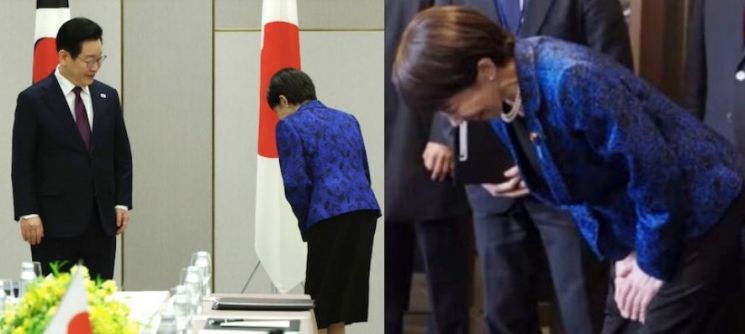 Sanae Takaichi, Prime Minister of Japan, is seen paying respect to the national flag before heading to her seat after shaking hands with President Lee Jae-myung at the Korea-Japan summit venue in Nara Prefecture, Japan, on the 13th. On the right is the same day’s scene of Prime Minister Takaichi greeting President Lee with a 90-degree bow at the hotel entrance. Photo by AFP Yonhap News Agency and Global Times
On January 14, the state-run Global Times (GT) referred to President Lee's visit to Japan, quoting experts as saying, "There is a difference in temperature between the perspectives of the two leaders regarding bilateral relations."
The scene highlighted by GT was Prime Minister Takaichi personally welcoming President Lee at the entrance of a hotel in Nara Prefecture, Japan, on the afternoon of the 13th. It is considered an unusual diplomatic gesture for the Japanese Prime Minister to visit the accommodation of a foreign head of state.
China Questions Sincerity of '90-Degree Bow'... Highlights Korea-Japan 'Differences'
However, GT did not view this scene as evidence of progress in relations. It pointed out that while Prime Minister Takaichi expressed hope for Korea-Japan relations to "advance to a new level," President Lee stated that "negative factors should be properly managed," thus illustrating the difference in perspectives between the two leaders.
GT also reported on Prime Minister Takaichi's 90-degree bow to President Lee, introducing a comment from a Korean online user who said this is "the attitude and expression Japan adopts when it wants something from Korea." The report emphasized the nuance that, despite the outward display of courtesy, there is a lack of genuine trust and strategic agreement.
GT stated, "The difference in statements between the two leaders shows that Japan is trying to minimize historical burdens and focus on strategic and economic cooperation, while Korea is seriously concerned about structural threats such as history and territorial issues and prioritizes preventing regression in bilateral relations. This demonstrates how fragile the foundation of the relationship is and how lacking strategic agreement has been. Cooperation between the two countries will remain limited in scope and will not create genuine strategic synergy."
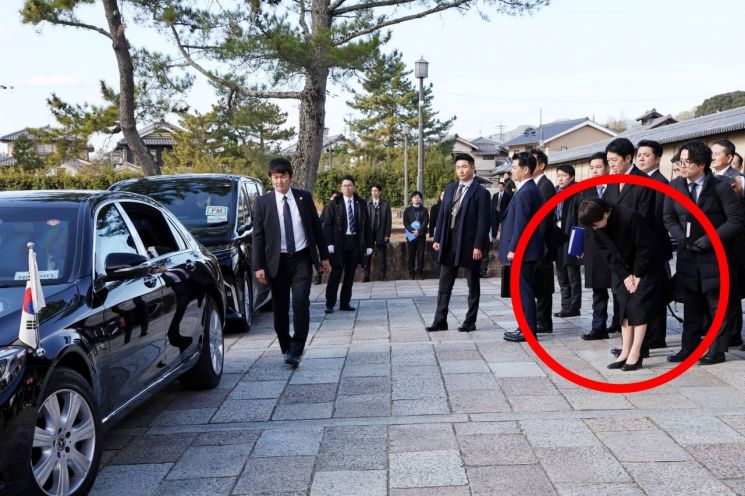 Prime Minister Takaichi is bowing to President Lee as he departs after visiting Horyu-ji Temple in Nara Prefecture, Japan, on the 14th. Photo by Yonhap News
Caution Over Korea-Japan Cooperation Amid China-Japan Tensions
Shang Haoyu, a researcher at the China Institute of International Studies, said in an interview with the media, "Takaichi is attempting to use Korea as leverage to create a geopolitical and strategic breakthrough for Japan," adding, "In contrast, the 'management' emphasized by President Lee reflects the defensive and pragmatic strategy of the Lee Jaemyung administration. This reveals the unstable foundation of Korea-Japan relations and the deep lack of mutual trust."
Dazhi Jiang, Director of the Northeast Asia Institute at the Heilongjiang Academy of Social Sciences, stated, "Any one of the issues-forced labor during the Japanese occupation, comfort women, territorial disputes, or the trend of historical revisionism in Japan-could provoke a strong backlash in Korean society at any time." He added, "Bilateral relations are highly vulnerable to a vicious cycle of improvement, regression, and re-improvement, making it difficult to achieve truly stable development."
The reason China is downplaying the achievements of the Korea-Japan summit is interpreted as an attempt to keep Japan in check. Since Prime Minister Takaichi suggested possible intervention in the event of a Taiwan contingency last November, China-Japan tensions have deepened. During President Lee's visit to China, the Chinese side also emphasized Korea-China solidarity by highlighting the fact that both countries fought against Japanese militarism during World War II.
© The Asia Business Daily(www.asiae.co.kr). All rights reserved.


















