A new reference signal technology has been developed that enables even unknown black holes to be observed with greater clarity. Radio telescopes are devices that capture faint radio signals from space and convert them into astronomical images, making them essential for black hole observation. However, to observe black holes more clearly, multiple radio telescopes must capture cosmic signals at exactly the same time, as if functioning as a single unit. The new reference signal technology is significant because it opens up new possibilities for meeting these requirements.
On January 15, KAIST announced that the research team led by Professor Kim Jungwon from the Department of Mechanical Engineering, in collaboration with the Korea Astronomy and Space Science Institute (KASI), the Korea Research Institute of Standards and Science (KRISS), and the Max Planck Institute for Radio Astronomy (MPIfR) in Germany, has become the first in the world to directly apply optical frequency comb laser technology to a radio telescope receiver.
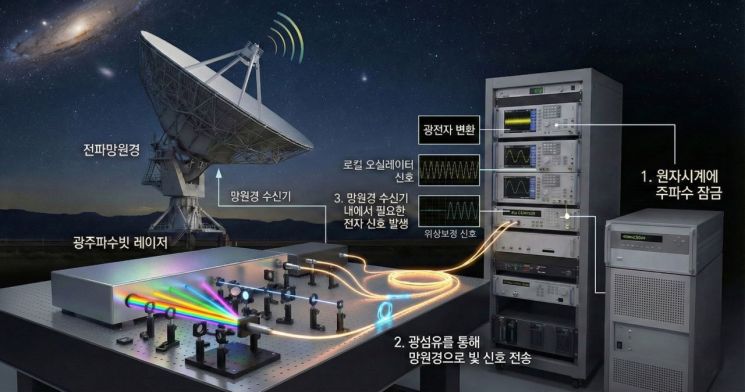 An image explaining the application principle of directly applying Gwangju Frequency Bit Laser technology to a radio telescope receiver. Provided by KAIST (AI generated)
The core of Very Long Baseline Interferometry (VLBI) technology, where multiple radio telescopes observe simultaneously, is to synchronize the phase of the radio signals received by each telescope as precisely as if aligning them to a single, exact ruler.
However, the conventional electronic reference signal method has limitations: as the observation frequency increases, the reference signal itself becomes slightly unstable, making precise phase correction difficult.
In response, the KAIST research team developed a method that directly delivers an optical frequency comb laser into the radio telescope, based on the idea of "enhancing the fundamental precision of phase alignment by using light (laser) from the signal generation stage." With this approach, they successfully solved both the reference signal generation and phase correction challenges within a single optical system.
Unlike standard lasers that emit only one color (frequency), an optical frequency comb laser arranges tens of thousands of highly precise colors at regular intervals. Because it resembles a "comb" used to brush hair, it is called a "frequency comb."
The frequency of each "tooth" of the comb can be known with extreme accuracy, and the spacing can be adjusted with atomic clock-level precision. For this reason, the scientific community often refers to it as an "ultra-precise ruler made of light."
Whereas the conventional method could be compared to a "ruler whose markings tremble slightly, making phase alignment difficult" as observation frequencies increase, the technology of directly delivering an optical frequency comb laser into the radio telescope can be likened to "an ultra-precise ruler that locks the phase with extremely stable light."
As a result, the research team explained that this technology lays the foundation for multiple radio telescopes located far apart to operate in perfect coordination, as if they were a single, massive telescope.
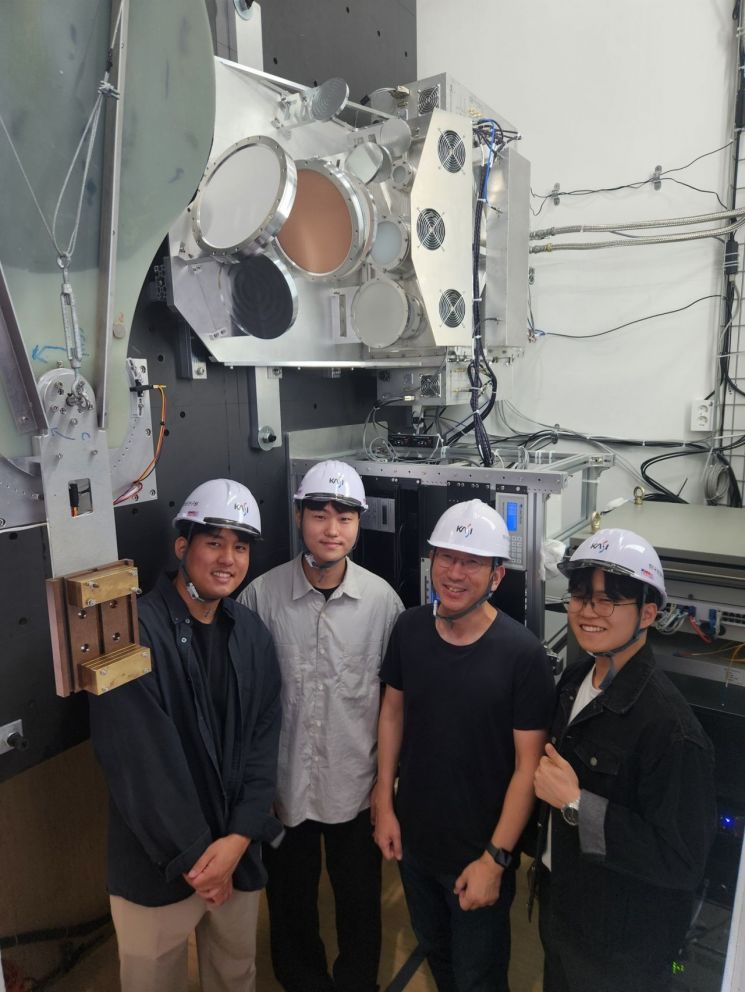 (from left) Researcher Choi Junyong, Researcher Jung Woosong, Professor Kim Jungwon, Researcher Paek Jihoon. Provided by KAIST
This technology was verified through test observations at the Yonsei Radio Telescope, part of the Korean VLBI Network. The research team successfully detected stable interference fringes between the signals of the radio telescopes, demonstrating through actual observation that precise phase correction is possible.
Recently, this system has also been installed at the KVN Seoul National University Pyeongchang Radio Telescope, and is being expanded to experiments involving simultaneous use of multiple observatories.
The research team expects that this will not only enable even clearer imaging of black holes, but also dramatically reduce phase delay errors between equipment-a long-standing issue in VLBI observations.
Most importantly, the application of this technology is not limited to astronomical observation. The team envisions its future use in a variety of advanced fields requiring precise space-time measurement, including intercontinental ultra-precise clock comparisons, space geodesy, and deep space probe tracking.
Professor Kim stated, "This research has overcome the limitations of conventional electronic signal generation technologies by directly applying optical frequency comb lasers to radio telescopes. We expect it will enhance the precision of next-generation black hole observations and contribute to advances in frequency measurement and time standardization."
Meanwhile, Dr. Hyun Minji of KAIST (currently at KRISS) and Dr. Ahn Changmin participated as co-first authors in this research. The results (paper) were published on January 4 in the international journal 'Light: Science & Applications.'
© The Asia Business Daily(www.asiae.co.kr). All rights reserved.
![Clutching a Stolen Dior Bag, Saying "I Hate Being Poor but Real"... The Grotesque Con of a "Human Knockoff" [Slate]](https://cwcontent.asiae.co.kr/asiaresize/183/2026021902243444107_1771435474.jpg)

















