Financial Stocks Fall Amid Earnings Reports and Credit Card Rate Cap
China's Ban on Nvidia H200 Imports Weighs on Tech Stocks
November Producer Prices Miss Expectations, Retail Sales See Biggest Gain in Four Months
Geopolitical Risks in Focus: Ir
On January 14 (local time), all three major U.S. stock indices declined simultaneously. Investors are growing increasingly cautious, focusing on corporate earnings reports-especially from financial companies-as well as geopolitical variables such as the possibility of U.S. military intervention in Iran and issues surrounding Greenland. Both technology and financial stocks are showing weakness.
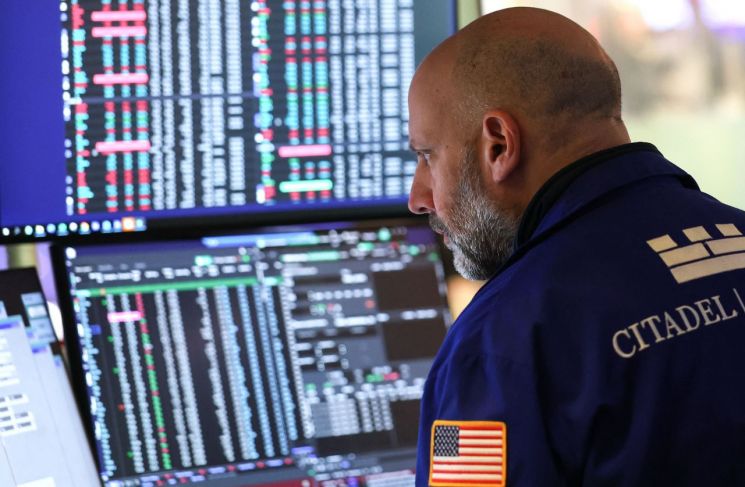 On the 14th (local time), a trader is working on the trading floor of the New York Stock Exchange (NYSE) in the United States. Photo by AFP
As of 2:41 p.m. on the New York Stock Exchange, the Dow Jones Industrial Average, which is centered on blue-chip stocks, was down 179.29 points (0.36%) from the previous trading day, standing at 49,012.7. The S&P 500 Index, which focuses on large-cap stocks, had fallen 56.88 points (0.82%) to 6,906.86, while the technology-heavy Nasdaq Index had plunged 323.918 points (1.37%) to 23,385.955.
By sector, technology stocks are showing particularly notable weakness. Broadcom is plunging by 4.71%. Nvidia and Micron are down by 2.16% and 1.92%, respectively. Investor sentiment has been negatively impacted by reports that, the previous day, Chinese customs authorities banned the import of Nvidia’s H200 artificial intelligence (AI) chip, which the United States had permitted for export to China.
Financial stocks are also weak, regardless of earnings. Wells Fargo is down 4.78% as its fourth-quarter revenue fell short of market expectations, while Bank of America and Citigroup are declining by 3.37% and 3.89%, respectively, despite strong earnings. This broad sell-off in financial stocks follows President Donald Trump’s announcement that he would cap credit card interest rates at 10% for one year. Bank of America has dropped 7% this week, while Citigroup and Wells Fargo have fallen by 8% each.
Investors also focused on inflation and consumer data released today. According to the U.S. Department of Labor, the Producer Price Index (PPI) for November of last year rose 0.2% from the previous month. This was higher than October’s 0.1%, but below market expectations of 0.3%. Retail sales were more robust than expected. The U.S. Census Bureau under the Department of Commerce reported that retail sales in November increased by 0.6% from the previous month to $735.9 billion. This exceeded the market forecast of 0.5% and marked the largest increase since July. Inflationary pressure was lower than expected, while consumer spending remained solid.
Uncertainty about the future path of interest rates remains high amid slowing employment and persistent inflation.
Tom Graff, Chief Investment Officer (CIO) at Facet, said, “If the PPI figures are converted to core Personal Consumption Expenditures (PCE), the result could be somewhat higher. In that case, it would pose a significant problem for the Federal Reserve (Fed) and could exacerbate concerns about its independence.”
Additionally, investor anxiety is being fueled by the U.S. Department of Justice’s launch of an investigation into Fed Chair Jerome Powell over the remodeling costs of the Fed’s headquarters building.
Geopolitical variables are also a major focus. President Trump stated the previous day that “a helping hand is being extended” to anti-government protesters in Iran, raising the possibility of U.S. military intervention.
Furthermore, U.S. Vice President J.D. Vance and Secretary of State Marco Rubio met with the foreign ministers of Denmark and Greenland at the White House to exchange views on the issue of U.S. acquisition of Greenland. President Trump has openly expressed his intention for the United States to acquire Greenland, a Danish autonomous territory, citing the need to strengthen Arctic security.
U.S. Treasury yields are falling as investors seek safe-haven assets. The yield on the benchmark 10-year U.S. Treasury note is down 3 basis points (1bp = 0.01 percentage point) from the previous day to 4.13%, while the yield on the 2-year Treasury note, which is sensitive to monetary policy, is down 1 basis point to 3.51%.
© The Asia Business Daily(www.asiae.co.kr). All rights reserved.

















