Consumer Spending Rebounds on Strong Auto Sales and Year-End Shopping Season
In November of last year, U.S. retail sales posted their largest increase in four months, driven by higher automobile sales and the effects of the year-end shopping season. This is seen as a sign that, despite a slowdown in the labor market and persistent high inflation, consumer spending continues to support the U.S. economy.
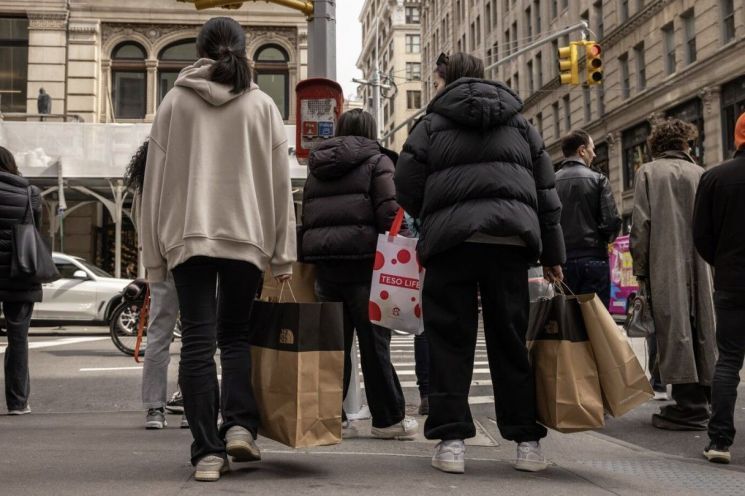
According to the U.S. Census Bureau under the Department of Commerce on January 14 (local time), retail sales in November of last year reached $735.9 billion, up 0.6% from the previous month. This exceeded the 0.5% increase forecast by experts surveyed by Bloomberg and marked the largest monthly gain since July.
Previously, the retail sales growth rate for October was revised downward from flat to a 0.1% decline.
Excluding automobiles, retail sales in November of last year rose 0.5% from the previous month, surpassing the expected increase of 0.4%.
Core retail sales (the control group), which exclude volatile sectors, increased by 0.4% from the previous month. Core retail sales exclude food services, automobiles, building materials, and gasoline sales, and are reflected in the calculation of Gross Domestic Product (GDP).
By category, sales increased in 10 out of 13 sectors. Sporting goods and bookstores (up 1.9%), general merchandise stores (up 1.7%), gasoline stations (up 1.4%), building materials and garden equipment (up 1.3%), and automobiles and auto parts (up 1.0%) all saw gains. Notably, automobile sales rebounded within a month after being subdued in October due to the expiration of federal electric vehicle tax credits. In contrast, sales of furniture and home improvement materials fell by 0.1%.
U.S. retail sales had been recovering since June, but the growth momentum weakened somewhat in September. Despite economic uncertainty caused by tariff burdens and other factors, the rebound in consumer spending in November suggests that consumption, which accounts for about two-thirds of the real U.S. economy, continues to serve as a pillar of growth. In particular, some analysts point out that rising consumption among high-income earners is leading the trend amid concerns over K-shaped polarization.
Additionally, the onset of the year-end shopping season in November, accompanied by large-scale discount events, appears to have contributed to increased spending. According to Adobe, U.S. consumers spent $257.8 billion online in November and December of last year, up 6.8% from the previous year. A notable trend was the significant increase in the use of buy now, pay later (BNPL) services alongside discount benefits.
With recent signs of easing inflationary pressure, there are also expectations that the recovery in consumer spending could gain further momentum. The previous day, the U.S. Department of Labor announced that the core Consumer Price Index (CPI) for December rose 2.6% year-on-year, which was below the market forecast of 2.7%.
Bloomberg reported, "Regarding the inflation data released the previous day, some economists believe that the degree to which tariffs are being passed on to consumer prices has peaked," adding, "This could support future goods consumption."
© The Asia Business Daily(www.asiae.co.kr). All rights reserved.

















