Second Follow-up Mediation Session Held by Seoul Regional Labor Relations Commission at 3 p.m.
The labor and management of Seoul city buses, who have been at odds over issues related to ordinary wage and collective bargaining agreements, have entered into negotiations for the first time since the strike began. Since the union has set the negotiation deadline at 9 p.m., if the two sides fail to reach a compromise by then, the bus strike is expected to continue on January 15 as well.
The Seoul Regional Labor Relations Commission held the second follow-up mediation meeting of the Special Mediation Committee at 3 p.m. on January 14 to mediate the wage and collective bargaining dispute between the Seoul City Bus Labor Union, affiliated with the Korean Automobile Workers' Federation, and the management, represented by the Seoul City Bus Transportation Business Association.
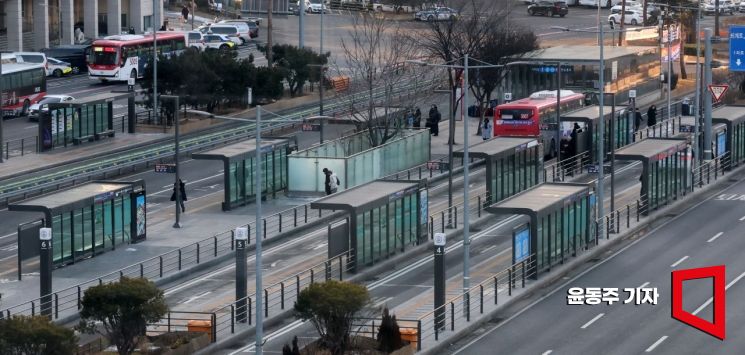 On the 14th, the second day of the Seoul city bus strike, the bus stop at Seoul Station showed a quiet scene. 2026.01.14 Photo by Yoon Dongju
Previously, on January 12, the labor and management held the first follow-up mediation meeting overnight, but it ultimately broke down, leading to the strike on January 13. This is the first time the two sides have returned to the negotiating table since then.
The union has announced that if an agreement is not reached by 9 p.m. on this day, the strike will continue on January 15. In this case, the Seoul city bus strike, which has already set a record for the longest duration ever, will enter its third day. Explaining the reason for setting the negotiation deadline, a union representative said, "In order to operate the first bus of the day, drivers have to leave home as early as 1:30 a.m., so if the negotiations conclude after 9 p.m., it will be difficult to operate the first bus."
After the first follow-up mediation meeting, the labor and management have continued to show significant differences in their positions. Kim Junghwan, Chairman of the Seoul City Bus Association, said at a briefing the previous day, "We have already offered better conditions than any other region," and added, "We are perplexed that even such proposals have been rejected, leading to a strike." Meeting with reporters just before the negotiations, the union side stated, "Our demands are not excessive, as we are only asking to normalize areas where we lag behind other regions. If we cannot even achieve that, we have no choice but to continue the strike."
The main issues in the wage and collective bargaining negotiations between Seoul city bus labor and management are: ▲ whether to reform the wage system in accordance with the ordinary wage ruling, ▲ the wage increase rate, ▲ extension of the retirement age, and ▲ whether to abolish Seoul City's bus operation inspection system.
Prior to the mediation meetings, Seoul City and management have maintained the position that the wage system needs to be reformed, considering that the scope of ordinary wages would be expanded under the Supreme Court ruling, leading to a sharp increase in labor costs. However, at the first mediation meeting on January 12, the mediation committee of the Regional Labor Relations Commission suggested postponing the wage system reform and instead proposed a 0.5% wage increase compared to the previous year, which the management accepted.
The union agreed to discuss the ordinary wage issue later, but rejected the first mediation proposal, insisting on a 3% wage increase. As a result, the wage increase rate is expected to be the key issue in the second meeting.
© The Asia Business Daily(www.asiae.co.kr). All rights reserved.

















