Record-Breaking Longest Strike in History
Negotiations Resume on the 14th; District Chiefs Launch Emergency Transportation Measures
At noon on the 14th, in Sinjeong-dong, Yangcheon-gu, Kim, a 27-year-old job seeker, said, "Our area does not have good subway access, so we have to either walk a long distance to a subway station or take a taxi. It seems that neither the Seoul city government nor the bus companies or drivers care about the inconvenience to citizens," he said, raising his voice.
The indefinite strike by the Seoul city bus union has continued for a second day, breaking the record for the longest strike ever. With just over four months left until the local elections in early June and a severe cold snap, public sentiment is deteriorating. Seoul Mayor Oh Sehoon and the heads of the 25 district offices have launched an all-out effort to minimize the damage.
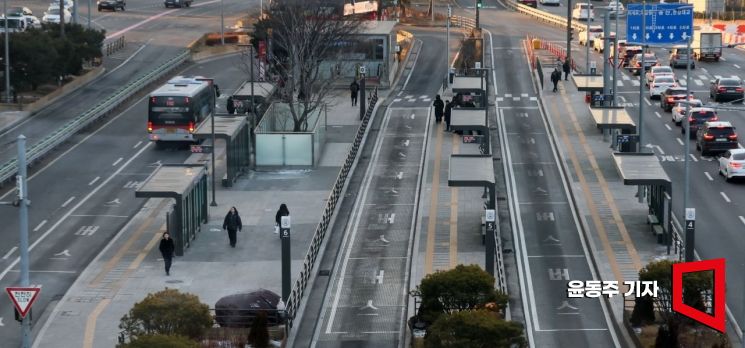 On the 14th, the second day of the Seoul city bus strike, the bus stop at Seoul Station showed a quiet scene. 2026.01.14 Photo by Yoon Dongju
The Seoul City Bus Labor Union began a full-scale strike at 4 a.m. on the 13th, and as of 3 p.m. on the 14th, operations remain suspended. More than 7,000 buses on 390 routes are parked in their depots. According to the Seoul city government, as of 8 a.m. on the 14th, only 562 buses from 53 companies were operating, resulting in an operation rate of 8.0% out of the total 7,018 authorized buses.
Unlike previous strikes, which lasted 8 hours in 1997, 20 minutes in 2012, and 11 hours in 2024, this strike has already surpassed 30 hours, setting a new record for the longest Seoul city bus strike in history.
The Seoul Regional Labor Relations Commission is holding a follow-up mediation meeting at 3 p.m. on the 14th, attended by representatives from both labor and management. If an agreement is reached before midnight, normal operations will resume from the first bus on the 15th. Otherwise, the strike will be prolonged.
The central issue of the strike is the method of wage increases based on the application of ordinary wages. Management has proposed restructuring the wage system to achieve an average increase of 10.3%, while the union is demanding a 3% increase without changing the wage system and an extension of the retirement age to 65.
On the morning of the 14th, Seoul Mayor Oh Sehoon visited the 120 Dasan Call Center to encourage the counselors and inspect the citizen information system. Mayor Oh said, "Due to the traffic congestion caused by the city bus strike, the volume of citizen consultations and civil complaint calls must have increased significantly. I ask that you do your best to minimize the inconvenience and difficulties experienced by citizens until the bus strike is over."
As an emergency transportation measure, the Seoul city government increased subway operations by 172 trips, deployed additional trains during rush hours, and extended the last train time to 2 a.m.
Amid concerns about a prolonged strike, the 25 districts of Seoul have urgently deployed 677 free shuttle buses. Jeong Wonoh, head of Seongdong District Office, has deployed 11 free shuttle buses, dubbed the "Success Bus," connecting six routes between major hubs in the district such as Seongsu and Majang and subway stations, operating until 10 p.m. The first bus time for four of the Success Bus routes has been moved up to 7 a.m., and the interval between village bus departures has been shortened.
Lee Suhee, head of Gangdong District Office, has deployed 70 free shuttle buses on seven routes connecting the Godeok, Amsa, and Cheonho areas. The interval between buses has been reduced to 5-15 minutes to alleviate congestion during rush hours. Lee stated, "We will mobilize all administrative resources to actively respond and minimize the inconvenience to residents caused by the strike."
© The Asia Business Daily(www.asiae.co.kr). All rights reserved.

















