Korea Expressway Corporation Fills Gaps in Psychological Recovery
'Anadream' Launches Full-Scale 11-Month Tailored Counseling Program
Specialized support to heal not only the physical injuries but also the long-lasting psychological trauma caused by expressway accidents is being further strengthened.
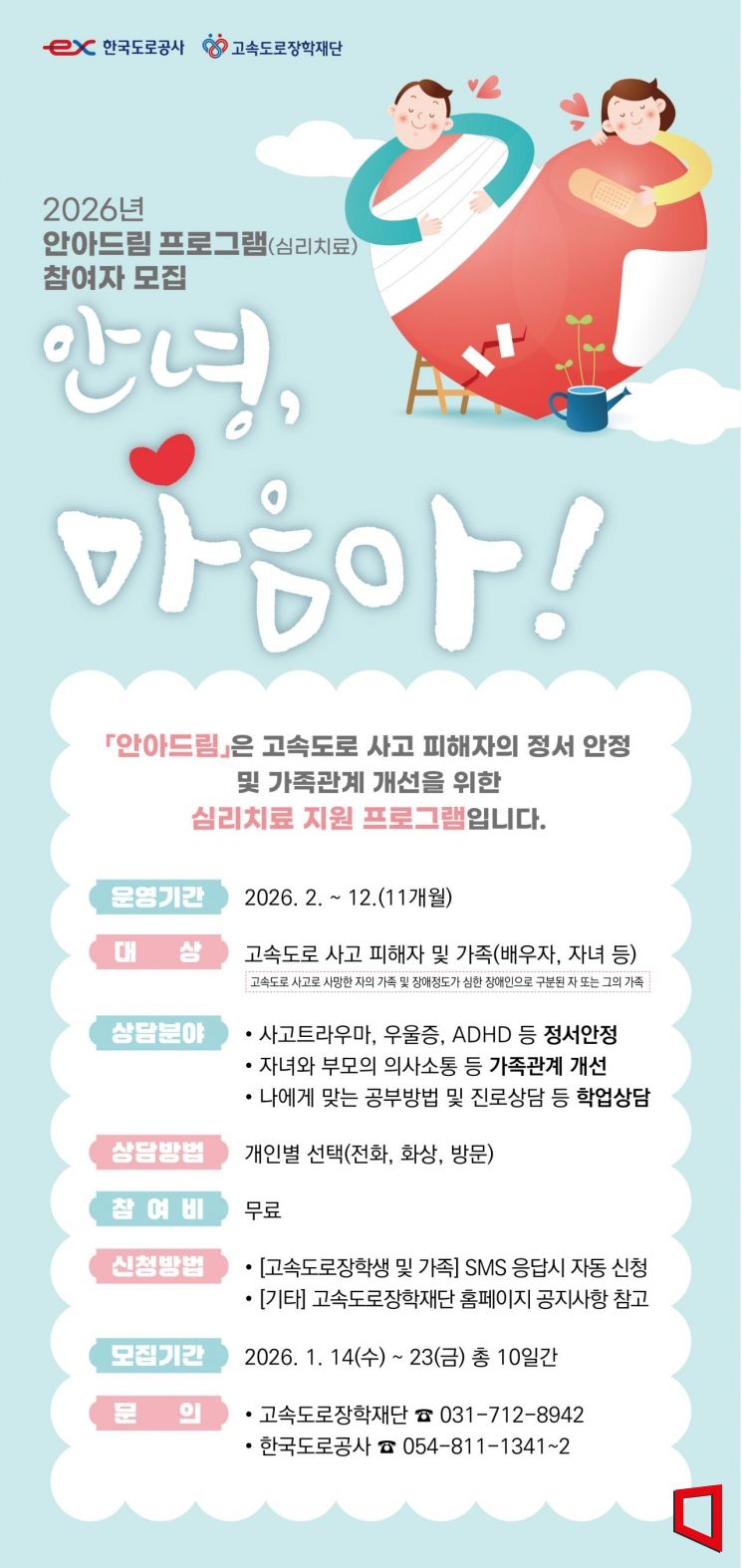
The Korea Expressway Corporation and the Expressway Scholarship Foundation announced that they will be recruiting participants for the psychological therapy program 'Anadream' for expressway accident victims and their families from January 14 to January 23.
'Anadream' is a psychological recovery program designed for victims who have been diagnosed with severe disabilities due to expressway traffic accidents (including construction and maintenance accidents), their families, and the families of those who have died in such accidents.
The program aims to provide professional counseling to those struggling to return to daily life due to psychological aftereffects such as depression, anxiety disorders, and post-traumatic stress disorder (PTSD) following an accident, thereby helping them regain emotional stability and restore family relationships.
This program is recognized for delivering tangible results beyond one-off support. Since its introduction in 2020, a total of 155 people have participated and received 1,897 counseling sessions. As of last year, the proportion of participants classified as 'stable' in terms of psychological state increased by 15 percentage points, from 73% to 88%. In contrast, the proportion of those classified as 'at risk,' who require ongoing management, dropped significantly from 27% to 12%, demonstrating clear effectiveness in alleviating depressive symptoms and overcoming accident-related trauma.
This year, the program's operation will be significantly improved. The duration will be extended from the previous 8 months (March to October) to 11 months (February to December), and one-on-one in-person counseling with professional therapists near participants' residences will be expanded to enhance both accessibility and effectiveness.
In addition, tailored support will be provided based on individual circumstances, including comprehensive psychological counseling via phone and in-person visits, parent-child relationship improvement programs, and career counseling for students. Those wishing to participate can fill out the application form posted on the Expressway Scholarship Foundation website and submit it via email.
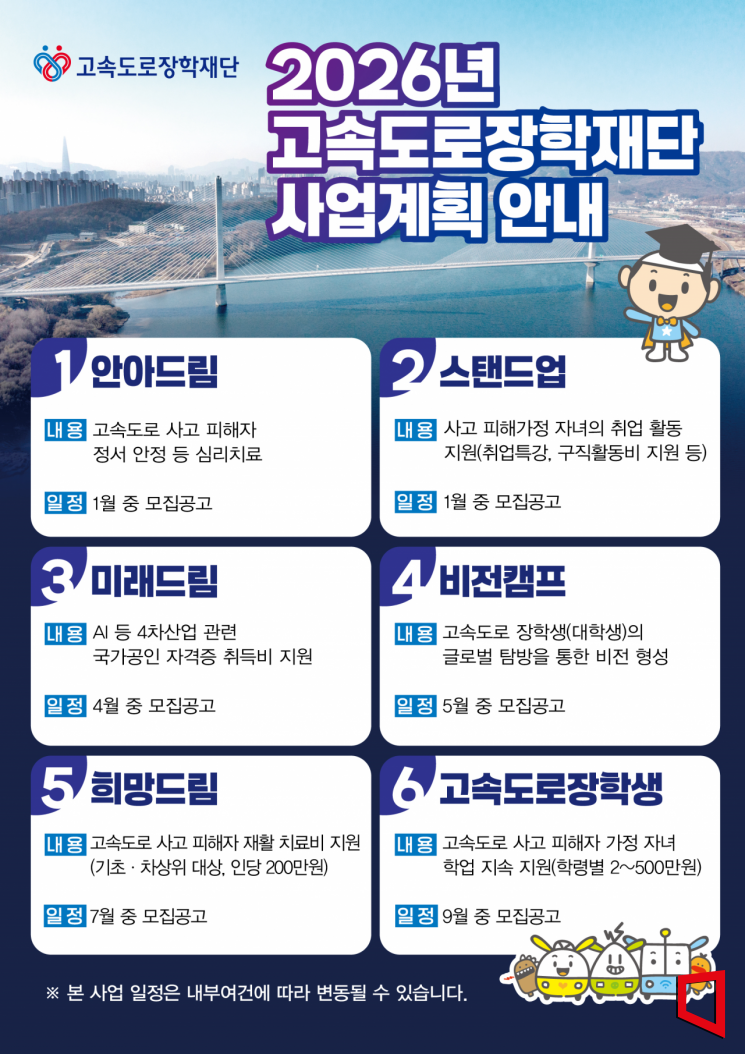
Meanwhile, from 1998 to last year, the Korea Expressway Corporation has provided approximately 13.4 billion won in scholarships to 7,274 expressway accident victims and their bereaved families. In addition, it operates year-round step-by-step support programs to help victims achieve independence and reintegrate into society after an accident, including the psychological therapy program 'Anadream,' employment support 'Stand Up,' certification fee support 'Future Dream,' global exploration 'Vision Camp,' and rehabilitation therapy fee support 'Hope Dream.'
A representative from the Korea Expressway Corporation stated, "Expressway accidents leave deep scars not only on the victims themselves but also on their entire families. As a public enterprise, we will fulfill our social responsibility by providing comprehensive support, from psychological recovery to independence, so that victims can return to their daily lives."
An accident happens in an instant, but life afterward can be affected forever. The suffering experienced by expressway accident victims often goes beyond physical injuries, leading to psychological aftereffects that disrupt the daily lives and relationships of entire families.
'Anadream' is significant in that it goes beyond compensation and support, representing a responsible public approach to the fundamental issues of recovery and healing.
This is a declaration that the operator of national infrastructure will shoulder the burden of life after an accident together with the victims, and an effort to reinforce the social safety net. Attention is focused on whether it can establish itself as a sustainable model for long-term healing, rather than merely achieving short-term results.
© The Asia Business Daily(www.asiae.co.kr). All rights reserved.


















