Core Businesses Remain with Surviving Entity: Defense, Shipbuilding, Marine, Energy, and Finance
Hanwha Machinery & Service Holdings Established
Tech and Life Divisions Spun Off Through Split
Hanwha Group has once again strengthened its succession structure centered on Vice Chairman Kim Dongkwan, the eldest son of Chairman Kim Seungyeon. Through a governance restructuring that separates the core businesses from the tech and life divisions, making the latter independent, the group has clarified its next-generation management system.
On January 14, Hanwha Group held a board meeting and resolved to spin off Hanwha Corporation into a surviving entity and a new entity. The new entity will be named "Hanwha Machinery & Service Holdings." Affiliates in the tech and life sectors, which have been overseen by Dongseon Kim, Executive Vice President for Future Vision at Hanwha Galleria, will be transferred under this new company. Based on net asset book value, the split ratio will be 76.3% for the surviving entity and 23.7% for the new entity. Existing shareholders will receive shares in both companies according to this ratio. The relevant procedures are scheduled to be completed in July following an extraordinary general meeting of shareholders in June.
After the split, the tech and life affiliates will be organized under the newly established Hanwha Machinery & Service Holdings. Specifically, the tech affiliates include Hanwha Vision, Hanwha Momentum, Hanwha Semitec, and Hanwha Robotics, while the life affiliates include Hanwha Galleria, Hanwha Hotels & Resorts, and Ourhome. Hanwha Machinery & Service Holdings will promote synergy between the tech and life businesses. The group has identified "Physical AI" as the next growth engine in the food & beverage (F&B) and retail sectors, designating smart F&B, smart hospitality, and smart logistics as its three core pillars.
The surviving entity will retain Hanwha Aerospace, Hanwha Ocean, Hanwha Solutions, and Hanwha Life Insurance, focusing on defense, shipbuilding, marine, energy, and financial affiliates. Hanwha Corporation, as the surviving entity, will concentrate on its core businesses: defense, shipbuilding, marine, energy, and finance. Given the policy-sensitive nature of these businesses, the company plans to proactively establish long-term strategies and investment plans to enhance global competitiveness.
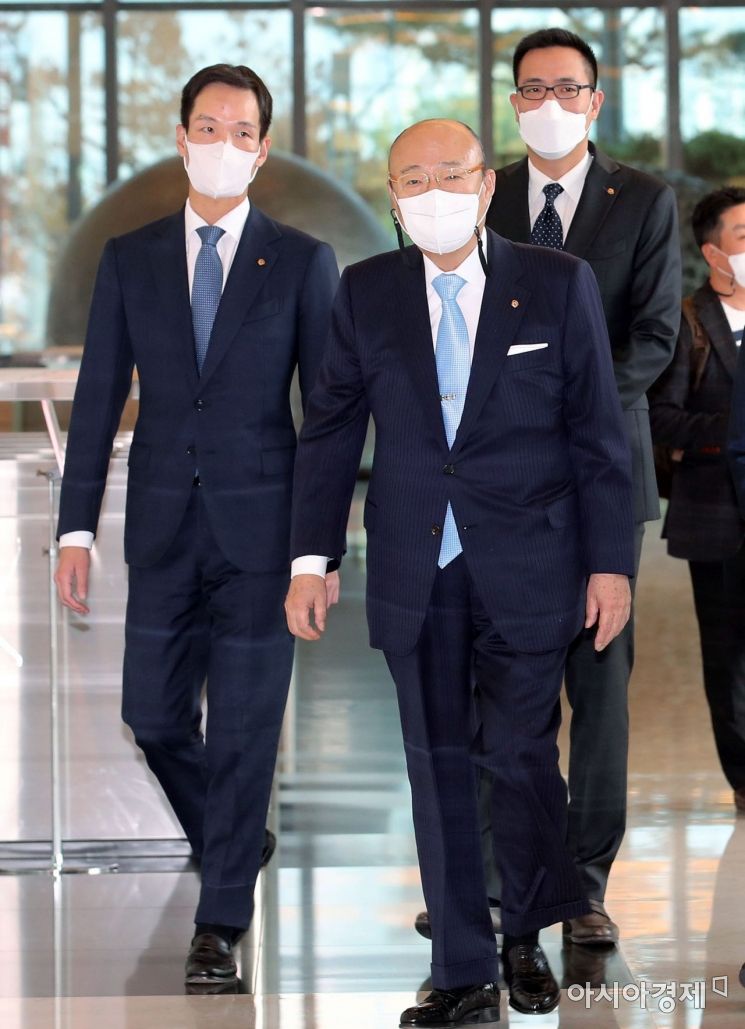 In 2022, Seungyeon Kim, Chairman of Hanwha Group, along with executives, attended the 100th anniversary commemorative event of Hyeonam Kim Jonghee, the founder of Hanwha Group, held at the 63 Building in Yeouido, Seoul. From left to right: Dongwon Kim, Vice President of Hanwha Life Insurance; Seungyeon Kim, Chairman; Dongseon Kim, Executive Director of Hanwha Solutions Galleria. Photo by Hyunmin Kim
A Hanwha representative explained, "This decision aims to enhance corporate and shareholder value by establishing management strategies tailored to the characteristics of each business group and market environment, and by building a system that enables swift decision-making." The company plans to strengthen the independence and responsible management of each business through the spin-off.
Officially, the company is emphasizing the resolution of the "conglomerate discount." Hanwha Corporation explained that, under one roof, the different business groups have faced ▲ misalignment in the speed and direction of strategy, ▲inefficient capital allocation, ▲and an increasing burden of portfolio management. The logic is that the spin-off will allow each entity to establish its own strategy independently and be re-evaluated in the market based on its individual value.
The company also highlighted that, when Hanwha Aerospace spun off its non-defense business in 2024, the combined market capitalization of the two companies increased by 35% three months after the split compared to before. Similar trends have been observed in other spin-off cases over the past five years, such as Samsung Biologics, ISU Chemical, and Ecopro.
The company also unveiled measures to strengthen shareholder returns. Hanwha Corporation decided to cancel 4.45 million common shares, excluding those reserved for employee compensation (RSUs). This represents 5.9% of all common shares, amounting to approximately 456.2 billion won based on market value. In addition, the company will raise the annual dividend per common share by more than 25%, from 800 won to 1,000 won. All remaining old preferred shares will also be repurchased and canceled.
As of 1:50 p.m. on the same day, Hanwha Corporation was trading at 128,800 won, up 25.66% from the previous session. At one point during the session, the stock rose as high as 130,700 won, maintaining its strong performance.
© The Asia Business Daily(www.asiae.co.kr). All rights reserved.


















