Calls for Establishing Organizational Culture and Improving Retention Conditions
Four Major Institutes Urged to Redesign Specialization Strategies
On January 14, Deputy Prime Minister and Minister of Science and ICT Baek Kyunghoon simultaneously pointed out the organizational culture conflicts at the Space Aviation Agency and the issue of strategic fragmentation at the four major Institutes of Science and Technology, stating that a structural overhaul is necessary for all national research institutions.
At the work report for the Space Aviation Agency and affiliated space and science institutes held at Seoul Central Post Office in Jung-gu, Seoul on the same day, Deputy Prime Minister Baek said, "Since the Space Aviation Agency is a newly established organization, it is important to establish an organizational culture," adding, "There are concerns that the heterogeneity between the deputy directorate, which is centered on general government officials, and the mission headquarters, which is led by external experts, could lead to conflicts."
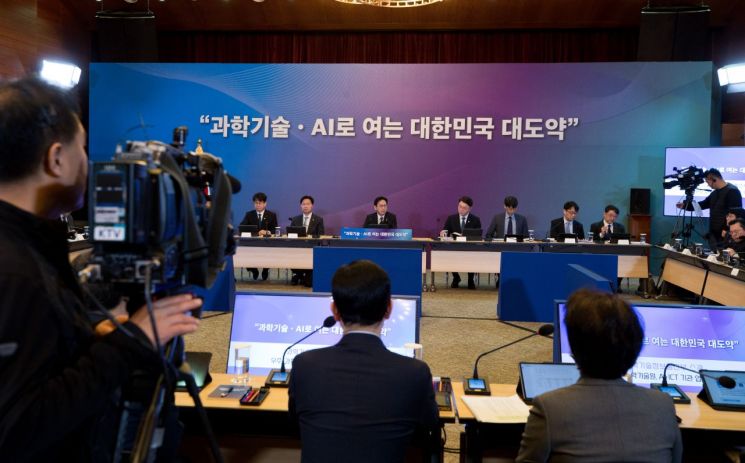 Deputy Prime Minister and Minister of Science and ICT Baek Kyunghun is speaking at the 'Space Aviation Agency, Institute of Science and Technology, and Information and Communication Technology Sector Work Report' held on the 14th at Seoul Central Post Office in Jung-gu, Seoul. Photo by Yonhap News
In response, Yoon Youngbin, Commissioner of the Space Aviation Agency, explained, "There may be suspicions that the organization is divided, but in reality, communication is smooth," and added, "We are continuously paying attention to establishing a healthy organizational culture."
"We must prevent talent from leaving"… Calls for improved living conditions and management systems at the Space Aviation Agency
Deputy Prime Minister Baek mentioned the recent departures of the mission headquarters director and aerospace division head, both formerly of NASA, stating, "The contracts for externally recruited fixed-term officials will also expire in 2028 and 2030," and emphasized, "It is important to continuously secure outstanding talent and create an environment where they can stay."
Commissioner Yoon responded, "We recruited excellent talent in the early stages and there should be no major issues with reappointment," adding, "We plan to bring in additional experts with extensive overseas experience." Deputy Prime Minister Baek reiterated the importance of improving living and working conditions, to which Commissioner Yoon replied, "We will strive to provide stable living conditions."
Deputy Prime Minister Baek, regarding additional launches of the Nuri rocket, stated, "To achieve a 90% success rate, five consecutive successful launches are needed." Commissioner Yoon replied, "The more successful launches we have, the higher the probability of success for subsequent launches. Once we secure more launch opportunities, we will work to further improve the success rate."
Lee Sangcheol, President of the Korea Aerospace Research Institute, explained, "Price competitiveness is also important in commercial launches," and added, "If we can conduct about four launches per year, our unit cost competitiveness will improve. Until then, we will work to reduce costs through public sector demand."
Deputy Prime Minister Baek instructed the Korea Aerospace Research Institute to focus on basic research for industrial infrastructure, and the Korea Astronomy and Space Science Institute to pursue long-term and challenging research that accepts the possibility of failure. He also directed the Ministry of Science and ICT, the Space Aviation Agency, the Korea Aerospace Research Institute, and the Korea Astronomy and Space Science Institute to convene discussions to realign the roles of each institution.
"The four major Institutes of Science and Technology lost focus by trying to do everything"
Deputy Prime Minister Baek also commented on the four major Institutes of Science and Technology, saying, "By trying to strengthen research, education, policy, and industrial response all at once, they seem to have reached the limits of their focus," and emphasized, "A strategy of selection and concentration in areas where they can excel is needed."
He cited the California Institute of Technology (Caltech) as an example and suggested that the Korea Advanced Institute of Science and Technology (KAIST) and Gwangju Institute of Science and Technology (GIST) could specialize in energy and mobility, Daegu Gyeongbuk Institute of Science and Technology (DGIST) in bio and robotics, and Ulsan National Institute of Science and Technology (UNIST) in industrial AI transformation (AX).
Regarding the four major institutes all pursuing the establishment of AI colleges, Deputy Prime Minister Baek stated, "They need to consider specialization while dividing roles with regional core universities." He also said, "The four major institutes are key institutions for regional economic growth," and urged that, aside from KAIST, the other institutes should also actively promote startups and industrial cooperation.
He related the recent increase in applicants to the institutes to "expectations stemming from the revitalization of high-tech industries," called for strengthened industry cooperation, and stressed, "Each institution must clarify its roles and strengths in order to secure global competitiveness."
© The Asia Business Daily(www.asiae.co.kr). All rights reserved.

















