Average Concentration Exceeds 2,000 ppm at 5,800m Depth in the Western Pacific High Seas
Data-Driven Deep-Sea Exploration Technology Proven
As competition to secure rare earth elements, which have emerged as a strategic asset for global resource security, expands into the deep sea, the presence of high concentrations of seafloor rare earths has been confirmed during Korea’s first ocean exploration conducted with domestic technology. This marks the first time that a Korean research team has both predicted the possibility of rare earth elements in the high seas and verified it through actual drilling.
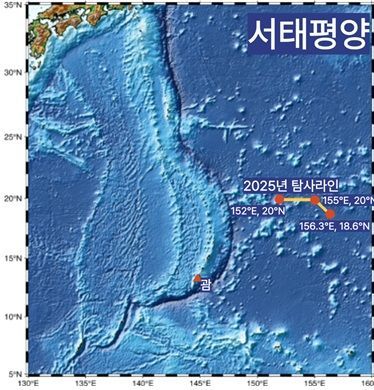
The Korea Institute of Geoscience and Mineral Resources (KIGAM) announced on January 15 that, during its first ocean exploration of the high seas in the western Pacific using the state-of-the-art geophysical survey research vessel Tamhae 3 in July 2025, it confirmed the presence of high concentrations of rare earth elements-up to 3,100 ppm, with an average exceeding 2,000 ppm-through drilling of seafloor sediments at a depth of approximately 5,800 meters.
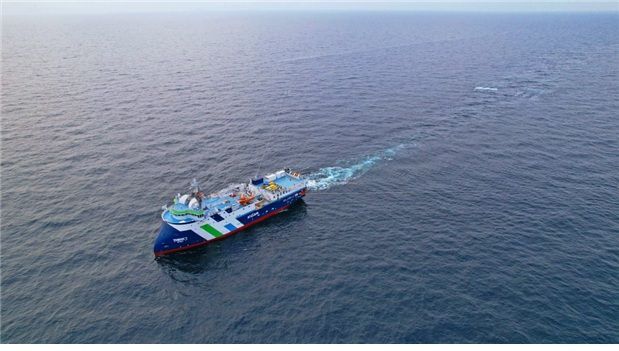 The state-of-the-art geophysical survey research vessel 'Tamhae 3' deploying a streamer. Photo by KIGAM
Beyond Terrestrial Limits to the Deep Sea: A New Solution for the Rare Earth Supply Chain
Although rare earth elements are distributed throughout the Earth’s crust, economically viable high-grade deposits are limited. Terrestrial rare earth ores face environmental constraints, as the refining process produces large quantities of radioactive materials such as thorium, and the supply chain is heavily concentrated in certain countries, posing significant resource security risks.
In contrast, seafloor rare earth mud is drawing attention as a next-generation source of critical minerals, as it contains a high proportion of heavy rare earths essential for manufacturing high-performance permanent magnets, while having low levels of radioactive substances. Recently, Japan has also conducted mining trials at a depth of 6,000 meters near the Minamitorishima Exclusive Economic Zone (EEZ) for similar reasons.
The research team deployed drilling equipment to the seafloor at a depth of 5,800 meters and used the 'piston coring' technique, which collects seafloor sediments using the vacuum suction force of a piston without disturbing the layer structure. This method prevents sediment layers from mixing or being compressed, allowing for direct confirmation of the geological state in which rare earth elements accumulate, and is considered a key drilling technology for verifying the existence of deep-sea resources.
First Deployment of 8.1 km Streamer: Achievement in Data-Driven Scientific Exploration
The core of this achievement lies in the first-ever practical deployment in Korea of Tamhae 3’s 8.1-kilometer-long marine seismic underwater receiver array (streamer). The streamer, which is extended behind the vessel, collects sound waves reflected from the seafloor at various angles, and the longer the streamer, the more effectively it can gather low-frequency sound waves reflected from deep beneath the seafloor from multiple angles.
The 648 channel sensors deployed along the 8.1-kilometer streamer captured even the faintest signals, clearly imaging the complex geological structures below 5,800 meters of water. By combining this with KIGAM’s geophysical interpretation technology, the team was able to pre-identify geological environments where rare earth elements could be concentrated, and successfully obtained high-concentration samples from all three predicted drilling points.
This is regarded as a demonstration of a 'data-driven scientific exploration process' that can increase the success rate and minimize development risks in deep-sea mineral exploration, which typically requires enormous costs and time.
The High Seas as a Realm of First-Mover Advantage: Data Equals Authority
Deep-sea resources in the high seas are managed by the International Seabed Authority (ISA) as the 'common heritage of mankind,' and are not subject to the sovereignty of any specific country. Instead, securing scientific data in advance leads to exploration rights, giving early exploration achievements significant strategic value.
This is why KIGAM has chosen the high seas, which account for two-thirds of the world’s oceans, as its exploration stage. This achievement is expected to serve as important scientific evidence for South Korea to secure deep-sea critical mineral exploration rights under the future International Seabed Authority regime.
Second Exploration in April: Toward Completion of a Detailed Resource Map
KIGAM plans to conduct a second exploration in April to increase exploration density and build a detailed resource map. While the first exploration served as a basic step to confirm the presence of rare earth elements, the second will be a key phase in a mid- to long-term roadmap for securing deep-sea critical minerals.
Kim Yunmi, Director of the Seafloor Geology Research Center, stated, "This exploration marks significant progress in the self-reliance of seafloor resource exploration technology, as we directly predicted and consistently achieved results in promising areas using our own technology. Through the second exploration, we will enhance data precision and secure an exclusive seafloor resource territory unique to South Korea."
Kwon Ikgyun, President of KIGAM, emphasized, "Tamhae 3 is a state-of-the-art 6,862-ton geophysical survey research vessel that traverses the world’s oceans to secure resource sovereignty and is a core strategic asset for South Korea’s resource security. KIGAM will focus all its capabilities to serve as a forward base for securing global critical mineral supply chains."
© The Asia Business Daily(www.asiae.co.kr). All rights reserved.


















