"Skill Improvement Not Adequately Rewarded in Wage Structure"
An analysis has found that the cognitive skills of Korean workers decline with age at a faster rate than in other advanced countries. The root cause has been identified as a wage system that inadequately rewards skill improvement, leading to calls for a shift toward a job- and performance-based wage structure and improvements in lifelong learning conditions.
According to the 'KDI FOCUS' report published by the Korea Development Institute (KDI) on January 14, a comparison using the Programme for the International Assessment of Adult Competencies (PIAAC) with major OECD countries showed that the cognitive skills of Korean workers-including numeracy and literacy-begin to decline in their late 20s, with the rate of decline accelerating significantly among middle-aged and older workers. In particular, the cognitive skills of workers in their 60s fell well below the OECD average, and the speed of age-related decline was found to be the fastest among major advanced economies.
The report states that in the 2011-2012 survey, Korean workers in their late 20s ranked among the top in the OECD for both numeracy and literacy. However, in the 2022-2023 survey, their scores dropped to the average level. Notably, among workers aged 25-29, cognitive skills declined by 14.1 points in numeracy and 18.9 points in literacy by their early 40s. This contrasts with trends in countries such as the United States, Japan, and Germany, where cognitive skills in young adulthood are either maintained or even improve. The gap widened further among middle-aged and older workers. Compared to those in their early 40s, workers in their early 60s in Korea experienced a decline of 39.77 points in numeracy and 45.77 points in literacy-figures that far exceed the OECD average.
KDI analyzed that this phenomenon reflects structural issues beyond the simple effects of aging. A lack of opportunities for skill development after adulthood, long working hours, ineffective learning and training programs, and rigid organizational cultures all combine to limit the accumulation and utilization of workers' skills.
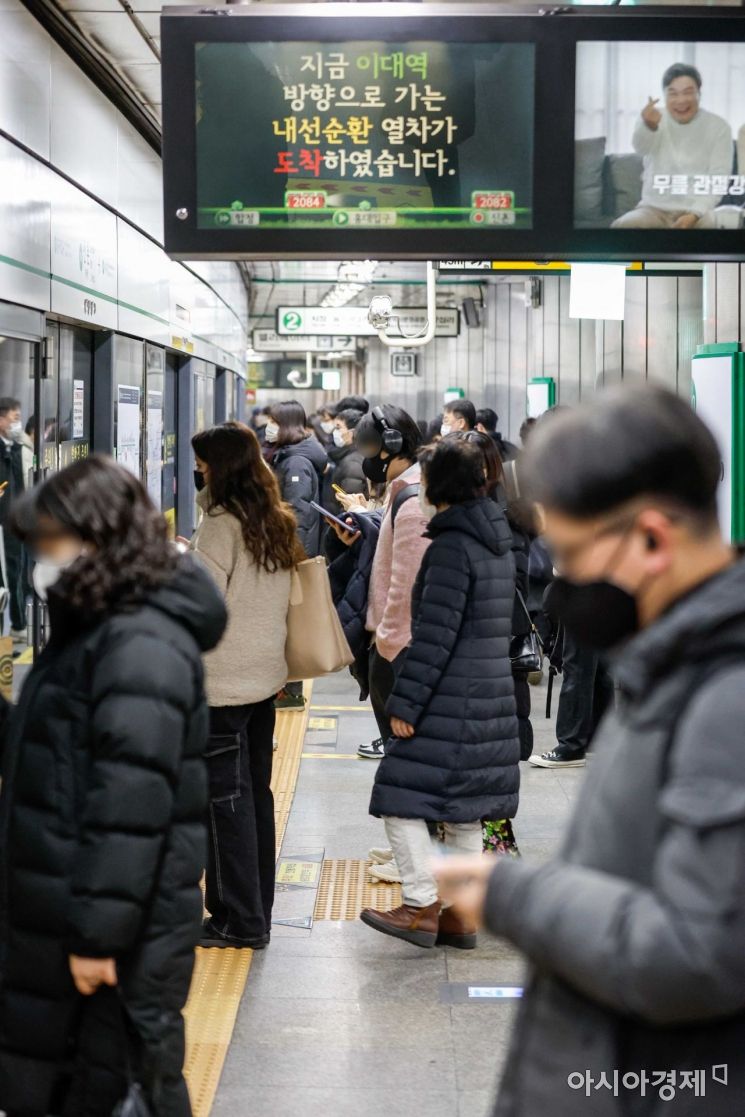 Except for some facilities, indoor mask-wearing shifted from mandatory to recommended on the 30th. Citizens are seen wearing masks while waiting for the train at Sinchon Station on Subway Line 2 in Seodaemun-gu, Seoul. Photo by Jinhyung Kang aymsdream@
The report specifically identified the structural problems of Korea's wage system as a key cause. Improvements in workers' skills are not sufficiently rewarded through wages. According to international comparative analysis, when a worker's numeracy score increases by one standard deviation in Korea, wages rise by only 2.98%. This is less than half the rate in the United States (8.10%), Germany (7.38%), and Japan (6.43%). OECD analysis using recent data also showed that the wage compensation rate for cognitive skills in Korea is significantly lower than the OECD average. On the other hand, the rate of wage increase based on years of service is much higher than the OECD average, indicating that seniority plays a greater role in wage determination than individual skills or performance.
The wage gap by company size was also pronounced. The wage difference between large corporations and small and medium-sized enterprises is so substantial that, from a worker's perspective, focusing on getting a job at a large company early in one's career is more advantageous for lifetime earnings than developing skills while employed. KDI pointed out that this labor market structure intensifies competition for academic credentials and qualifications and acts as a barrier to continuous skill development after employment.
KDI emphasized that, to effectively respond to automation and industrial transformation, it is essential to enhance labor productivity by strengthening workers' cognitive skills. To achieve this, the spread of a wage system based on skills and performance must come first, along with the establishment of human resources and compensation systems that can systematize jobs and measure performance. In addition, comprehensive policy responses are needed, including expanding workers' choice of working hours, improving the quality of education and training programs for employees, and fostering organizational cultures that enable the utilization of skills.
© The Asia Business Daily(www.asiae.co.kr). All rights reserved.

















