Twice as Many Departed as During SK Telecom's Waiver Period
64.4% of KT's Departing Customers Chose SK Telecom
Compensation Policies Influenced Subscriber Choices
Total Number Portability Cases Surge, Over Triple the Usual Volume
Following the hacking incident, KT decided to waive early termination fees for departing customers, and over the two-week period, approximately 310,000 customers left KT. During the period when KT waived early termination fees, the three major mobile carriers engaged in a subsidy competition, causing the daily average number of mobile number portability cases to more than triple compared to normal times. Some retail stores even experienced a shortage of mobile phone devices.
According to the telecommunications industry on January 14, on the last day of KT's early termination fee waiver, a total of 46,120 subscribers switched from KT to other carriers. By carrier, SK Telecom attracted the most with 28,870 new subscribers, followed by LG Uplus with 9,985 and MVNO (Mobile Virtual Network Operators) with 7,265.
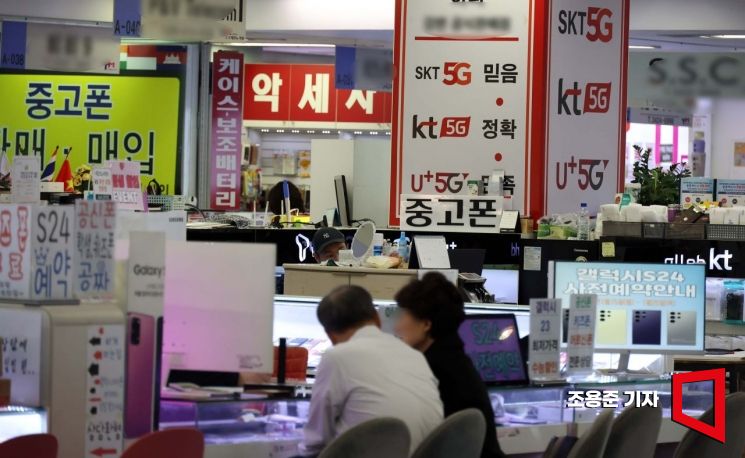 Mobile phone store related to the abolition of the Mobile Phone Distribution Improvement Act. Photo by Yongjun Cho jun21@
As a result, from December 31, when the waiver began, until this date, the cumulative number of KT subscribers who left reached about 310,000. This figure is nearly twice as high as the 166,000 customers who left SK Telecom during its own early termination fee waiver period last year, which followed a USIM information hacking incident. The greater customer exodus from KT compared to SK Telecom is attributed to the lower perceived value of KT's compensation plan, which only offered additional data, while SK Telecom provided a 50% discount on one month's bill to all customers. It is also noted that SK Telecom had already lost a significant number of subscribers before it announced its early termination fee waiver.
During this period, KT recorded a net loss of about 238,000 subscribers, while SK Telecom and LG Uplus saw net increases of approximately 165,000 and 55,000 subscribers, respectively.
Among the customers who left KT, 64.4% switched to SK Telecom. Excluding MVNOs and considering only the three major carriers, 74.2% of departing KT customers moved to SK Telecom. Industry experts believe that SK Telecom's policy of restoring the length of subscription and membership status for returning customers, which was introduced as part of its compensation after last year's USIM information hacking incident, played a significant role. Customers who had previously left for KT are now returning to SK Telecom.
During KT's early termination fee waiver period, the three major mobile carriers competed with subsidies, resulting in a sharp increase in overall demand for number portability. The total number of number portability cases during this period reached around 660,000, averaging about 47,000 per day. Considering that the daily average during normal times without new product launches is about 15,000, this represents more than a threefold increase in demand.
Some retail stores that offered high subsidies experienced shortages of devices due to the surge in number portability demand. In particular, it was reported that securing inventory of the Galaxy S25 and Galaxy Z Flip 7, which received the most subsidies, was especially difficult. Some stores reportedly processed number portability for customers using their existing phones and then replaced the devices once inventory became available.
Meanwhile, the surge in number portability demand during KT's early termination fee waiver period caused system disruptions in the subscription systems of each carrier. According to industry sources, intermittent system outages occurred on Mondays (the 5th and the 12th), when subscription requests submitted on Sundays-when no activation work is done-were processed, resulting in delays in number portability procedures.
© The Asia Business Daily(www.asiae.co.kr). All rights reserved.
![Clutching a Stolen Dior Bag, Saying "I Hate Being Poor but Real"... The Grotesque Con of a "Human Knockoff" [Slate]](https://cwcontent.asiae.co.kr/asiaresize/183/2026021902243444107_1771435474.jpg)
















