KAIST Surpasses the Luminescence Efficiency Limit of Nano Semiconductors
"We have increased the light efficiency of nano semiconductors from less than 1% to 18.1%. This is the highest performance ever reported among 'ultra-small nano semiconductors' based on indium phosphide. It is significant because it surpasses what was previously considered an almost impossible limit."
On January 14, KAIST announced that Professor Cho Himchan's research team in the Department of Materials Science and Engineering has developed a fundamental technology to control the surface of indium phosphide (InP)-based magic-sized clusters (MSC) nano semiconductor particles at the atomic level.
Indium phosphide is a compound semiconductor material made from indium (In) and phosphorus (P). It is emerging as a next-generation eco-friendly semiconductor material because it does not use environmentally hazardous substances such as cadmium.
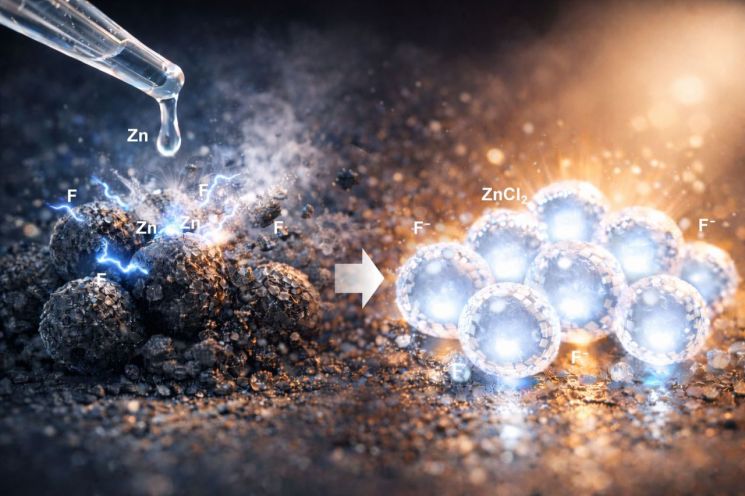
The material highlighted in this research is an ultra-small semiconductor particle. These particles are formed by the aggregation of dozens of atoms and are called 'magic-sized clusters.' Theoretically, because all particles have the same size and structure, they are known to emit very clear light. However, due to their extremely small size of only 1 to 2 micrometers and minute surface defects, most of the light is lost. In reality, contrary to theory, the luminescence efficiency was less than 1%.
To improve luminescence efficiency, the conventional approach was to etch the surface using hydrofluoric acid (HF), a strong chemical. However, because the reaction was too intense, the semiconductor itself was often damaged beyond repair.
In response, the research team changed their approach. Instead of etching the semiconductor all at once, they devised a precise, stepwise etching strategy that allows chemical reactions to occur gradually.
Through this method, they succeeded in selectively removing only parts of the surface that interfered with light, while maintaining the overall shape of the semiconductor. Additionally, during the defect removal process, fluorine generated from the reaction combined with zinc in the solution to form zinc chloride, which stably encapsulated the exposed nano crystal surface.
As a result, the research team was able to increase the semiconductor's luminescence efficiency from less than 1% to 18.1%. This is the highest performance ever reported among indium phosphide-based ultra-small nano semiconductors, improving luminescence efficiency by more than 18 times compared to previous results.
The greatest achievement of this study is that the team devised and proved a strategy to precisely manipulate the surface of ultra-small semiconductors at the atomic level, which was previously considered impossible. The researchers expect that the developed technology will be widely applicable in various advanced technology fields, including next-generation displays, quantum communication, and infrared sensors.
Professor Cho emphasized, "This study is not just about making brighter semiconductors, but it demonstrates how crucial it is to have technology that manipulates surfaces at the atomic level to achieve desired performance."
Meanwhile, this research was conducted with PhD candidate Joo Changhyun and integrated master's and doctoral student Yeon Seongbeom from the KAIST Department of Materials Science and Engineering as co-first authors, and Professor Cho and Professor Ivan Infante from BCMaterials, the Basque Center for Materials, Applications & Nanostructures in Spain, as co-corresponding authors. The research results (paper) were recently published online in the Journal of the American Chemical Society (JACS), a leading journal in the field of chemistry.
© The Asia Business Daily(www.asiae.co.kr). All rights reserved.
![Clutching a Stolen Dior Bag, Saying "I Hate Being Poor but Real"... The Grotesque Con of a "Human Knockoff" [Slate]](https://cwcontent.asiae.co.kr/asiaresize/183/2026021902243444107_1771435474.jpg)
















