The Era of 100,000 Coffee Shops
MegaMGC Coffee Leads Low-Cost Franchise Sales
Average Annual Sales Per Franchise Near 388 Million Won
With the number of coffee shops in South Korea surpassing 100,000, MegaMGC Coffee has been identified as the franchise brand with the highest annual sales per franchise location. The average annual sales per franchise reached nearly 400 million won, thanks to the growing presence of affordable coffee, which has become a staple in the daily lives of ordinary people struggling with prolonged high inflation due to its price competitiveness.
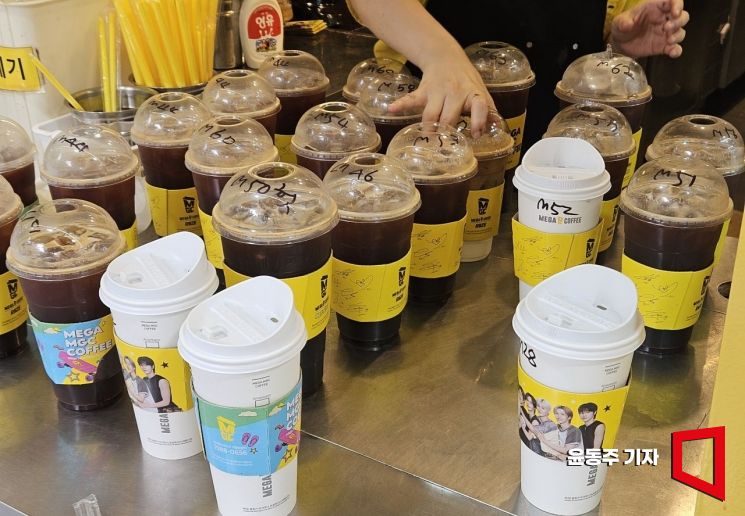 Coffee is the lifeblood of office workers. As soon as they arrive at work, an iced Americano order is waiting for its owner. Photo by Dongju Yoon
According to franchise business disclosure data from the Fair Trade Commission on January 14, the average sales per franchise operator for MegaMGC Coffee was reported at 388.44 million won. This is the highest figure among the low-cost coffee franchise brands included in the survey. With around 4,000 franchise locations, MegaMGC Coffee continues to lead not only in the number of stores but also in franchise sales volume.
Paik’s Coffee ranked second in franchise sales. The brand has about 1,850 franchise locations, with an average sales per franchise of 324.48 million won. This is the second-highest figure among affordable coffee brands. Compose Coffee recorded 2,900 franchise locations and an average sales per franchise of 271.88 million won. Thanks to aggressive expansion, the brand has grown in scale while maintaining mid-to-upper-tier sales per franchise.
Mammoth Express had 750 franchise locations and an average sales per franchise of 230.73 million won. The Venti recorded 1,311 franchise locations and an average sales per franchise of 221.44 million won. In contrast, Ediya Coffee, with nearly 2,500 franchise locations, had the lowest average sales per franchise among the surveyed brands, at 194.81 million won. Despite the large number of stores, there is a significant gap in sales per location.
Industry experts attribute these sales differences to variations in store operation and structure. MegaMGC Coffee, Paik’s Coffee, and Compose Coffee have focused on small, takeout-oriented locations to increase turnover rates. In contrast, Ediya Coffee has maintained a relatively larger store format with a higher proportion of seating.
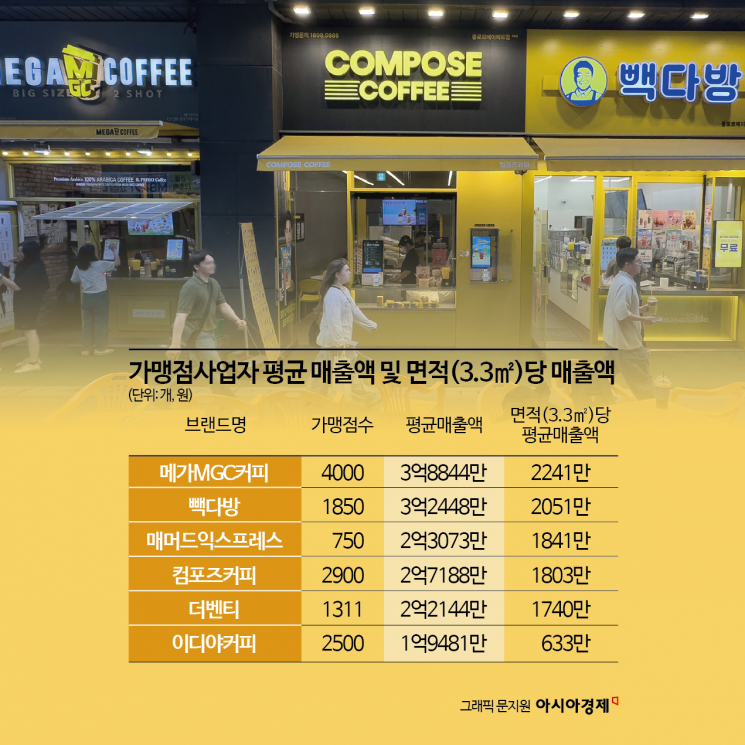
The gap becomes even more pronounced when looking at sales per 3.3 square meters. MegaMGC Coffee’s average sales per 3.3 square meters was 22.41 million won. Paik’s Coffee followed with 20.51 million won, Mammoth Express with 18.41 million won, Compose Coffee with 18.03 million won, and The Venti with 17.40 million won. Ediya Coffee lagged far behind at just 6.33 million won.
Recently, as rent and labor costs have risen in the coffee franchise market, sales efficiency has become a more important metric than store size. A franchise industry insider commented, “Even within the same commercial district, franchise sales can vary significantly by brand. Among prospective entrepreneurs, there is a growing trend of prioritizing sales per store and sales per area over the sheer number of franchise locations.”
The growth of low-cost coffee franchises can be attributed to their competitive pricing, typically in the 1,000 to 2,000 won range. While coffee consumption has remained steady despite ongoing high inflation, consumer sensitivity to price has increased. Major low-cost coffee brands have attracted demand from office workers and students by offering Americanos at prices ranging from the high 1,000 won to the low 2,000 won range. With takeout demand concentrated during morning commutes and lunchtime, these affordable coffee shops, which emphasize short stays and high turnover, have established themselves as everyday consumption channels.

Riding this growth trend, low-cost coffee franchises have also emerged as key investment targets for private equity funds (PEFs). In 2021, Premier Partners, together with a strategic investor, acquired MegaMGC Coffee for approximately 140 billion won and later exited with more than double their initial investment. In July last year, Philippine food service company Jollibee signed a deal to acquire Compose Coffee through its subsidiary Elevation PE, a domestic PEF operator. More recently, U.S.-based PEF Orchestra Private Equity acquired 100% of Mammoth Coffee Lab, the operator of Mammoth Coffee, and coffee bean roaster Seojin Roasters for over 100 billion won.
Meanwhile, according to Statistics Korea, as of the end of 2022, there were 100,729 coffee shops nationwide, an increase of 4.5% (4,292 stores) from the previous year’s 96,437. The number of coffee shops has nearly doubled in six years, from 51,551 in 2016.
© The Asia Business Daily(www.asiae.co.kr). All rights reserved.



















