KEPCO and KHNP Urged to Resolve Nuclear Export Dispute in Work Report
Calls for Redefining Public Enterprise Roles, Resource Security, and Productivity Assessment
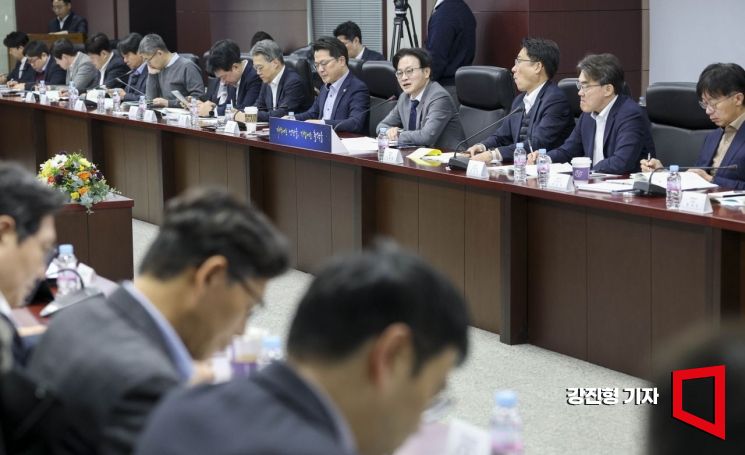 Kim Jeong-Kag, Minister of Trade, Industry and Energy, is delivering opening remarks at the 'Public Institutions (Trade Security, Standards Sector) Work Report' held at the Korea Trade Insurance Corporation in Jongno-gu, Seoul on January 9, 2026. Photo by Kang Jinhyung
Kim Jeong-Kag, Minister of Trade, Industry and Energy, addressed the ongoing dispute over nuclear power plant export construction costs between Korea Electric Power Corporation and Korea Hydro & Nuclear Power during a work report session with affiliated agencies, urging both parties to resolve their conflict. Minister Kim pointed out that the situation "does not meet public expectations" and called for the restoration of cooperation between the two organizations. The Ministry also announced that it would consider restructuring the nuclear power export system.
Oh Seungcheol, Director General for Planning and Coordination at the Ministry, conveyed this during a follow-up briefing on the work report at the Government Complex Sejong on January 13.
The Ministry explained that there have been cases where overseas nuclear power plant exports were delayed due to issues related to financial burdens and the allocation of responsibilities among public enterprises. In particular, it was pointed out that after the Barakah project in the United Arab Emirates, repeated concerns were raised over the lack of clear roles and responsibilities in areas such as construction cost settlement, risk sharing, and subsequent EPC packaging processes.
Under the current structure, Korea Hydro & Nuclear Power serves as the main exporting entity, but the design requires Korea Electric Power Corporation to share the burden of large-scale financing and guarantees. This difference in risk perception between the public enterprises has been identified as a source of conflict. The Ministry added that various approaches are being considered, including adjustments to the roles of public enterprises, the EPC allocation structure, guarantee and insurance systems, and government support schemes, without presupposing any specific model.
From January 8 to 12, the Ministry received work reports from 25 public and related institutions across four sessions. The reports brought together ministers, vice ministers, directors general, division directors, institution heads, and working-level staff in one place and were conducted in a face-to-face Q&A and discussion format. Director General Oh explained, "The sessions were designed to focus on current issues rather than just task presentations."
Minister Kim presented five criteria to each institution: expertise, public accountability, safety, regional coexistence, and ethics and discipline. In the resources and public enterprise sector, he instructed Korea National Oil Corporation to present its own reform plan first, rather than waiting for the "organizational innovation plan" scheduled for May. Regarding the blue whale drilling project, he reportedly pointed out that the problem was not the failure in resource development itself, but rather the lack of communication and transparency during the process. He also called for a supply-oriented resource security approach to bring overseas developed resources into the domestic market.
For Korea Coal Corporation, he effectively called for an early winding-up. While acknowledging the company's contribution to industrialization, Minister Kim conveyed that "it can no longer be delayed" and instructed the preparation of a follow-up roadmap by February. Korea Mine Rehabilitation and Mineral Resources Corporation was asked to play a dedicated role in resource security, contingent on restoring financial soundness and internal trust. Kangwon Land was tasked with simultaneously addressing the conflicting goals of revitalizing the local economy and preventing gambling addiction.
There were also notable points beyond business issues. The Ministry announced plans to commission an external "productivity assessment" of its own operations. This plan aims to quantitatively evaluate work processes such as reporting, meetings, approvals, and events using private sector methods. It is rare for a central government ministry to measure its own productivity. The Ministry is currently operating an internal "fake work reporting channel," and Korea Petroleum Quality & Distribution Authority has even formed a related task force, raising the possibility that such initiatives could spread to affiliated agencies in the future.
Calls for role redefinition were also made. Korea Industrial Complex Corporation was tasked with leading the implementation of the "Five Poles Three Special Zones," manufacturing AI transition (M.AX), and youth strategies. Korea Institute for Advancement of Technology and Korea Evaluation Institute of Industrial Technology were instructed to strengthen the linkage of budget execution within the Ministry. KOTRA and Korea Trade Insurance Corporation were asked to develop a plan that packages export and financial support for small and medium-sized enterprises. Korea Strategic Trade Institute was directed to review a system that would allow it to simultaneously manage strategic materials and support companies.
The Ministry plans to hold biannual meetings with the heads of institutions to monitor the implementation status.
© The Asia Business Daily(www.asiae.co.kr). All rights reserved.
![Clutching a Stolen Dior Bag, Saying "I Hate Being Poor but Real"... The Grotesque Con of a "Human Knockoff" [Slate]](https://cwcontent.asiae.co.kr/asiaresize/183/2026021902243444107_1771435474.jpg)
















