Third HMPDC Meeting Discusses Criteria for Physician Workforce Training Capacity
Full Linkage to Strengthening Regional, Essential, and Public Healthcare
The government is pushing forward a plan to allocate all additional medical school admissions for next year to the "regional doctor system," thereby deploying these new students to regional and essential medical services. This move is seen as an effort to revive regional healthcare, which is at risk of disappearing, while also minimizing backlash from the medical community over the increase in medical school admissions.
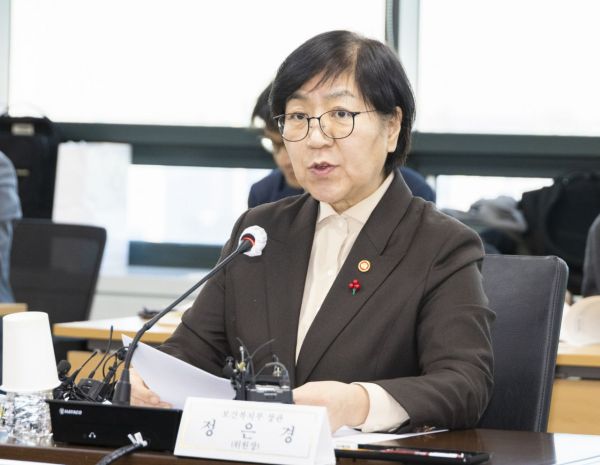 Jung Eunkyung, Minister of Health and Welfare, is speaking at the 3rd Health and Medical Policy Deliberation Committee held on the 13th at the International Electronics Center in Seocho-gu, Seoul. Ministry of Health and Welfare
The Ministry of Health and Welfare announced at the Health and Medical Policy Deliberation Committee (HMPDC) held on the 13th that "a plan was discussed to apply all increases in physician workforce after 2027 to the regional doctor system quota." In her opening remarks, Minister Jung Eunkyung emphasized, "The ultimate goal of discussions on the physician workforce is to strengthen regional, essential, and public healthcare, which are facing crises."
The regional doctor system is a policy that expands regional admissions at the medical school entry stage and provides full scholarships in exchange for mandatory service in medically underserved areas or specific regions for 10 years after graduation. As a key initiative of the Lee Jaemyung administration to address gaps in regional and essential healthcare, the relevant legislation passed the National Assembly in December of last year.
Accordingly, the government has decided that, starting from the 2027 academic year, all increases in physician training capacity beyond the 2026 quota of 3,058 students will be selected through the regional doctor system and deployed to regional and essential medical services. As a result, medical schools in non-metropolitan areas are expected to see their quotas expanded.
The HMPDC also decided that, if a public medical academy is established or new medical schools are created in regions currently without them, the scale of workforce training and the actual timing of deployment to the medical field will be considered together in ongoing discussions.
Changes in the future medical environment and health policy will also be taken into account. The HMPDC will review training capacity by considering all combinations of the three demand models and two supply models adopted by the estimation committee.
To ensure the quality of medical education, measures were reviewed to prevent the rate of change in admissions from exceeding a certain level between the 2026 and 2027 academic years, as well as ways for small-scale medical schools to secure an adequate number of students. The current situation, where students admitted in the 2024 and 2025 academic years are taking classes together, was also considered.
Additionally, reflecting the five-year cycle for supply-demand projections, the newly set quota will be applied from the 2027 to the 2031 academic years. Considering that students admitted during this period will enter the medical field between 2033 and 2037, the year 2037 has been set as the reference year for workforce management, and a plan to conduct the next supply-demand projection in 2029 is also being considered.
At the HMPDC meeting, the shortage of physicians was also discussed based on the demand-supply model analyses submitted by the estimation committee. It was estimated that, by the reference year of 2037, there will be a shortage of between 2,530 and 7,261 physicians. The HMPDC plans to prepare several scenarios for physician workforce training, reflecting the discussion results, and present them at the next meeting.
Minister Jung Eunkyung stated, "We will continue discussions with the goal of strengthening regional, essential, and public healthcare, which is the ultimate purpose of the physician workforce debate, rather than focusing solely on quantitative figures or numbers."
© The Asia Business Daily(www.asiae.co.kr). All rights reserved.
![Clutching a Stolen Dior Bag, Saying "I Hate Being Poor but Real"... The Grotesque Con of a "Human Knockoff" [Slate]](https://cwcontent.asiae.co.kr/asiaresize/183/2026021902243444107_1771435474.jpg)
















