Business Briefing of Financial Public Institutions under the Financial Services Commission Held on the 13th
Eunwook Lee: "Financial Public Institutions Must Move Beyond Merely Delivering Government Policy"
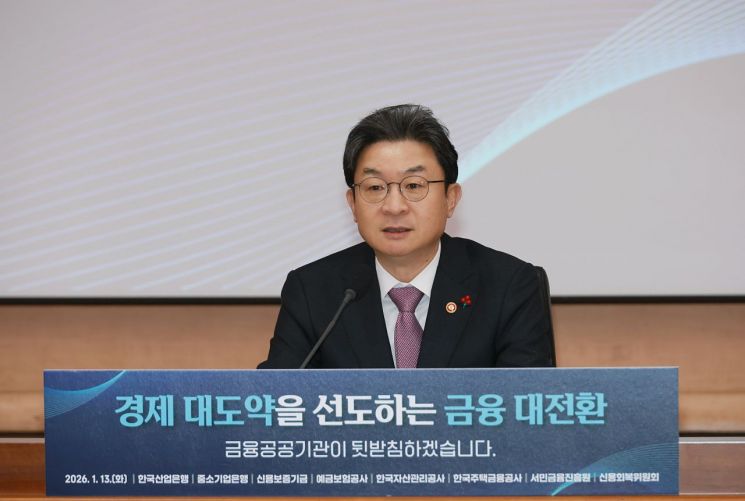 On the afternoon of the 13th, Eunok Lee, Chairman of the Financial Services Commission, received reports on future business directions and key tasks from Korea Development Bank, Industrial Bank of Korea, Korea Credit Guarantee Fund, Korea Inclusive Finance Agency, Credit Recovery Committee, Korea Asset Management Corporation, Deposit Insurance Corporation, and Korea Housing Finance Corporation during a business briefing held at the annex of the Government Seoul Office in Jongno-gu, Seoul. Discussions were held regarding detailed strategies for productive finance, inclusive finance, and trusted finance. Financial Services Commission
Eunok Lee, Chairman of the Financial Services Commission, emphasized, "Financial public institutions are not merely organizations that deliver government policies," adding, "They are the entities responsible for realizing policy directions on the ground and being accountable to the public for their achievements and outcomes."
"Financial Public Institutions Must Deliver Policy Results and Be Accountable to the Public"
Chairman Lee made these remarks during a business briefing for financial public institutions under the Financial Services Commission, held at the Government Seoul Office in Jongno-gu, Seoul, on the 13th. He stated, "Today's public institution business briefing is being broadcast live to the public," and added, "This is not simply a change in format, but rather an important turning point that clarifies for whom financial public institutions work, to whom they must explain, and to whom they must be accountable."
He continued, "I will closely examine whether Korea Development Bank, Industrial Bank of Korea, and Korea Credit Guarantee Fund, which are leading the major shift toward productive finance, are properly fulfilling their role as priming pumps by channeling market funds into advanced industries, regional economies, startups, ventures, and small and medium-sized enterprises."
He further explained, "I will also review how the Korea Inclusive Finance Agency, Credit Recovery Committee, and Korea Asset Management Corporation, which are responsible for inclusive finance, are implementing 'finance that saves lives' by restoring financial accessibility for vulnerable groups and providing opportunities for recovery from failure and crisis."
Additionally, he said, "I will examine the overall operations of the Deposit Insurance Corporation, focusing on its role in financial stability as a safety net for the economy, and the Korea Housing Finance Corporation, focusing on its responsibilities in the housing finance sector, which is directly linked to the lives of the people."
Korea Development Bank Chairman: "National Growth Fund Could Exceed 30 Trillion Won This Year"
During the business reports from each institution, Park Sangjin, Chairman of Korea Development Bank, spoke about the National Growth Fund, which aims to provide 150 trillion won over five years to advanced strategic industries, stating, "Our goal is to approve 30 trillion won this year, but if the industry requires it, we will consider additional approvals."
Chairman Park said, "The industry is supportive of the fund's implementation, and investment demand has already exceeded 150 trillion won." He added, "We have established a fund secretariat and hired external experts, and financial institutions will conduct their own screening processes. We are also improving the performance evaluation system to provide motivation for achievement."
Industrial Bank of Korea announced that it would invest more than 300 trillion won by 2030 to drive the major shift toward productive finance. Kim Hyungil, Executive Vice President and Acting President of Industrial Bank of Korea, stated at the Financial Services Commission business briefing held at the Government Seoul Office on the 13th, "To focus on productive finance, we will implement the 30-300 project, supporting over 300 trillion won in productive finance over the next five years."
The bank plans to allocate 250 trillion won to the small business sector and 20 trillion won to the venture investment infrastructure sector. In addition, 37.8 trillion won will be invested in the consumer-centric trusted finance sector, and 10 trillion won will be invested in the National Growth Fund. The National Growth Fund will primarily focus on investments in energy and infrastructure.
Kim Seongsik, President of the Deposit Insurance Corporation, stated, "We will do our utmost to introduce a financial stability account that prevents insolvency of financial institutions by providing preemptive funding support in times of financial market liquidity shortages." He added, "If financial institutions become insolvent, we will work to swiftly resolve such cases and prevent the spread of crisis by introducing and improving rapid resolution systems."
Kim Eunkyung, President of Korea Inclusive Finance Agency, emphasized the need to expand education for military personnel to prevent them from becoming credit delinquents due to a lack of financial knowledge. President Kim said, "Sergeant salaries have increased and are saved in a matching (contributory) format, so they suddenly have large sums of money, but there are many cases where these funds are mismanaged." She added, "There is also a risk of becoming credit delinquents by spending game money on their phones at night."
Korea Asset Management Corporation (KAMCO) reported that participation by lending companies in the New Leap Fund, which provides debt relief for vulnerable borrowers, has been low. Jeong Junghoon, President of KAMCO, explained, "Most lending company receivables are held by the top 30 companies, but as of the beginning of this year, only 12 companies have joined the New Leap Fund." President Jeong added, "Unlike banks or credit card companies, lending companies may hold overdue receivables that represent all or nearly all of their assets and business operations. Since they have to transfer their key assets, it is difficult for them to join the New Leap Fund."
He emphasized, "We will make efforts so that most lending companies can join the New Leap Fund by the end of the year by facilitating transfers at the necessary times and providing incentives to ease various difficulties."
© The Asia Business Daily(www.asiae.co.kr). All rights reserved.

















