Seven Candidates Submit Petition
"Education Is Not a Subordinate Area of Administration, but an Independent Value Guaranteed by the Constitution"
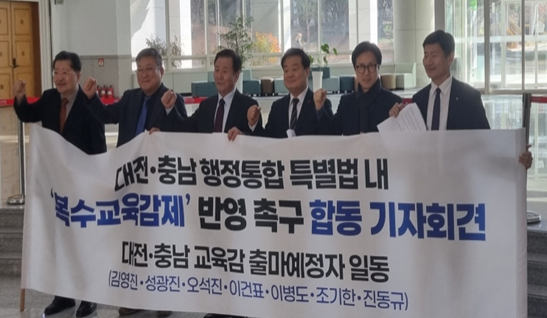 Candidates for the superintendent of education in Daejeon and Chungnam are holding a joint press conference at 2 p.m. on the 13th in the press room of the Daejeon City Council. (Photo by Mo Seokbong)
Candidates for the Daejeon and Chungnam Superintendent of Education election have argued that, if the Daejeon-Chungnam integrated local government is established, the education sector should be operated under a "multiple superintendent system." In other words, even if Daejeon and Chungnam are administratively integrated, the superintendents for Daejeon and Chungnam should be elected separately.
The seven candidates for the Daejeon and Chungnam Superintendent of Education election (Kim Youngjin, Sung Kwangjin, Oh Seokjin, Lee Geonpyo, Lee Byungdo, Cho Gihan, Jin Donggyu) held a joint press conference in the press room of the Daejeon City Council on the 13th, where they announced a petition urging that the "multiple superintendent system" be reflected in the special law on Daejeon-Chungnam administrative integration.
The candidates stated, "While administrative integration may be a policy choice to enhance regional competitiveness, it is not desirable for educational autonomy to be integrated in the same manner during this process," emphasizing that "education is not a subordinate area of administration, but an independent value guaranteed by the Constitution."
They cited Article 31, Paragraph 4 of the Constitution of the Republic of Korea as the basis for their argument, stating that the autonomy, expertise, and political neutrality of education must be upheld even in the process of administrative integration.
They particularly expressed concern that if the Office of Education is absorbed as a subordinate organization of the integrated local government, or if the superintendent position is unified, political or administrative efficiency could be prioritized over educational expertise.
The candidates also made it clear that Daejeon and Chungnam are regions that require entirely different educational approaches. Daejeon, as a metropolitan city, faces major challenges such as resolving overcrowded classes in new urban areas, reducing educational disparities between old and new districts, and fostering future talent in connection with research complexes. In contrast, Chungnam's key issues include responding to the risk of school closures due to declining school-age populations, addressing educational gaps in island and remote areas, and establishing educational models linked to ecological and local industries.
The candidates argued, "A structure in which a single superintendent is responsible for such different educational conditions and tasks will inevitably lead to a decline in the quality of education in one of the regions," and insisted that "the 'multiple superintendent system,' in which local residents directly elect a superintendent suited to their educational environment, is the most democratic and realistic alternative."
Through their petition, they officially demanded that: ▲ when enacting the special law on Daejeon-Chungnam administrative integration, a "special provision for educational autonomy" be stipulated so that the Daejeon Office of Education and the Chungnam Office of Education can each maintain their administrative and financial independence within the integrated local government; and ▲ the "multiple superintendent system," in which superintendents are elected separately in Daejeon and Chungnam, be unequivocally adopted.
They concluded by emphasizing, "Even amid the trend of administrative integration, the responsibility for education cannot be simplified," and called for a clear and responsible decision to introduce the multiple superintendent system for the future of learning for children and the future of education in Daejeon and Chungnam."
© The Asia Business Daily(www.asiae.co.kr). All rights reserved.
![Clutching a Stolen Dior Bag, Saying "I Hate Being Poor but Real"... The Grotesque Con of a "Human Knockoff" [Slate]](https://cwcontent.asiae.co.kr/asiaresize/183/2026021902243444107_1771435474.jpg)
















