Won-Dollar Exchange Rate Rises Above 1,470
Market Sentiment Remains Weak Despite Authorities' Intervention
Driven by Increased Demand for Overseas Assets and Yen Weakness
As domestic investors increase their overseas investments, this is acting as a factor weakening the Korean won, and the won is expected to continue its longest losing streak against the US dollar since 2008.
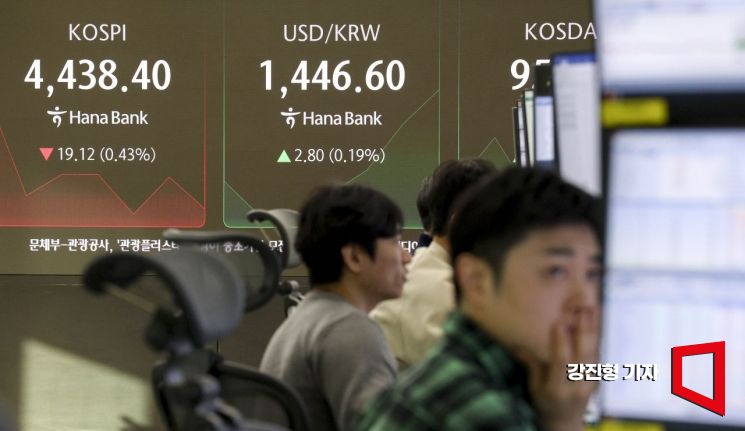 On the 6th, the KOSPI index opened at 4445.19, down 12.33 points from the previous trading day, displayed on the electronic board in the dealing room of Hana Bank in Jung-gu, Seoul. 2026.1.6 Photo by Kang Jinhyung
According to Bloomberg on the 12th (local time), the won-dollar exchange rate rose 0.5% during the session to reach 1,475 won per dollar, with the value of the won falling more than 2% compared to the end of last year. At the end of last year, the foreign exchange authorities intervened aggressively, deploying the National Pension Service as a stabilizing force for the exchange rate, which drove the rate down to 1,433.90 won, but more than half of that year-end decline has now been reversed.
Bloomberg analyzed that, despite the authorities' efforts to stabilize the won, unfavorable external conditions and persistent supply-demand imbalances are preventing any improvement in market sentiment regarding the won's weakness. In fact, while the Bloomberg Dollar Spot Index has risen about 0.6% so far this year, the value of the won has fallen about 2.3% against the dollar. The dollar has strengthened, supported by geopolitical tensions in Latin America and the Middle East and robust US economic indicators, reversing much of the won's appreciation that had been seen at the end of last year as the exchange rate fell.
In addition, both domestic and international capital flows are working against the won. As domestic investors continue to prefer overseas assets, demand for the dollar is increasing, while foreign investors are accelerating their selling of Korean stocks, adding further downward pressure on the won. According to the Korea Securities Depository, as of the 11th of this year, domestic individual investors have made net purchases of about 2.4 billion US dollars in US stocks, an increase of about 60% compared to the same period last year. In contrast, net purchases of Korean stocks by foreign investors amounted to only 728 million US dollars during the same period, showing a slowdown. Considering that net purchases at the beginning of the year exceeded 2 billion US dollars, this represents a significant decrease.
The weakness of the Japanese yen is also believed to have affected the value of the won. In periods of dollar strength, both the won and the yen have repeatedly weakened together, and this trend of the two currencies moving in tandem has become more pronounced in the 2020s.
With this high exchange rate environment continuing, the Bank of Korea is scheduled to hold a Monetary Policy Board meeting on the 15th. According to a survey of economists conducted by Bloomberg, the Bank of Korea is expected to keep its benchmark interest rate unchanged at 2.50% per annum at this meeting.
© The Asia Business Daily(www.asiae.co.kr). All rights reserved.
![Clutching a Stolen Dior Bag, Saying "I Hate Being Poor but Real"... The Grotesque Con of a "Human Knockoff" [Slate]](https://cwcontent.asiae.co.kr/asiaresize/183/2026021902243444107_1771435474.jpg)
















