When Combined, Hangang New Town and Hangang 2 Compact City
Will Create a New Town on the Scale of Bundang
Extensive Integration of Smart City Features and Technologies
A Specialized City Leading the Era of Future Mobility
The Gimpo Hangang 2 Public Housing District Development Project (hereinafter referred to as the Gimpo Hangang 2 Compact City Project), which will lead to the completion of Gimpo Hangang New Town, is progressing smoothly.
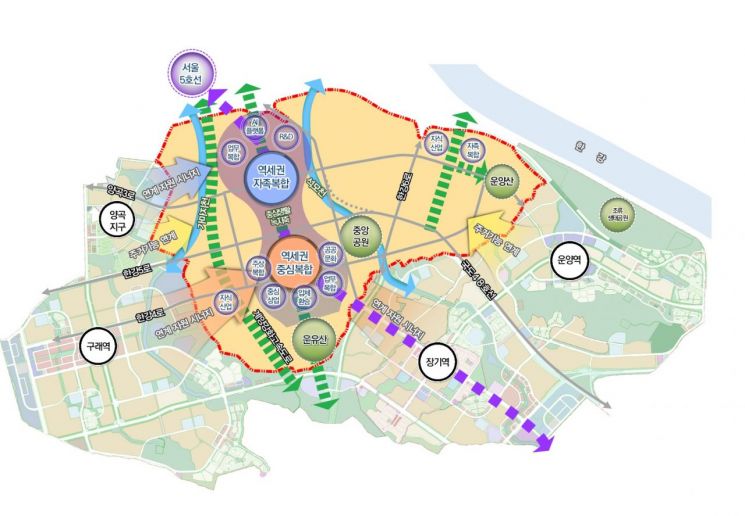
Aiming to become a "smart self-sufficient city," the Gimpo Hangang 2 Compact City Project is expected to achieve qualitative growth by enhancing urban self-sufficiency, securing metropolitan transportation, and promoting specialized growth. This large-scale public housing district development project will develop 7.3 million square meters in Yangchon-eup, Janggi-dong, Masan-dong, and Unyang-dong in Gimpo City, supplying a total of 51,540 housing units.
The distinguishing feature of the project is the application of the "Transit-Oriented Compact City" concept, which promotes high-density and compact development centered around subway stations within the district, while establishing an integrated new town system through connected development with the existing Gimpo Hangang New Town. When the two new towns are combined, the total area amounts to 18.17 million square meters (5.77 million pyeong), and the total number of households reaches 121,000, creating a city on par with Bundang New Town.
In particular, a wide range of smart city elements and technologies will be introduced within the district. Gimpo Hangang 2 Compact City will leverage its geographical advantages, such as proximity to airports (Gimpo and Incheon), urban rail (Line 5 extension), the Western Metropolitan Rapid Transit, expressway interchanges, and the Han River waterfront, to create water-friendly theme parks. It will also incorporate future-oriented transportation systems such as autonomous vehicles and Urban Air Mobility (UAM), establishing itself as a specialized city leading the era of advanced mobility.
Gimpo City is taking a leading role in the development of Gimpo Hangang 2 Compact City. Unlike the previous Korea Land and Housing Corporation (LH)-led approach, the city has shifted to a city-led model, taking an active rather than a passive stance in developing the compact city. As a result, practical improvements in citizen convenience and effective responses to future changes in transportation and industry are expected.
To focus on balanced development of projects linked to the Gimpo Hangang 2 Public Housing District, such as the extension of Seoul Subway Line 5, the creation of the Gimpo Environmental Regeneration Innovation Complex, and investment attraction, the city has established a comprehensive master plan from the early stages of new town development. Through the operation of a metropolitan infrastructure strategy task force, the city is thoroughly reviewing key issues in each sector and proactively proposing alternatives tailored to Gimpo's circumstances.
Last year, the city participated in Master Planner (MP) meetings organized by LH Corporation to establish the district plan, where it specifically proposed development strategies suited to the city's needs. The city also hosted a meeting with LH Corporation to discuss plans for the full undergrounding of the Gyeyang-Ganghwa Expressway and utilization of the upper space, as well as to request a review of transportation circulation systems in line with advances in smart mobility technologies, demonstrating continued proactive efforts.
In June of last year, the city met with the president and staff of Korea Expressway Corporation to make requests and seek cooperation on major issues, including the complete undergrounding of the Gyeyang-Ganghwa Expressway section passing through Gimpo Hangang 2 Compact City. In addition, the city continued its efforts by hosting meetings with MP committee members and LH Corporation, submitting requests to reflect key items tailored to Gimpo City's characteristics in the district plan.
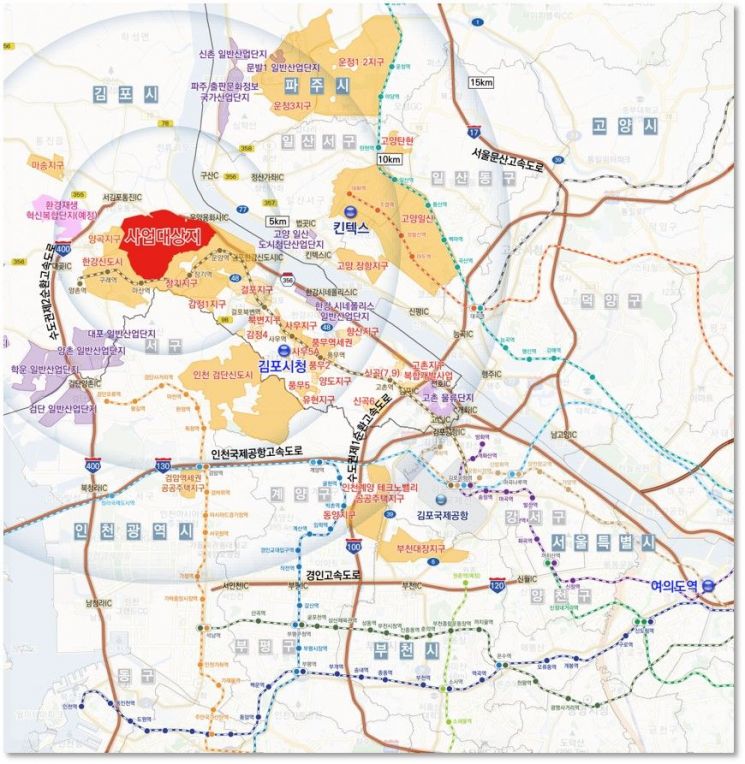
The main points of the city's requests include: commercialization of a central mixed-use special planning zone to vitalize the transit-oriented area; expansion of core hub parks and creation of various themed parks by region; increasing the proportion of for-sale housing to provide diverse residential options; developing plans for undergrounding and converting the upper space of the Gyeyang-Ganghwa Expressway into parks; establishing a safe school commute environment; and measures to activate the educational development special zone.
Having made consistent efforts, the city plans to continue active consultations until the district plan approval scheduled for December this year.
Currently, the city is conducting a development strategy study for "Gimpo Hangang 2 Compact City" to reflect local conditions and vision. Since launching the study in June 2024, the city has been thoroughly analyzing the development concept, specialization strategies, infrastructure plans, and metropolitan transportation improvement measures to derive a comprehensive development strategy.
Meanwhile, the Gimpo Hangang 2 Compact City Project was designated as a district on July 31, 2024, following a public notice for collecting opinions from residents and others on November 11, 2022. The application for district plan approval was completed in July last year. Currently, the Gimpo Hangang 2 Public Housing District is preparing for consultations with relevant agencies regarding the district plan approval application. The district aims to complete procedures such as the environmental impact assessment and finalization of metropolitan transportation improvement measures, with the goal of obtaining district plan approval in the second half of 2026 through a comprehensive review committee. The city plans to continue close cooperation with the public housing operator (LH) to ensure the project proceeds smoothly, targeting the announcement of sales in 2030 and project completion in 2033.
© The Asia Business Daily(www.asiae.co.kr). All rights reserved.
!["The Woman Who Threw Herself into the Water Clutching a Stolen Dior Bag"...A Grotesque Success Story That Shakes the Korean Psyche [Slate]](https://cwcontent.asiae.co.kr/asiaresize/183/2026021902243444107_1771435474.jpg)

















