Call for Explicit Guarantee of Grassroots Autonomy in the Special Integration Law
Demand for Administrative, Fiscal, Legislative, and Organizational Self-Governance
Emphasis on Decentralized, Autonomy-Based Integration Over Centralization
Highlighting the Role of Grassroots Governments Closest to Residents' Lives
As discussions on the administrative integration of Gwangju and Jeonnam are gaining momentum, the mayors of the five autonomous districts in Gwangju have stated, "The success or failure of integration depends not on expanding the scale of metropolitan government, but on how substantially grassroots autonomy is strengthened." They emphasized that the principle of strengthening local autonomy must be clearly stipulated in the special integration law.
The Gwangju Metropolitan City District Mayors' Council held a press conference at the Gwangju City Council briefing room on the morning of the 13th, declaring, "We will actively participate in and cooperate with the discussions on the administrative integration of Gwangju and Jeonnam." However, they also stated, "Integration without the precondition of enhanced local autonomy cannot guarantee tangible benefits for residents or administrative effectiveness."
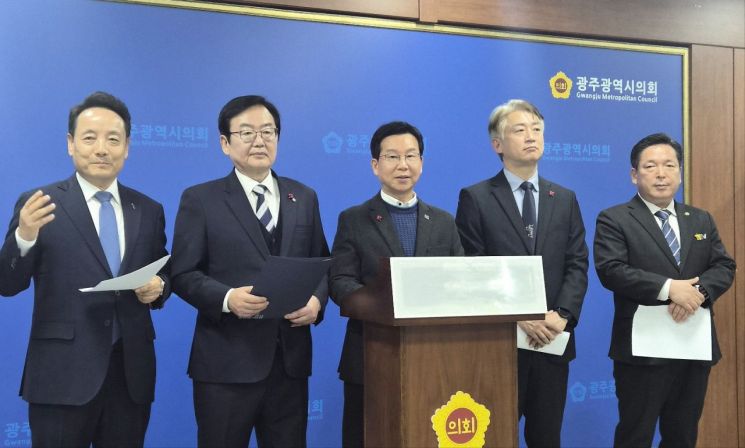 Im Taek, Mayor of Dong-gu, Moon In, Mayor of Buk-gu, Park Byunggyu, Mayor of Gwangsan-gu, Kim Ikang, Mayor of Seo-gu, and Kim Byungnae, Mayor of Nam-gu, are holding a joint press conference on the 13th at the briefing room of Gwangju City Council, urging administrative integration of Gwangju and Jeonnam and strengthening of autonomy. Photo by Song Bohyun
The mayors acknowledged that administrative integration could enhance regional competitiveness through economies of scale and strengthen policy negotiation power with the central government. However, they pointed out that if the integration discussions remain limited to the metropolitan level, the role and value of grassroots local governments, which are closest to residents' daily lives, could actually be weakened.
They stressed that the autonomous districts of Gwangju have been responsible for administration directly connected to residents' daily lives, including welfare, urban environment, safety, and social infrastructure (SOC). They stated that if a new metropolitan local government is established through integration, a sophisticated division of roles between the metropolitan and grassroots levels must be designed to improve both administrative efficiency and accessibility.
The District Mayors' Council asserted that administrative integration should go beyond simple organizational or jurisdictional restructuring, and should develop in a way that strengthens the authority and functions of grassroots local governments. They explained that "integration based on the precondition of enhanced grassroots autonomy and decentralized governance" is a model that realizes resident-centered administration and allows the benefits of integration to be felt throughout the region.
To this end, they proposed that the special integration law must include the following: ▲ the fundamental maintenance and expansion of grassroots local governments' administrative authority; ▲ guarantees for legislative autonomy reflecting local realities; ▲ strengthening of fiscal authority for grassroots governments; ▲ granting of organizational autonomy; ▲ incorporation and substantial empowerment of residents' councils; and ▲ special provisions for changing the names of autonomous districts.
Specifically, they argued that even after integration, the existing administrative authority of the autonomous districts should be maintained, and that resident-focused administrative functions should be further transferred from the metropolitan to the grassroots level. They also called for improvements to allow for local legislation that reflects regional realities, by addressing issues where the absence of higher-level laws restricts or invalidates the enactment of ordinances.
Regarding finance, they demanded that the legal distribution ratios of general grants and adjustment grants to grassroots local governments be clearly defined and increased. They also mentioned the need to adjust the distribution methods of certain metropolitan taxes, such as resident tax, tobacco consumption tax, and automobile tax, or to convert them into district taxes.
Additionally, they called for expanded autonomy over personnel and organizational management for administrative agencies and staffing, to enable administration tailored to local conditions. They also stated that the autonomous police system, which residents currently perceive as having little impact, should be expanded to the grassroots level to strengthen community policing services. They suggested granting legal status to residents' councils at the town, township, and neighborhood levels, and delegating certain administrative functions and budget authority to these bodies.
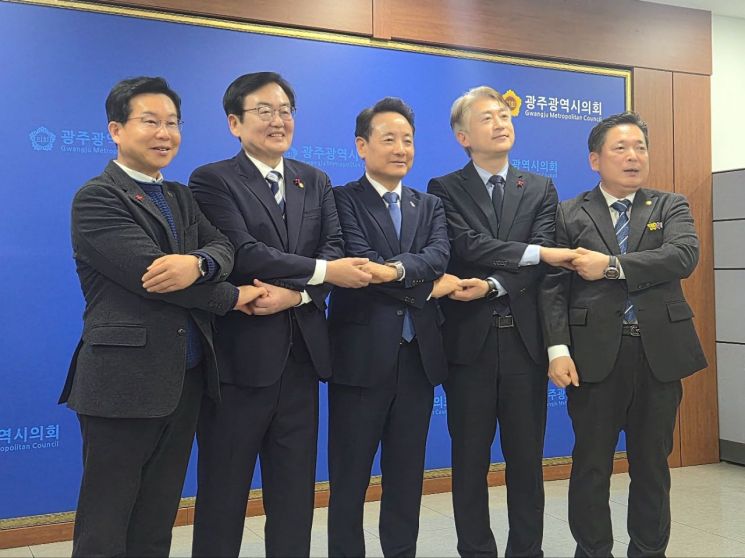 Five district mayors belonging to the Gwangju Metropolitan City District Mayors' Council are holding hands after a press conference at the Gwangju City Council briefing room on the 13th. From the left, Byeonggyu Park, Mayor of Gwangsan District; In Moon, Mayor of Buk District; Taek Lim, Mayor of Dong District; Ikang Kim, Mayor of Seo District; Byeongnae Kim, Mayor of Nam District. Photo by Bohyun Song
The mayors also stated that, as part of administrative integration, special provisions should allow for changes to district names to reflect local history and symbolism, and that the central government should explicitly provide administrative and financial support for such changes.
They emphasized, "The administrative integration of Gwangju and Jeonnam is not an end, but a new beginning," and added, "The special law must ensure that grassroots local governments, which are closest to residents' lives, are further strengthened, and that the integration lives up to the ideals of autonomy and decentralization."
© The Asia Business Daily(www.asiae.co.kr). All rights reserved.


















