Korea Consumer Agency Investigates Functional Ingredients in 10 Products
No Functional Ingredients Used in Any Product
"Efficacy and Effects Cannot Be Expected"
A recent investigation has found that rhubarb general food products, which are promoted as if they are health functional foods claiming to alleviate menopausal symptoms, are in fact misleading advertisements that do not contain any functional ingredients.
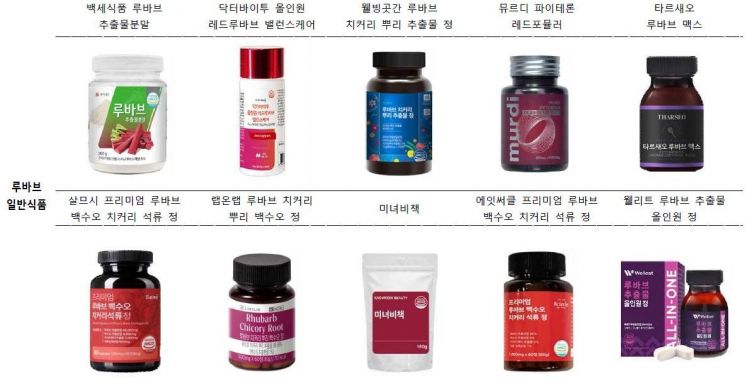
The Korea Consumer Agency announced on January 13 that, after examining the content of functional ingredients and the labeling and advertising of 10 rhubarb general food products distributed in Korea, none of the products were found to be related to alleviating menopausal symptoms.
Rhubarb health functional foods must use rhubarb root extract, which has been recognized for its functionality and safety by the Ministry of Food and Drug Safety, as their raw material, and must contain 2.52 mg of the functional indicator ingredient rhaponticin per daily intake. Rhaponticin, a functional indicator ingredient in rhubarb root extract, is known to help alleviate menopausal symptoms such as hot flashes and depression.
All 10 products investigated were labeled as containing 33.61% to 80% rhubarb extract, but the rhubarb extract used in these products was not the extract from rhubarb root, which is the functional ingredient. The Korea Consumer Agency explained that, as these products have not been recognized for their functionality, it is difficult to expect any efficacy or effects from them.
Furthermore, when the rhaponticin content-the indicator ingredient-was analyzed to confirm the menopausal health efficacy of the 10 products, the ingredient was either not detected or found to be less than 0.03 mg per daily intake. The rhaponticin content in all products was only about 1% of the standard required for functional recognition.
General foods that are not health functional foods are prohibited from using labels or advertisements that may cause them to be perceived as health functional foods, according to the Act on Labeling and Advertising of Foods. However, 8 out of the 10 products investigated were engaged in misleading advertising by emphasizing unverified efficacy and effects such as "menopausal supplements" and "cholesterol control."
Based on the results of this investigation, the Korea Consumer Agency recommended that the relevant businesses delete or improve misleading advertisements so that foods without functional ingredients are not sold as health functional foods. As a result, 6 businesses suspended sales of the products, and 1 business responded by improving its labeling. The remaining 3 businesses (Geongang Pyeonuijeom, DW Retail, and Byeolgeongangso) did not respond.
The Korea Consumer Agency also announced plans to request the Ministry of Food and Drug Safety to inspect these rhubarb general food products that may be mistaken for health functional foods. Consumers are advised to carefully check the ingredients and health functional food certification marks on products when purchasing health functional foods for menopausal symptom relief.
© The Asia Business Daily(www.asiae.co.kr). All rights reserved.
![Clutching a Stolen Dior Bag, Saying "I Hate Being Poor but Real"... The Grotesque Con of a "Human Knockoff" [Slate]](https://cwcontent.asiae.co.kr/asiaresize/183/2026021902243444107_1771435474.jpg)
















