Early Symptoms Are Mild, but Risk of Death Within 24 Hours
'MenQuadfi' Launched... Vaccination Available From Six Weeks of Age
Infants aged six weeks or older and under 24 months can now receive the meningococcal vaccine. Meningococcal infection is a disease with a fatality rate approaching 15% even with treatment. In particular, if treatment is delayed, the mortality rate can reach 50%, making it one of the key vaccines recommended by the World Health Organization (WHO).
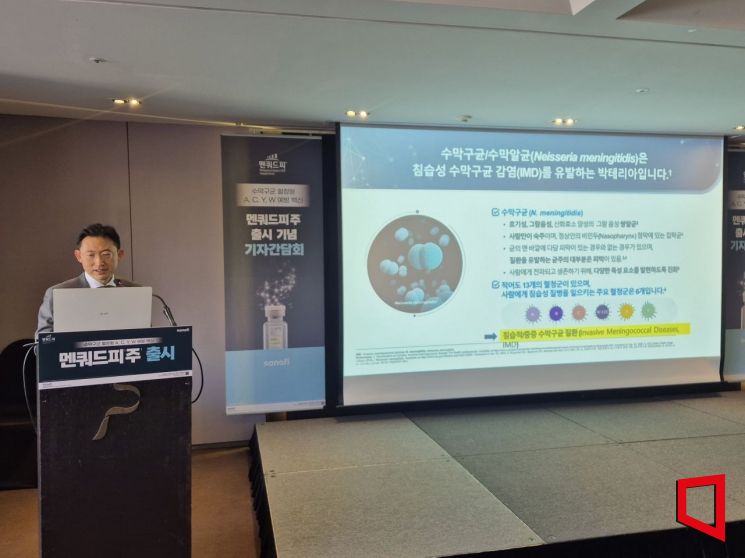 Lee Jinsoo, a professor of Infectious Diseases at Inha University Hospital, is explaining the importance of vaccination at a press conference commemorating the launch of the quadrivalent protein-conjugate vaccine 'MenQuadfi' for the prevention of invasive meningococcal disease (IMD) held on the 13th at The Plaza Hotel in Jung-gu, Seoul. Photo by Choi Taewon
On January 13, Sanofi Korea announced at a press conference held at The Plaza Hotel in Jung-gu, Seoul, to commemorate the launch of the quadrivalent protein-conjugate vaccine 'MenQuadfi' for the prevention of invasive meningococcal disease (IMD). MenQuadfi is the only vaccine in Korea approved for efficacy against meningococcal serogroup A in infants aged six weeks or older and under 24 months.
Meningococcal infection is an acute infectious disease caused by meningococcal bacteria. In Korea, it is classified as a second-grade notifiable infectious disease, which requires isolation in case of occurrence or outbreak and must be reported within 24 hours.
MenQuadfi, launched in Korea on January 5, is a quadrivalent protein-conjugate vaccine that prevents meningococcal infections caused by four serogroups: A, C, Y, and W. In March 2024, it was approved by the Ministry of Food and Drug Safety for use in individuals aged 2 to 55 years. In August of the previous year, its indication was expanded to include infants as young as six weeks old.
The vaccination schedule consists of a total of four doses (three primary doses and one booster) for infants aged six weeks or older and under six months, two doses for infants aged six months or older and under 24 months, and a single dose for individuals aged two to 55 years.
According to the WHO, meningococcal infection is most prevalent among infants under one year of age worldwide, as it takes time for sufficient immunity to develop after birth. The incidence decreases after infancy but tends to rise again during adolescence. In Korea, people living in crowded environments or those with weakened immune systems are known to be at higher risk of infection.
In addition, even after recovery from invasive meningococcal disease, there is an approximately 11-19% chance of developing severe sequelae. Common sequelae include limb necrosis, hearing loss, and neurological disorders. Furthermore, the fatality rate remains as high as 10-14% even with appropriate treatment. Early symptoms are nonspecific, such as fever and nausea, but as the disease progresses, it can rapidly escalate within 24 hours to confusion or delirium, loss of consciousness, and even death.
Strengthening meningococcal infection prevention policies is a global trend. The WHO recommends administering appropriate vaccines according to the serogroups of meningococcus and patterns of disease occurrence prevalent in each country. More schools are also requiring proof of meningococcal vaccination for admission.
Lee Jinsoo, a professor of Infectious Diseases at Inha University Hospital, stated, "Considering the global trend of enhancing immunization across various age groups, the domestic launch of MenQuadfi, which can be administered to a wide age range, is a significant advancement in preventive healthcare."
Park Heekyung, Head of the Vaccine Division at Sanofi, said, "Although meningococcal infection is rare, it can rapidly progress to a severe condition, so prevention is paramount. MenQuadfi can be widely used from infants as young as six weeks old to adults, and will greatly contribute to the prevention of meningococcal disease."
© The Asia Business Daily(www.asiae.co.kr). All rights reserved.

















