Calls Grow for Integration of the Muan Peninsula and Eastern Region
Concerns Rise Over Potential Gwangju Dominance After Administrative Integration
Key Variables Identified for Success or Failure of Metropolitan Administrative Reform
Kim Youngrok: "Balanced Development Fund Will Be Allocated"
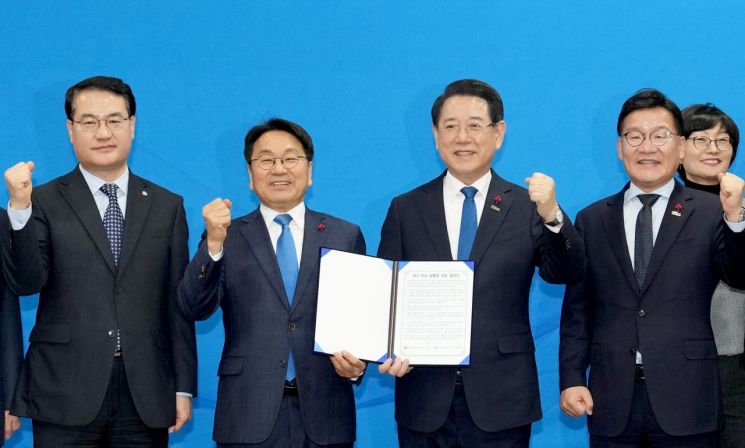 As administrative integration between Gwangju and Jeonnam accelerates, public opinion increasingly holds that the integration of smaller areas within Jeonnam is now on the test bench. The photo shows the report meeting for residents of Gwangju and Jeonnam regarding administrative integration. Provided by Jeonnam Province
As administrative integration between Gwangju Metropolitan City and Jeollanam-do comes into view, the need for integration of smaller regions within Jeonnam by area is emerging as a key issue. The aim is to resolve long-standing integration issues in the western region-Muan, Mokpo, and Shinan-and the eastern region-Yeosu, Suncheon, and Gwangyang-to proactively address potential conflicts that may arise from the upcoming Gwangju-Jeonnam metropolitan integration.
The "Mokpo, Muan, and Shinan Preemptive Integration Promotion Residents' Coalition" held a press conference in the briefing room of the Jeonnam Provincial Council on January 8, stating, "Alongside the Gwangju-Jeonnam metropolitan administrative integration, the government and metropolitan governments must support the integration of Mokpo, Muan, and Shinan to realize the long-standing regional aspiration of integrating the Muan Peninsula."
As discussions on administrative integration between Gwangju and Jeonnam accelerate, the issue of integrating smaller regions within Jeonnam is emerging as a new focal point.
Whether administrative integration remains a political event at the metropolitan level or leads to genuine regional restructuring will depend on how the structure of Jeonnam's smaller regions is redesigned.
Jeonnam is divided into 22 cities and counties, but due to population decline and decreasing fiscal independence, many areas have lost the ability to sustain themselves independently.
In particular, the Muan Peninsula region, represented by Muan, Mokpo, and Shinan, is already tied together as a single living and economic zone, sharing resources such as airports, ports, industrial complexes, and tourism. However, administrative divisions remain at the city and county level, leading to persistent criticism that policy implementation is slow and inefficient.
Similarly, Yeosu, Suncheon, and Gwangyang form a de facto metropolitan urban area with closely interconnected industries. However, the main base industry-petrochemicals-continues to stagnate due to ongoing oversupply from China and growing external uncertainties. The steel industry is also struggling, with no solution in sight, as it faces a downturn in the construction sector. Furthermore, the separation of industrial infrastructure by region makes it difficult to generate synergy.
Both regions are considered the economic and industrial pillars of the eastern and western parts of Jeonnam, which makes the current situation even more regrettable.
Calls to resolve these instabilities have been ongoing for a long time. Discussions on integrating the Muan Peninsula (Mokpo, Muan, Shinan) date back to 1994, while talks of integrating Yeosu, Suncheon, and Gwangyang have been ongoing since the mid-2000s.
Efforts such as resident opinion surveys have been made to find practical solutions, but actual agreements or implementation have not been achieved due to a mix of political interests and regional power struggles.
There are concerns that if administrative integration between Gwangju and Jeonnam becomes a reality, these structural limitations will become even more pronounced. This is because Gwangju, with its concentration of personnel, finances, and facilities, could become a "black hole" that absorbs administration and politics.
The already weakened networks among smaller regions within Jeonnam may become even more fragile than they are now.
As the Lee Jaemyung administration is pushing strongly for the development of renewable energy and AI industries, the establishment of the RE100 industrial complex in the Honam region, and the expansion of the semiconductor industry base, whether or not the Muan Peninsula and Yeosu, Suncheon, Gwangyang, and Goheung are integrated will serve as a test case and barometer.
A political figure from Jeonnam stated, "I believe the success of the Gwangju-Jeonnam administrative integration ultimately depends on how Jeonnam is reorganized internally," emphasizing, "The integration of the Muan Peninsula as well as Yeosu, Suncheon, and Gwangyang will serve as an example of which direction Jeonnam will take after metropolitan integration."
Meanwhile, at a New Year's press conference held on January 13, Jeonnam Governor Kim Youngrok addressed concerns about possible regional marginalization following administrative integration, saying, "I believe it will no longer be possible for the locations of city and provincial offices to serve as the political and economic centers as they did in the past. In the special integrated city, where Jeonnam's 22 cities and counties and Gwangju's 5 cities and counties will be combined for a total of 27, I do not believe anyone will be disadvantaged in terms of budget allocation. In particular, I believe the extent to which industrial infrastructure is developed will serve as the key metric for regional development. We will establish a balanced development fund to support underdeveloped areas such as rural regions first."
© The Asia Business Daily(www.asiae.co.kr). All rights reserved.
![Clutching a Stolen Dior Bag, Saying "I Hate Being Poor but Real"... The Grotesque Con of a "Human Knockoff" [Slate]](https://cwcontent.asiae.co.kr/asiaresize/183/2026021902243444107_1771435474.jpg)











