President Lee Departs for Japan... Summit with Prime Minister Takaichi Scheduled Today
Japan in a Hurry, Korea Taking Its Time... Attention on Whether "Historical Issues" Will Be Included in Joint Press Announcement
On January 13, President Lee Jaemyung departed for Japan to hold a summit meeting in Nara, the hometown of Japanese Prime Minister Sanae Takaichi. This marks a series of back-to-back summit-level diplomatic engagements, coming just one week after his return from a state visit to China. Amid rapidly changing circumstances in Northeast Asia, including deteriorating China-Japan relations, this summit is expected to serve as a diplomatic test for South Korea's role in the region. There is also keen interest in whether topics such as economic cooperation-artificial intelligence (AI), supply chains, and the Comprehensive and Progressive Agreement for Trans-Pacific Partnership (CPTPP)-as well as historical issues like the Josei Coal Mine, will be discussed for the first time.
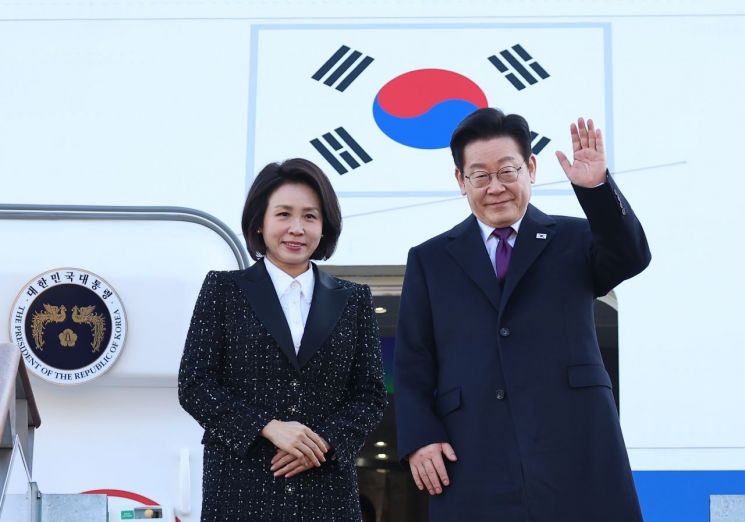
At around 9:15 a.m. on the 13th, President Lee boarded Air Force One at Seoul Airport. At the departure ceremony, he was seen off by Minister of the Interior and Safety Yoon Hojoong, Presidential Chief of Staff Kang Hunsik, Democratic Party leader Jung Chungrae, Second Vice Minister of Foreign Affairs Kim Jina, Matsuo Hirotaka, Deputy Chief of Mission at the Japanese Embassy in Korea, and the commander of the 15th Special Mission Wing of the Air Force. President Lee wore a black coat and a burgundy tie, while First Lady Kim Hye-kyung was dressed in a black coat and a white blouse.
After arriving at Kansai Airport in Osaka, President Lee will travel to Nara, where he will hold both a one-on-one and an expanded summit meeting with Prime Minister Takaichi, followed by a joint press announcement. The summit will continue with a private conversation and a dinner. On the morning of the 14th, the two leaders will jointly tour Horyu-ji, a representative cultural heritage site in Nara Prefecture. President Lee will also meet with Korean residents in the Kansai region, including Osaka, and will return to Korea after completing his two-day, one-night schedule in Japan.
This summit is expected to address both "practical agendas" and "sensitive issues" at the same table. The presidential office announced that a broad range of topics will be discussed, including future-oriented cooperation in areas such as intellectual property (IP) protection, AI, and supply chains, as well as responses to transnational crimes like scams, social issues, and people-to-people exchanges that directly affect the public.
In addition, National Security Advisor Wi Sung-rak identified "strengthening humanitarian cooperation" on historical issues, including the Josei Coal Mine, as one of the main goals. The Josei Coal Mine is an undersea mine where more than 130 Korean laborers were forcibly conscripted during the Pacific War, and in 1942, a collapse at the mine resulted in the deaths of over 180 people, including Japanese workers.
The fact that the summit is being held in Nara, Prime Minister Takaichi's hometown, rather than in Tokyo, is being described as an "exceptional omotenashi (extraordinary hospitality)." Nara is an ancient capital of Japan and the hometown of Prime Minister Takaichi, who has been elected to parliament ten times since first running as an independent in the 1993 general election. To prepare for the summit, Prime Minister Takaichi traveled to Nara a day earlier, on the 12th. Japanese media noted that it is extremely rare for a prime minister to travel to the summit location a day in advance.
Attention is also being drawn to the continuation of "shuttle diplomacy," a commitment made with Prime Minister Takaichi following former Prime Minister Shigeru Ishiba. National Security Advisor Wi defined this as "strengthening the bond and trust between the leaders of the two countries through shuttle diplomacy." Over the course of the two-day visit, the two leaders are expected to meet a total of five times.
There is also interest in whether historical issues will be formally brought to the table. President Lee appears to be aiming to create an atmosphere for serious discussions on historical matters with Japan by first addressing the excavation of Korean remains at the Josei Coal Mine-a topic where Korea and Japan may be able to cooperate-rather than immediately tackling the highly sensitive issues of Japanese military "comfort women," forced labor, or the Sado Mine. Until now, President Lee has maintained that while a correct understanding of history is a prerequisite for summit discussions, historical issues should not hinder future cooperation, and he has refrained from rushing the process.
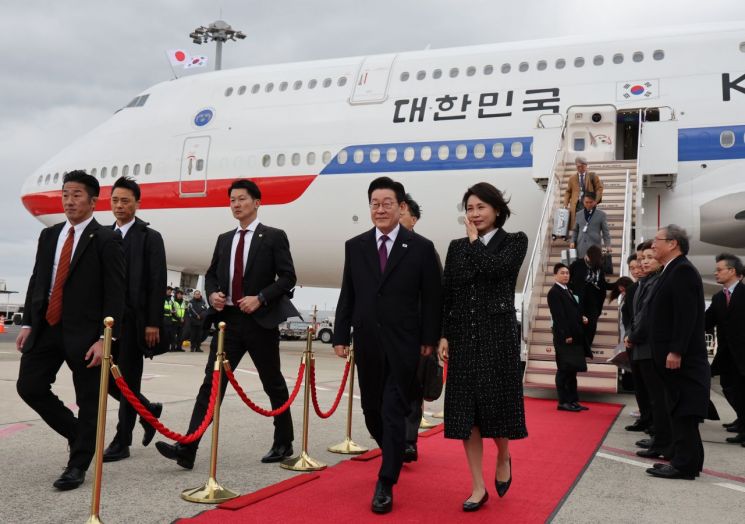
However, as China-Japan relations continue to deteriorate due to China's restrictions on rare earth exports to Japan, the volatile situation in Northeast Asia is both a point of concern and a variable that could determine the outcome of the summit. The Japanese government has repeatedly emphasized the importance of Korea-Japan relations and trilateral cooperation among Korea, the United States, and Japan, publicly expressing its hope for "frank dialogue."
There is speculation that, amid escalating tensions between China and Japan, South Korea may face pressure to choose sides. Accordingly, observers are watching how President Lee will maintain his "pragmatic" stance while managing differences over regional security issues such as the peace and coexistence process on the Korean Peninsula and the Taiwan Strait. In an exclusive interview with NHK released on the 12th, President Lee stated, "In the complex situation of Northeast Asia, it is extremely important for Korea and Japan to share values and aspirations."
Regarding the ban on imports of seafood from Fukushima, Japan, President Lee said this is an issue that must be resolved in the long term in order to join the CPTPP. The CPTPP is a multilateral free trade agreement (FTA) launched in 2018 by countries in the Asia-Pacific region. Twelve countries, including Japan, Canada, and Australia, are participating, and Korea is also seeking to join. President Lee said, "In the current situation, it will be difficult in the short term because we must address the emotional and trust issues of the Korean people."
On the final day of his visit to Japan, the 14th, President Lee will meet Prime Minister Takaichi again at Horyu-ji. Prime Minister Takaichi is expected to highlight the history of Korea-Japan exchanges prior to historical conflicts by visiting Horyu-ji, the world's oldest wooden structure, which was influenced by Baekje architectural techniques.
© The Asia Business Daily(www.asiae.co.kr). All rights reserved.
![Clutching a Stolen Dior Bag, Saying "I Hate Being Poor but Real"... The Grotesque Con of a "Human Knockoff" [Slate]](https://cwcontent.asiae.co.kr/asiaresize/183/2026021902243444107_1771435474.jpg)

















