Despite Declining Student Population, Private Education Spending Hits Record High
Winter Break Tuition Costs Millions of Won, with Additional Fees Charged Separately
As the 2026 College Scholastic Ability Test is being evaluated as a so-called 'Bulsuneung' and changes in the admissions environment are anticipated, the atmosphere in the academy district during this winter vacation is even more heated than in previous years. Expensive winter school programs and advance retake classes are filling up early, increasing the burden of private education costs for parents. On January 13, Yonhap News reported that, with changes in the admissions process expected, more students are flocking to academies during this year's winter break compared to previous years.
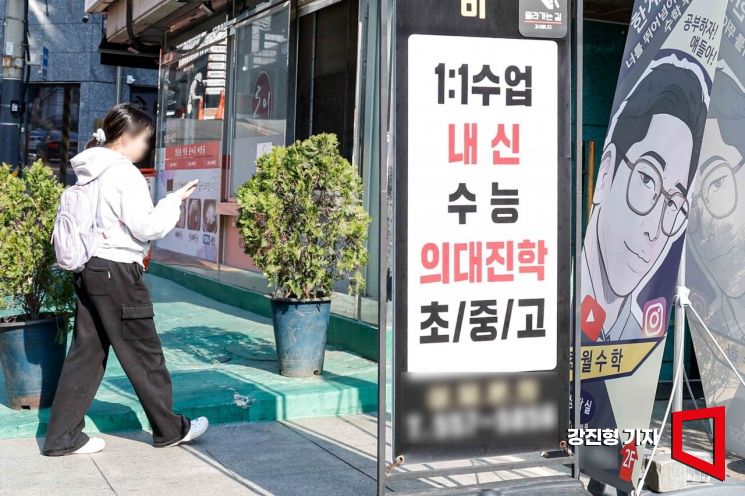 As the 2026 College Scholastic Ability Test is being evaluated as a so-called 'Bulsuneung' and changes in the admissions environment are anticipated, the academy district this winter vacation is experiencing a more heated atmosphere than in previous years. Photo by Kang Jinhyung
According to Yonhap News, winter school and advance retake classes, which cost between 2 million and 3 million won, are already so full that even joining a waitlist is difficult. In this environment, winter break special classes are essentially being treated as a 'mandatory course.' The tuition for winter special classes offered by academies is generally between 2 million and 3 million won for a 6 to 7 week program, with mock test fees, meal fees, and textbook fees charged separately. Full-day students attend from 7:50 a.m. until 10 p.m., enduring a grueling schedule.
Special classes were originally designed as optional courses to help students address individual weaknesses, but some academies are making them mandatory, citing their connection to the regular curriculum. In fact, some academies in Incheon and Gyeonggi Province require students to take winter break special classes when enrolling in regular classes. In such cases, the tuition for a single subject over two months can exceed 1.4 million won.
 A phrase reading "Medical School Repeat Students" is written on the window of an academy located in the academy district of Daechi-dong, Gangnam-gu, Seoul. Photo by Kang Jin-hyung
Despite the high tuition, demand continues to rise. Comprehensive academies for retake students and winter schools for prospective sophomores in Mok-dong, Seoul, are fully booked for all grades, making new registrations or even joining a waitlist nearly impossible. Some academies offer priority enrollment in regular classes to students who take special classes, further increasing the pressure on parents to make a choice. The upward trend in private education spending supports this. According to the national statistics portal (KOSIS), total private education expenditures in 2024 reached 29.1919 trillion won, an increase of more than 60% compared to 2014. The financial burden on households becomes even heavier during the winter, when special classes are concentrated during school breaks.
Im Seongho, CEO of Jongno Academy, told Yonhap News on January 12, "The number of early applicants for comprehensive retake classes has increased by about 10 to 20 percent compared to the same period last year," adding, "There is strong demand from both high-achieving students who missed their targets on the CSAT and lower-performing students who want to build better study habits." He also noted, "Since the 9-grade high school GPA system and the integrated CSAT system will only be applied through this year, students and parents are approaching the admissions process with a 'last chance' mindset," and predicted, "Registrations for regular retake classes starting in February could increase by more than 10 percent compared to last year."
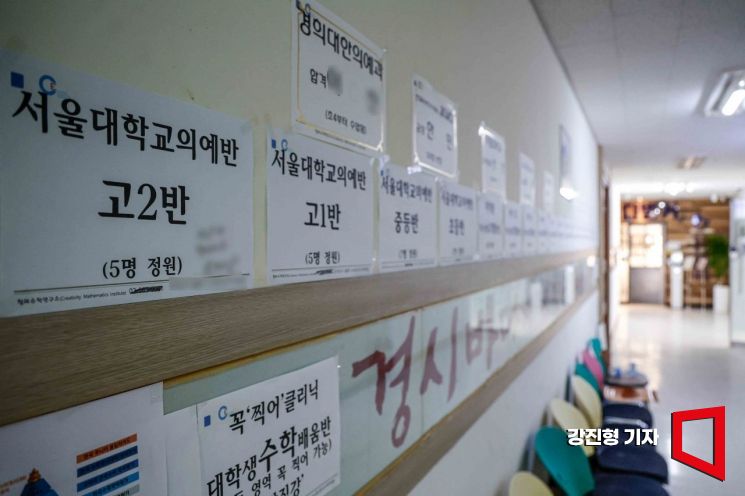 At the entrance of an academy located in Daechi-dong, Gangnam-gu, Seoul, there is a recruitment notice for the "Seoul National University Pre-Medical Class for 11th Grade Students." Photo by Kang Jin-hyung
On online parenting forums, posts such as "Everyone around me is sending their kids, so I feel anxious," and "If I don't think about the money, I can't send them," are appearing one after another. One parent confessed, "Special classes are supposed to be optional, but I end up registering because I'm worried my child will fall behind if they don't attend." Experts diagnose this phenomenon as the 'private education dilemma.' Han Moonseop, Professor Emeritus of English Education at Hanyang University College of Education, pointed out, "Special classes are optional, but the anxiety that their child will fall behind if they don't attend puts pressure on parents," adding, "This cycle of recurring anxiety is ultimately expanding private education." However, he emphasized, "The key to improving learning outcomes ultimately lies in the time and attitude students dedicate to studying on their own."
© The Asia Business Daily(www.asiae.co.kr). All rights reserved.
![Clutching a Stolen Dior Bag, Saying "I Hate Being Poor but Real"... The Grotesque Con of a "Human Knockoff" [Slate]](https://cwcontent.asiae.co.kr/asiaresize/183/2026021902243444107_1771435474.jpg)


















