Difficulties Expected in Securing Investigative Personnel... No Likelihood of Prosecutors Transferring
Dual Structure of "Investigative Judicial Officers" and "Specialized Investigators"
Criticism Over Similarities to the Prosecution's Organization
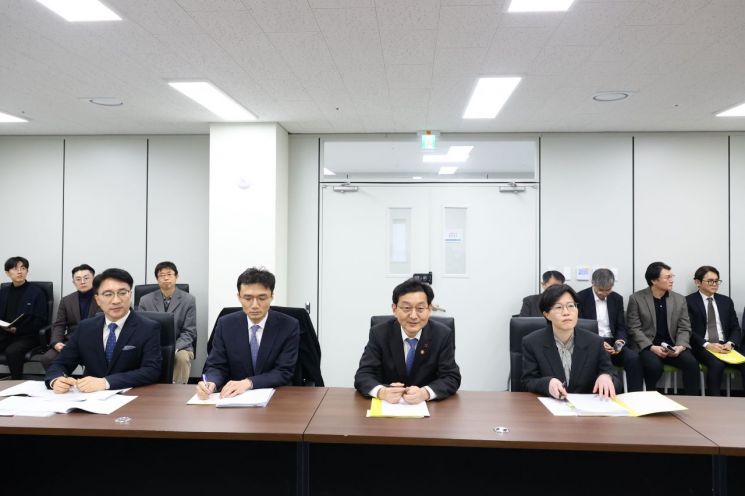 Yoon Changryul, Director of the Prosecution Reform Promotion Team under the Prime Minister and Secretary General of the Office for Government Policy Coordination, is speaking at a press briefing related to the legislative notice of the Public Prosecution Office and Serious Crime Investigation Office Act held at the Changseong Annex of the Government Seoul Office Building on the 12th. Courtesy of the Prime Minister's Office.
In October of this year, a massive investigative agency capable of handling nine major crimes will be established. The newly created Serious Crime Investigation Office (SCIO) will investigate nine major crimes: corruption, economic crimes, crimes by public officials, election crimes, defense procurement, major disasters, drug crimes, national security, and cybercrimes. The SCIO will be set up in seven locations nationwide.
The prosecution will be reorganized into the Public Prosecution Office, and under the principle of separating investigation and indictment, the roles of "criminal investigation" and "initiation of investigation" will be removed from prosecutors' duties. Instead, the Public Prosecution Office will be transformed into an agency exclusively responsible for "filing and maintaining indictments." The government has decided not to reach a conclusion on whether the Public Prosecution Office will have supplementary investigative authority for now, leaving the matter for future discussion.
On January 13, legal professionals and observers pointed out that although the SCIO will launch as a much larger investigative body compared to the existing prosecution's scope for initiating investigations, there is a lack of concrete measures for securing sufficient investigative personnel.
According to the SCIO Act, which the government has announced for legislative notice, the SCIO's investigative staff will consist of "investigative judicial officers" who are qualified lawyers and "specialized investigators" with extensive experience. The dual structure was designed to allow for the smooth transfer of current prosecution investigators. The government expects the SCIO to have around 3,000 personnel. The plan is to ensure that prosecutors can transfer as investigative judicial officers and prosecution investigators as specialized investigators, with their compensation and status guaranteed, maintaining their current treatment.
Although the SCIO will not be granted the authority to request warrants or indict, some members of the ruling party have pointed out that the internal rank structure is similar to the current prosecution, which is divided into prosecutors and investigators. Therefore, there remains a possibility that the composition of the investigative staff could change before the SCIO officially launches.
An official from the Prosecution Reform Promotion Team under the Prime Minister's Office stated, "Securing investigative personnel is our biggest concern, and it cannot be done by force. Since people would have to give up their current positions, the most important thing is to create incentives for them to move naturally. However, if we are unable to fill all the positions, we may have to conduct public recruitment for experienced professionals from outside. At this stage, we believe that a significant number of prosecutors and investigators need to join."
The problem is that it will not be easy to secure enough investigative judicial officers, who are responsible for legal reviews and other tasks during investigations. The government plans to recruit prosecutors as investigative judicial officers, but the likelihood of prosecutors transferring to the SCIO appears low.
One chief prosecutor commented, "If a prosecutor moves to the SCIO, their affiliation will change from the Ministry of Justice to the Ministry of the Interior and Safety, and they would have to resign before transferring. There are multiple complex factors, including issues of job security. I do not think any prosecutors will move to the SCIO."
Previously, when the Corruption Investigation Office for High-ranking Officials (CIO) was launched, there were also expectations that prosecutors would transfer, but none did. The CIO has not been able to fill its prosecutor positions, has struggled with staffing, and has failed to deliver any significant results in its five years of operation.
© The Asia Business Daily(www.asiae.co.kr). All rights reserved.
![Clutching a Stolen Dior Bag, Saying "I Hate Being Poor but Real"... The Grotesque Con of a "Human Knockoff" [Slate]](https://cwcontent.asiae.co.kr/asiaresize/183/2026021902243444107_1771435474.jpg)
















