One in Five Danish Students Attends a Private School
Higher Academic Achievement Attracts Parents with Higher Education and Income
Concerns Over Declining Quality of Public Education
Denmark, a country that has pursued educational equality through free education, is now experiencing a surge in private schools. One out of every five Danish students attends a private school that requires tuition fees.
According to Statistics Denmark on January 17, the proportion of students attending private schools increased from 13% in 2011 to 18% in 2023. In some regions, the share of private school students reaches as high as 25% to 30%.
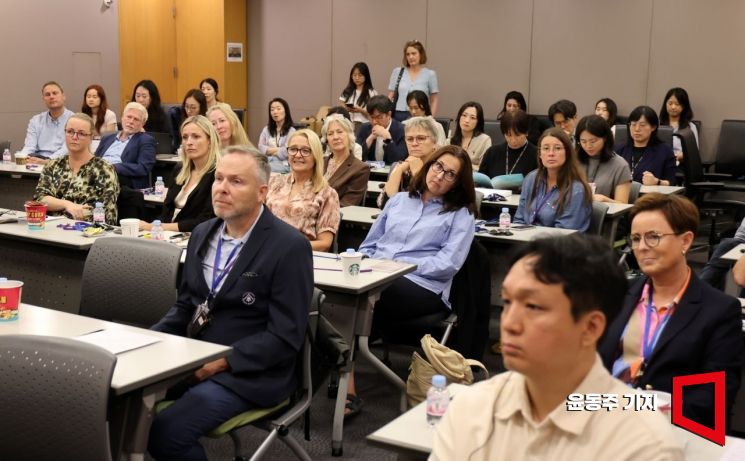 Principals of Danish private primary and secondary schools visiting Korea and Korean education officials are discussing topics such as international joint classes and exchanges with the Danish education sector at the Embassy of Denmark in Korea last September. 2025.09.22 Photo by Yoon Dongju
With the growing popularity of private schools in Denmark, it is now common for parents to put their child's name on the waiting list for admission as soon as the child is born. Danish private schools conduct their own admissions process independently, without going through the local education office. Registering on the waiting list is the first step toward admission. Like public schools, private schools in Denmark can provide classes from kindergarten through compulsory education (grades 1 to 9). At Klostermarksskolen, a 150-year-old private school located in Aalborg (population about 120,000), the minimum waiting period for admission is five years.
In Korea, Danish private schools have mostly been introduced as free schools or alternative schools, focusing on music, art, or operating without exams. However, there are now more private schools that teach the same subjects and content as public schools but educate students at a higher level. According to educational statistics from the Danish Ministry for Children and Education (2023-2024), private school students scored higher on average than public school students in all subjects, including Danish, English, and mathematics, in exams for ninth graders. On a 12-point scale, the average scores for English and mathematics were more than one point higher for private school students. In the joint exams for physics, chemistry, biology, and geography, private school students averaged 8.2 points, while public school students averaged 7.3 points.
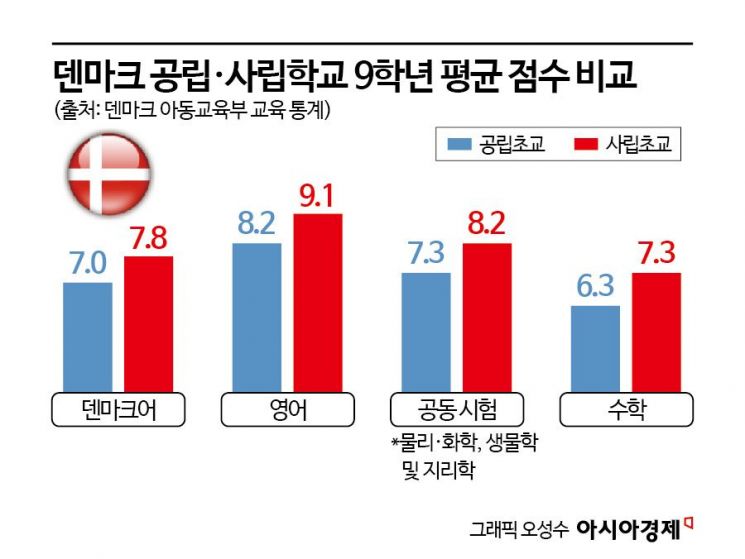 The subject-wise test results for 9th-grade students conducted in 2023-2024 show that the full score is 12 points.
The private school market has heated up as more Danish parents, whose education and income levels have risen, seek differentiated education for their children. Lars Peter Nitschke, principal of Klostermarksskolen, explained, "Private schools offer options to parents with high expectations for education," adding, "Because parents choose the school, it is easier for the school to satisfy them."
In Denmark, government subsidies for public schools mean that parents do not bear any tuition costs. In contrast, attending a private school requires paying an average monthly tuition of about 500,000 won. As a result, there are growing concerns in Denmark that private schools, which require tuition, are mainly attended by students from middle-class or wealthier families, potentially deepening social divides and educational inequality.
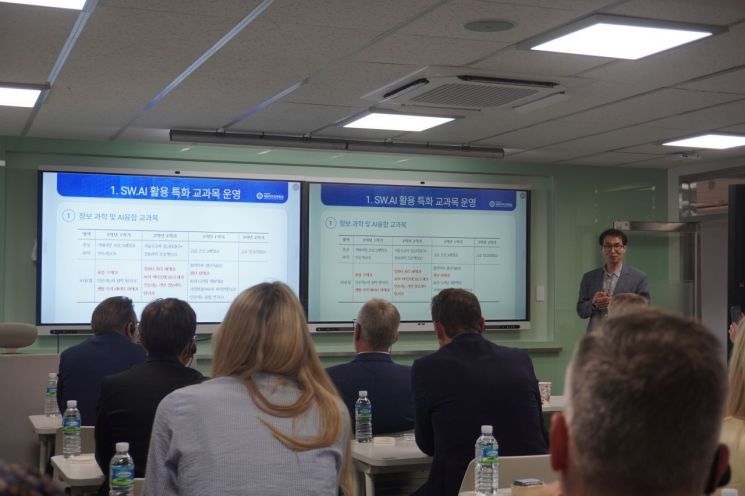 The principals of private schools from Denmark visiting Korea are listening to an explanation during their visit to Daejeon Science High School in September last year. Embassy of Denmark in Korea
There are also concerns that the increasing popularity of private schools could lead to a decline in the quality of public school education. Talented teachers may prefer private schools, which offer better compensation, and as the number of public school students decreases, financial support from local governments may also be reduced, making it harder to operate public schools.
The University of Southern Denmark, in an article titled "The Exodus from Public Schools Creates Social Inequality," analyzed, "Parents from economically advantaged families will begin to leave public schools, and once they leave, it becomes even harder to raise the academic level of the class. When the number of students decreases, the school budget also shrinks." Jakob Boje, associate professor at the University of Southern Denmark, stated, "This is part of a neoliberal trend that essentially abandons the welfare state ideology, but public opinion seems to support this movement as well."
© The Asia Business Daily(www.asiae.co.kr). All rights reserved.
!["The Woman Who Threw Herself into the Water Clutching a Stolen Dior Bag"...A Grotesque Success Story That Shakes the Korean Psyche [Slate]](https://cwcontent.asiae.co.kr/asiaresize/183/2026021902243444107_1771435474.jpg)


















