Launch of the First Metropolitan Local Government
Council Formed with 20 Representatives from Various Sectors
Special Law, Public Opinion Gathering, and Public Engagement Strategies Discussed
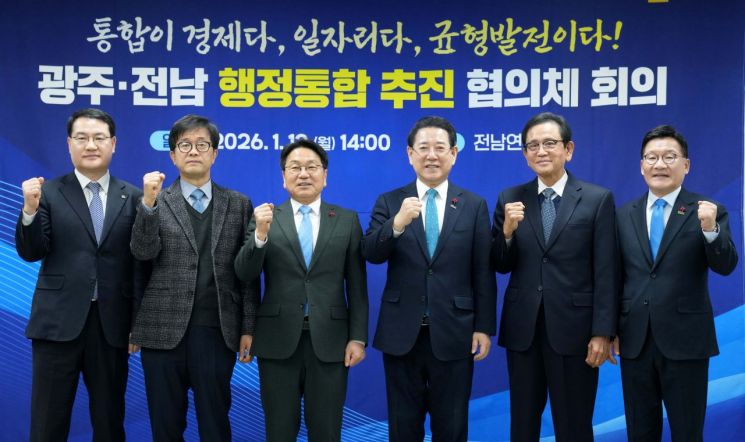 Kim Youngrok, Governor of Jeollanam-do, is taking a commemorative photo with participants at the "Gwangju-Jeonnam Administrative Integration Promotion Council" meeting held on the 12th at the Jeonnam Research Institute in Naju. Provided by Jeonnam Province
On January 12, Jeollanam-do and Gwangju Metropolitan City held the first meeting of the Gwangju-Jeonnam Administrative Integration Promotion Council, a joint public-private working body, at the Jeonnam Research Institute in Naju. During the meeting, participants discussed a special law, ways to gather opinions from city and provincial residents, and strategies for public engagement.
The Gwangju-Jeonnam Administrative Integration Promotion Council is composed of 20 representatives from various sectors in Gwangju and Jeollanam-do.
Kang Wiwon, Vice Governor for Economic Affairs of Jeollanam-do, and Kim Youngmoon, Vice Mayor for Economic and Cultural Affairs of Gwangju, will serve as the ex officio co-chairs. For the private sector, Jo Bohun, former Vice President of the Korea Industrial Complex Corporation, will represent Jeollanam-do, and Jung Youngpal, Chairperson of the Gwangju Regional Era Committee, will represent Gwangju. The council includes eight representatives each from the city and province, including members from the city and provincial councils, city, county, and district councils, heads of local governments, economic and social organizations, and representatives from the education and cultural sectors.
At the meeting, attended by Kim Youngrok, Governor of Jeollanam-do, Kang Gijung, Mayor of Gwangju, and about 30 other council members, the results of the January 9 luncheon at the Blue House were reported. Participants also discussed strategies for gathering public opinion and public engagement, as well as the special administrative integration bill.
On January 2, Jeollanam-do and Gwangju jointly announced a declaration for "Great Revival of Gwangju and Jeonnam" to open a new chapter in their history, and began forming and operating a task force for administrative support. With this council meeting, they plan to activate the structure for administrative integration discussions and increase practical momentum.
The Promotion Council is responsible for setting the basic direction for administrative integration with the goal of joint development and strengthening future competitiveness for both Jeollanam-do and Gwangju. It will propose a special bill to serve as the institutional foundation and will establish methods and procedures for public engagement and participation. Notably, the process does not predetermine the outcome of integration but emphasizes a democratic procedure that reflects sufficient information and social discussion, which is of great significance.
To this end, Jeollanam-do and Gwangju have launched the Gwangju-Jeonnam Grand Integration Communication Platform since January 8 to ensure that voices from all regions and social strata are heard. In addition, they plan to form the "Gwangju-Jeonnam Pan-Provincial Administrative Integration Promotion Council" to expand public consensus, and will hold explanatory sessions and roundtable discussions across all 27 cities, counties, and districts in stages to achieve sufficient social agreement.
Based on the outcomes of the Promotion Council’s discussions, Jeollanam-do and Gwangju will jointly prepare an administrative integration bill and, after consultations with central government ministries and the National Assembly, aim to pass the special law in the National Assembly by February.
On June 3, at the upcoming local elections, a mayor for the integrated special city will be elected, and on July 1, a new integrated local government representing 3.2 million residents of Gwangju and Jeonnam will be launched, marking a new chapter in administrative integration.
Governor Kim Youngrok stated, "Gwangju and Jeonnam already function as a single living and economic zone," adding, "The basic framework established by the Gwangju-Jeonnam Administrative Integration Promotion Council will serve as the starting point for all future discussions." He continued, "Through the enactment of a special law and a process of public engagement, we will ensure that the will of the city and provincial residents is fully reflected. We will uphold the principle of balanced development so that no region among the 27 cities, counties, and districts is left behind."
Mayor Kang Gijung remarked, "We have gathered here to plant the seeds for a new future for Gwangju and Jeonnam. The Promotion Council will listen to the voices of the residents, provide legislative support, and envision the future of Gwangju-Jeonnam integration with boundless imagination."
He also requested, "At the luncheon hosted by President Lee Jaemyung at the Blue House on January 9, the government expressed a strong commitment to support, including special fiscal incentives that exceed the expectations of city and provincial residents. I ask the Promotion Council members, who represent various sectors, to pool their capabilities and wisdom."
© The Asia Business Daily(www.asiae.co.kr). All rights reserved.

















