Han Byungdo Firmly Denies Reports of Internal Disagreement
Some Lawmakers Call for Abolishing Supplementary Investigative Powers
Possible Amendments During Judiciary Committee Review
On January 12, the Democratic Party of Korea revealed internal disagreements regarding the establishment of the Major Crimes Investigation Agency (MCIA), which is being promoted as part of prosecutorial reform, and moved to address the situation. The party asserted that there are no internal differences of opinion. However, controversy continues, as some members of relevant parliamentary committees, such as the Legislation and Judiciary Committee, have suggested possible amendments during the National Assembly discussions.
Han Byungdo, the newly appointed floor leader of the Democratic Party, told reporters that day, "There have been reports of disagreements between the party and the government regarding the MCIA, but this needs to be corrected." He explained, "There is no disagreement between the party and the government. There is a proposal today, and some lawmakers expressed their views on it, but it was portrayed as if there was a rift between the party and the government." He added, "There is absolutely no discord between the party and the government. The government thoroughly prepared and announced the proposal, and after significant discussions with the party, the comprehensive plan was finalized and announced."
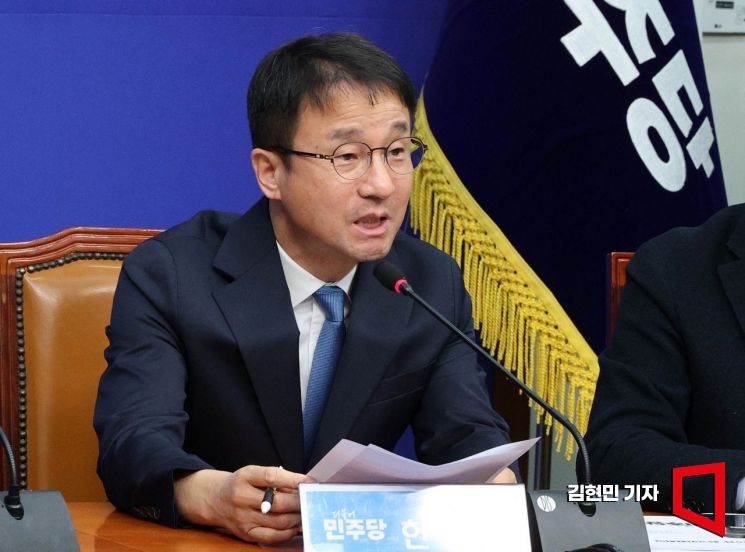 Han Byungdo, the newly appointed floor leader of the Democratic Party of Korea, is speaking at the Supreme Council meeting held at the National Assembly on January 12, 2026. Photo by Kim Hyunmin
Regarding remarks made by party lawmakers, he stated, "Lawmakers are currently expressing their individual opinions on the proposal."
On the same day, the Prosecutorial Reform Task Force under the Prime Minister's Office unveiled a draft bill for the MCIA. The bill would allow the agency to exclusively investigate not only corruption and economic crimes, which are currently under the prosecution's jurisdiction, but also nine major crimes, including: ▲ public officials ▲ elections ▲ defense projects ▲ major disasters ▲ narcotics ▲ national security crimes such as insurrection and treason ▲ cybercrimes. The agency's personnel would be divided into "investigative judicial officers" and "specialized investigators."
In response, concerns were publicly raised within the broader ruling bloc. Cho Kuk, leader of the Cho Kuk Innovation Party, criticized the government’s proposal, saying, "This is an attempt to give the MCIA the appearance of a second prosecution office." He warned, "If the MCIA becomes a second prosecution office, a cartel could form between prosecutors at the Public Prosecution Office and investigative judicial officers at the MCIA." He further expressed concern that, "If a pro-prosecution administration comes to power in the future, the prosecution could be revived by merging the Public Prosecution Office and the MCIA."
Earlier that day, Floor Leader Han also made remarks suggesting there were internal differences regarding the legislative notice of the MCIA bill. On a YouTube channel, he said, "The government’s position is to establish both the MCIA and the Public Prosecution Office and to pursue this through amendments to the Criminal Procedure Act around April. However, some of our (Democratic Party) lawmakers believe that there should be no room for supplementary investigative powers and that we should move toward abolishing them from the outset, which is a point of contention." He added, "Since there are differing views among lawmakers and the party, members of the Ministry of Justice, the Legislation and Judiciary Committee, the party leadership, and the Policy Committee need to coordinate quickly."
Meanwhile, Kim Yongmin, the Democratic Party’s secretary on the Legislation and Judiciary Committee, commented on social media, "The government's legislative notice for the prosecutorial reform bill is just that-a legislative notice. Amendments can be made during the drafting process, and further changes can be made during the committee review." This suggests that amendments may be made during the National Assembly discussions.
© The Asia Business Daily(www.asiae.co.kr). All rights reserved.

















