Korea Power Exchange to Introduce Semi-Centralized Dispatch System in March
Settlement Payments Based on Day-Ahead Power Generation Forecasts
VPP Operators Accelerate Efforts with AI Technology Integration
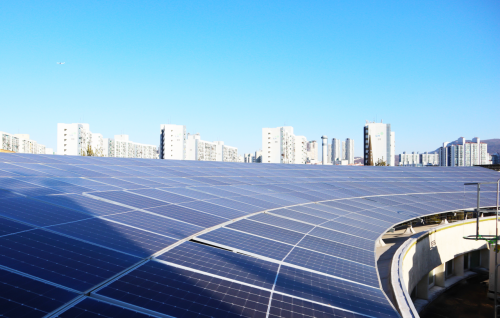 A 96kW rooftop solar power plant installed on the roof of the Gwangmyeong City Public Health Center in Gyeonggi Province. H Energy
At 2 p.m. on January 8, dozens of solar panels with a total capacity of 96 kilowatts (kW) were generating electricity under the sunlight on the rooftop of the Gwangmyeong City Public Health Center in Haan-dong, Gwangmyeong, Gyeonggi Province. The electricity produced by the solar power plant at the Gwangmyeong City Public Health Center is converted to alternating current by an inverter, passes through a meter, and is then sent directly to the adjacent utility pole.
This power plant is equipped with an additional device rarely seen at other solar power plants: a remote monitoring system installed by H Energy, a virtual power plant (VPP) operator. H Energy uses this device to analyze the solar plant’s power data in real time from its headquarters and, based on this analysis, predicts the amount of electricity to be generated the following day.
In fact, the error rate between H Energy’s predicted and actual power output at the Gwangmyeong City Public Health Center over the past seven days was only 2.89%. The lower the error rate, the more additional settlement payments the center receives from the Korea Power Exchange, up to 4 KRW per kilowatt-hour (kWh).
This is thanks to the renewable energy generation forecasting system introduced by the Korea Power Exchange in 2020. A representative from H Energy explained, “We use our proprietary artificial intelligence (AI) technology to predict power output based on data from the Korea Meteorological Administration and the power plant itself.”
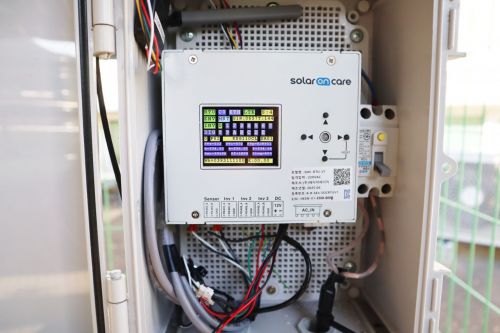 Remote monitoring equipment for H Energy's solar power plant installed at the Gwangmyeong City Public Health Center in Gyeonggi Province. H Energy
In addition to the existing renewable energy forecasting system, the Korea Power Exchange plans to introduce a semi-centralized dispatch system starting in March, beginning with the Honam region. A representative from the Korea Power Exchange stated, “We will set the specific settlement payments in January, recruit operators, and then introduce the semi-centralized dispatch system in Honam in March, with plans to expand it nationwide in the second half of the year.”
Power plants participating in the semi-centralized dispatch system must submit their next-day generation forecasts to the Korea Power Exchange and adjust their output in real time according to dispatch instructions. Renewable energy generators can receive both forecasting settlement payments and additional payments for output control.
The output control settlement payment is expected to be determined by forecasting accuracy and the rate of compliance with control instructions. Even during normal periods without output control, resources capable of real-time control are recognized and compensated. The payment is expected to be set at up to 11 KRW per kWh.
The semi-centralized dispatch system targets power generators already participating in the current renewable energy forecasting system. Large-scale solar and wind power plants with a capacity of 20 megawatts (MW) or more can participate individually. Smaller facilities, such as the one at the Gwangmyeong City Public Health Center, can participate as “aggregated resources” through intermediaries like VPP operators.
The Korea Power Exchange expects that introducing the semi-centralized dispatch system will enhance the predictability of intermittent and highly variable renewable energy sources, thereby contributing to stable grid operation. It is also anticipated to alleviate some of the dissatisfaction among renewable energy operators regarding frequent output control.
Following the semi-centralized dispatch system, the Korea Power Exchange plans to introduce a renewable energy bidding system in the long term. Jeju Island has been operating a pilot version of the bidding system since June 2024. In Jeju’s case, the introduction of the bidding system has reportedly reduced output control and stabilized the power grid.
With the introduction of the semi-centralized dispatch and bidding systems for renewable energy on the horizon, VPP operators are ramping up their activities.
A VPP refers to an operator that integrates distributed energy resources such as solar, wind, energy storage systems (ESS), and electric vehicles using information and communication technology (ICT), and manages them as if they were a single power plant.
As settlement payments vary according to forecasting accuracy, VPP operators are emphasizing their AI technology to attract power generators to their platforms.
H Energy, which operates the SolarOn Care remote solar operation management platform, has developed a power output forecasting system based on operational data from more than 4,000 solar power plants. H Energy stated, “We have applied six proprietary patents and ten domestic and international patent-pending technologies,” adding, “By precisely analyzing AI-based weather data, we can remotely and accurately diagnose any abnormalities in installed solar panels.”
LG Energy Solution, which has experience operating the renewable energy bidding system in Jeju, is also preparing to participate in the mainland’s semi-centralized dispatch system. Since last year, LG Energy Solution has been forecasting the output of the 100 MW Hallim Offshore Wind Farm and providing renewable energy bidding services both a day ahead and in real time.
Enerdot has completed patent applications and registrations for four key technologies essential for power plant operation and management, including forecasting, control, and data infrastructure. The company explained that it possesses machine learning-based solar irradiance forecasting technology, big data aggregation and storage technology for energy platforms, and a reverse transmission prevention system for self-consumption generation facilities.
© The Asia Business Daily(www.asiae.co.kr). All rights reserved.


















