AI Model Developed for Automated Detection of Frank's Sign
Association with Hereditary Cerebral Small Vessel Damage Confirmed
A study has found that "Frank's sign," a diagonal crease on the earlobe, may reflect the degree of hereditary cerebral small vessel damage. A research team at Seoul National University Bundang Hospital became the first in the world to develop an artificial intelligence (AI) model that automatically detects Frank's sign using 3D brain MRI, and demonstrated that this sign is closely associated with the severity of cerebral small vessel disease.

Frank's sign is a diagonal crease that appears on the earlobe at about a 45-degree angle. It was first reported in 1973 by American physician Sanders Frank, who observed it frequently in patients with angina. While it was previously considered a simple sign of aging, recent studies have suggested a correlation with cardiovascular and cerebrovascular diseases such as myocardial infarction, stroke, and vascular dementia.
However, existing studies have only shown a correlation between Frank's sign and vascular disease patients, without providing an objective assessment method or clearly establishing a link with actual vascular damage. The fact that previous research relied on visual observation, which can lead to differing judgments among researchers, has also been cited as a limitation.
Frank's Sign Objectively Identified by AI...Development of an Automatic Detection Model
According to Seoul National University Bundang Hospital on January 12, the team led by Professor Kim Kiwoong from the Department of Psychiatry developed an AI model to automatically detect Frank's sign, leveraging the fact that both the face and earlobe are captured in 3D brain MRI scans. The model was trained using 400 brain MRI scans collected at Seoul National University Bundang Hospital, and its accuracy was validated with an additional 1,060 cases.
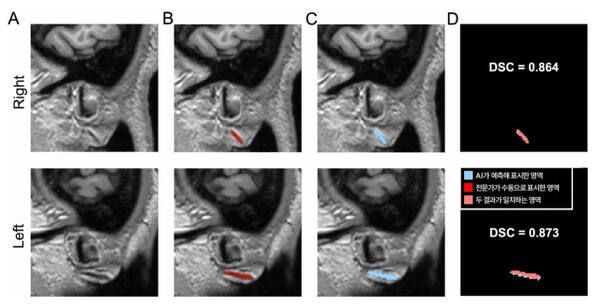 3D original image (A), manually annotated wrinkles by experts (B), and AI-predicted automatically annotated regions (C). Seoul National University Bundang Hospital
The validation results showed that the concordance between the areas manually annotated by experts and those automatically detected by AI reached a high level, as recognized in the field of medical imaging. The model's classification performance in distinguishing the presence or absence of Frank's sign also exceeded 0.9, demonstrating its potential for clinical application.
The research team then used this AI model to analyze patients with CADASIL, a hereditary cerebral small vessel disease caused by genetic mutations. The results showed that the incidence of Frank's sign was significantly higher in CADASIL patients than in the general population, and even after adjusting for age and other factors, the probability of occurrence was more than 4.2 times higher.
"Earlobe Crease May Serve as an Additional Signal for Vascular Risk"
Notably, among CADASIL patients, those with Frank's sign had about 1.7 times greater white matter degeneration volume than those without the sign. When patients were divided into three groups-lower, middle, and upper-based on white matter degeneration volume, the incidence of Frank's sign increased proportionally at 37.0%, 66.7%, and 74.1%, respectively, confirming its association with disease severity.
Professor Kim Kiwoong stated, "We have provided scientific evidence that Frank's sign is not merely an indicator of aging but objectively reflects the degree of hereditary cerebral small vessel damage. While Frank's sign alone cannot be used to diagnose disease, if other vascular risk factors are present, an earlobe crease may serve as an additional warning sign, so it is advisable to consult a specialist."
The results of this study were published in the international journal Scientific Reports and the Journal of Clinical Medicine.
© The Asia Business Daily(www.asiae.co.kr). All rights reserved.


















