Efforts to Persuade the Ministry of Economy and Finance and Financial Services Commission See Little Support
Some Say "Governor Lee Chanjin Is the Only Possible Game-Changer"
Concerns Over Weakened Response to National Policy Tasks and Electroni
As the decision on the re-designation of the Financial Supervisory Service (FSS) as a public institution is scheduled for the end of this month, it has been reported that the FSS is attempting to persuade the government by arguing that such designation would actually hinder the fulfillment of national policy tasks related to financial consumer protection and the supervision of financial accidents. The FSS claims that if it comes under the dual control of both the Financial Services Commission and the Ministry of Economy and Finance, creating a "supervisory body over another supervisory body" structure, it will become difficult to respond flexibly-such as by reinforcing personnel-in the operation of the special judicial police for financial crimes affecting people's livelihoods. Additionally, the FSS argues that its ability to respond to electronic financial incidents, such as the Coupang case, may also be weakened. This is being evaluated as a distinct argument compared to the discussions on public institution re-designation eight years ago.
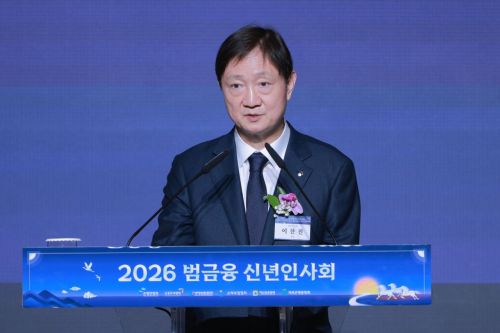 Lee Chanjin, Governor of the Financial Supervisory Service, is delivering a New Year's address at the "2026 Pan-Financial New Year's Gathering" held at Lotte Hotel in Jung-gu, Seoul, on the afternoon of the 5th. 2026.1.5 Photo by Kang Jinhyung
According to the financial sector on the 13th, the FSS is currently engaged in efforts to persuade the Ministry of Economy and Finance, its affiliated advisory body the Public Institution Management Committee, and the Financial Services Commission to oppose the re-designation as a public institution. While the arguments against the "supervisory body over another supervisory body" structure and concerns over undermining the independence of financial supervision remain the same as eight years ago, the FSS is now newly emphasizing the negative impact on the execution of national policy tasks and the response to electronic financial incidents. Previously, in 2018, the FSS was subject to re-designation as a public institution in the wake of a hiring scandal, with then-Deputy Prime Minister and Minister of Strategy and Finance Kim Dongyeon, the Public Institution Management Committee, and the National Assembly's Strategy and Finance Committee citing the need to strengthen management and oversight. However, the plan was ultimately scrapped due to opposition from the Financial Services Commission and the National Assembly's Political Affairs Committee.
From the perspective of fulfilling President Lee Jaemyung's national policy tasks on financial issues affecting people's livelihoods, the government also agrees, to some extent, on the need to strengthen the FSS's special judicial police organization. However, it is expected that legal amendments to grant investigative authority and increase personnel will take considerable time. Furthermore, the FSS faces significant procedural constraints, such as the need for cooperation from other ministries like the Ministry of Science and ICT in order to conduct joint investigations into companies like Coupang.
The FSS believes that, as financial crimes such as cyber incidents and voice phishing become more sophisticated and industry boundaries blur, rapid cooperation among relevant agencies is more important than ever. The FSS argues that if it is designated as a public institution and comes under the "supervisory body over another supervisory body" structure, the effectiveness of its work could be significantly reduced. If designated as an "other public institution," the FSS would be subject to oversight not only from the Financial Services Commission but also from the Public Institution Management Committee; if designated as a "quasi-governmental institution," it would face even stronger management and oversight, including changes to its board composition. On January 5, FSS Governor Lee Chanjin publicly pointed out, "It is fundamentally difficult to accept the creation of a supervisory body over another supervisory body in a structure where the Financial Services Commission already determines the budget and organization."
The problem is that, compared to eight years ago, political and financial authorities' support for the FSS's opposition to public institution re-designation has noticeably weakened. Currently, neither the Ministry of Economy and Finance, the Financial Services Commission, nor the National Assembly's Political Affairs Committee has publicly expressed opposition. There are also very few politicians who have stated a clear position on the issue. Within the financial sector, there is a sense that the ruling party is unlikely to actively oppose the re-designation, as evidenced by Democratic Party Policy Committee Chairperson Han Jeongae's statement on September 25 last year, when she announced the withdrawal of the financial authorities' organizational restructuring, saying, "If necessary, we will discuss it further in the future."
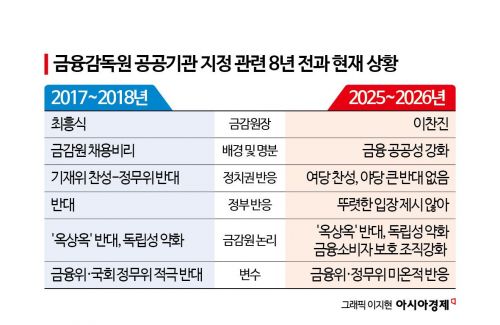
With about two weeks left until the Public Institution Management Committee's decision, there have been no voices of opposition to the FSS's re-designation as a public institution from either the opposition parties or government ministries, increasing the sense of pressure within the FSS. Some within the FSS have even made self-deprecating remarks, saying, "Since we blocked the organizational restructuring, maybe we have to accept the re-designation as a public institution." The FSS labor union has also decided to refrain from external actions such as protests, as it did last year against the organizational restructuring. A union official stated, "We have no plans for separate expressions of opinion or rallies related to the Public Institution Management Committee."
In this situation, there is speculation that FSS Governor Lee Chanjin may be the only person capable of creating a variable. It is believed that there is no clear breakthrough other than directly appealing to President Lee Jaemyung that a "supervisory body over another supervisory body" should not be created in order to fulfill national policy tasks related to financial consumer protection.
However, as the re-designation of public institutions falls under the jurisdiction of the Ministry of Economy and Finance (government) and the Strategy and Finance Committee (National Assembly)-not the Financial Services Commission or the Political Affairs Committee-some believe that it could be burdensome for the FSS Governor to make a direct appeal to the President. There are concerns that, since the political sphere has already agreed to withdraw the FSS's organizational restructuring at the FSS's request, opposing the re-designation as well could provoke a backlash.
An FSS official commented, "There are questions as to whether there is any way to create a variable in the public institution re-designation discussion other than a request from the FSS Governor," adding, "No matter how close the Governor is known to be to the President, it will not be easy to actively oppose the re-designation after already having the organizational restructuring withdrawn."
© The Asia Business Daily(www.asiae.co.kr). All rights reserved.
!["The Woman Who Threw Herself into the Water Clutching a Stolen Dior Bag"...A Grotesque Success Story That Shakes the Korean Psyche [Slate]](https://cwcontent.asiae.co.kr/asiaresize/183/2026021902243444107_1771435474.jpg)

















