Accelerating the Shift to AI-Centric Research
National Science AI Research Institute to Open in June
Transition to Mission- and Collaboration-Based Structure After PBS Abolition
Major Overhaul of Evaluation and Follow-Up Management Announced
The Ministry of Science and ICT will transform the overall research structure of government-funded research institutes to focus on artificial intelligence (AI), and will significantly expand investment in high-risk, high-reward research. The key objective is to establish a system that regards research failures not as setbacks in performance evaluation, but as assets for learning and accumulation.
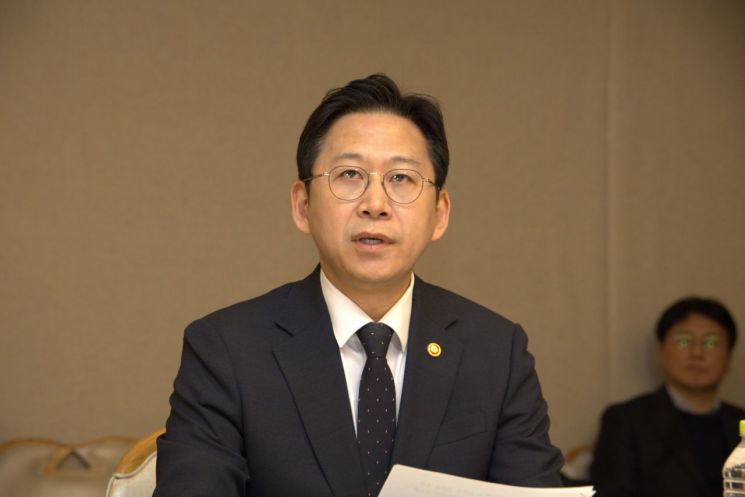
On January 12, Baek Gung-hoon, Deputy Prime Minister and Minister of Science and ICT, stated at a work briefing for government-funded research institutes and public institutions held at the National Research Council of Science & Technology (NST), "We must integrate AI across all areas of science and technology and fundamentally change the research and development (R&D) landscape through bold and innovative approaches." He emphasized, "We need to invest aggressively in high-risk research, and instead of hiding failures, we must create an ecosystem where failures are converted into opportunities for learning and accumulation."
Embracing Failure, Including 'Management and Disclosure'
Deputy Prime Minister Baek instructed the creation of an environment that allows researchers to focus by reducing unnecessary administrative procedures, while also stressing the need for strict standards and follow-up management to prevent the culture of accepting failure from being abused. In particular, he called on the National Research Foundation of Korea to implement rigorous operational standards and to establish a system for transparently disclosing and sharing the details and causes of failures.
In response, Hong Wonhwa, Chairman of the National Research Foundation of Korea, stated, "We will strictly address complacent projects that lack challenge, but we will not regard meaningful failures in the process as failures." He added, "We must clearly explain to the public what the failures were and ensure that everyone can share in the information."
During the work briefing, there were also on-site discussions regarding the status of organizations supporting failure and the evaluation fee system. Koo Hyukchae, First Vice Minister of Science and ICT, questioned whether the organizational restructuring of the Limit Challenge Center, which supports failure and challenge-driven research, was in line with policy direction. Chairman Hong replied that the restructuring aims to expand the model across all national projects, leaving open the possibility of further adjustments if necessary. In addition, discussions regarding the evaluation fees of the National Science Foundation (NSF) in the United States led to a consensus on the need to reconsider the long-term direction of planning and evaluation expenses.
'National Science AI Research Institute' to Open in June... Pilot for AI Co-Researcher Model
Key infrastructure to support the AI transition of government-funded research institutes will also be launched in earnest. During the first half of the year, NST will open the 'National Science AI Research Institute' to provide dedicated support for the convergence of science, technology, and AI. The institute will pilot the 'AI Co-researcher' model for government-funded research institutes, supporting experimental design, data analysis, and hypothesis verification.
By institution, the Korea Institute of Science and Technology (KIST) will focus on developing core physical AI technologies and building an open platform, while the Korea Institute of Science and Technology Information (KISTI) will launch the sixth national supercomputer service, allocate 30% of GPU resources to AI research, and develop an AI agent for literature to support research.
The Ministry of Science and ICT will also accelerate institutional reforms so that, following the abolition of the Project-Based System (PBS), government-funded research institutes can shift from a project acquisition-centered approach to a structure focused on collaboration and mission. NST will establish a new organization to support the full cycle of strategic research projects and operate a demand-based research planning council. The evaluation system will also be restructured into an integrated annual assessment of both research and management to reduce the focus on short-term results.
The work briefings will be held over three days from January 12 to 14. Starting with government-funded research institutes and public institutions on January 12, the briefings will continue with science museums and postal services on January 13, and the Korea Aerospace Administration and the four major science and technology institutes on January 14, with a total of 55 institutions participating.
© The Asia Business Daily(www.asiae.co.kr). All rights reserved.

















