Lucent Block Holds Press Conference Ahead of Financial Services Commission's OTC Exchange Approval
"Innovation Protection Undermined by the Special Act on Financial Innovation Support"
KDX and NXT Consortiums Reported to Fair Trade Commission... "Solo Protest Starting on the 13th"
"We are not asking for special privileges. We are by no means insisting that approval for the over-the-counter exchange for fractional investment must be granted unconditionally. All we are asking is for a decision to be made in accordance with the intent and principles of the law."
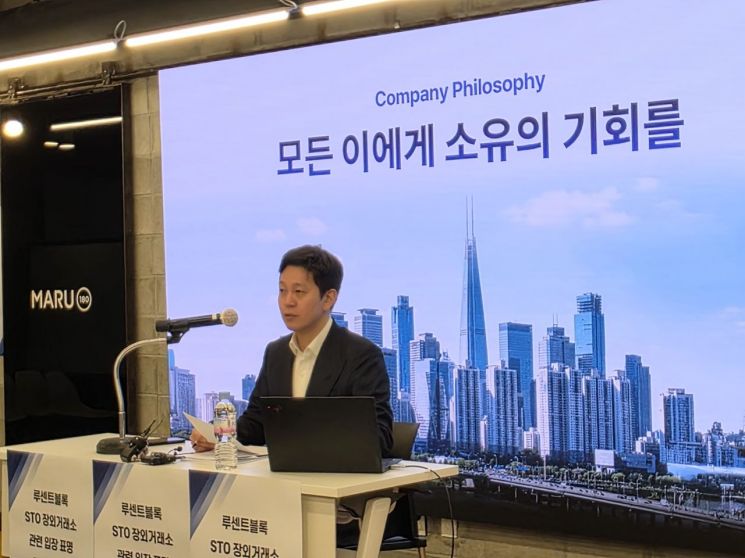 Lucent Block CEO Seo Young Hur held a press conference regarding the approval of the STO over-the-counter exchange on the morning of the 12th at Maru180 in Gangnam-gu, Seoul, expressing his position. Photo by Yoo Hyunseok
Lucent Block, which has been operating a domestic security token offering (STO) platform, has called for a review of the approval process for the over-the-counter exchange for fractional investment, claiming that the process is being conducted unfairly by financial authorities. The company argues that innovative firms that pioneered the market through the regulatory sandbox are now being excluded in the institutionalization process.
At a press conference held on the morning of the 12th at Maru180 in Gangnam-gu, Seoul, Lucent Block CEO Hur Seyoung stated, "Lucent Block took on this challenge with faith in Korea's laws and institutions," adding, "This issue is not simply a matter for one company, but concerns the very foundation of the entrepreneurial ecosystem that relies on the rule of law in this country."
The Financial Services Commission is scheduled to review preliminary approval for the over-the-counter exchange for fractional investment for the 'Korea Exchange-Koscom (KDX Consortium)' and the 'NextTrade-Musicow (NXT Consortium)' at its regular meeting on the 14th of this month. The 'Soyu' consortium, led by Lucent Block, is reportedly on the verge of being eliminated. Previously, the Financial Services Commission had stated its intention to approve up to two companies.
Lucent Block pointed out that the current approval process runs counter to the intent of the 'Special Act on Financial Innovation Support.' This law temporarily eases regulations to allow for the free development and testing of financial products and services based on new technologies. It also includes safeguards to ensure that the achievements of operators are not copied or encroached upon during the institutionalization process.
Hur explained, "If a business site receives approval for innovative financial services, it is granted the exclusive right to operate those services. Denying the main operator the right even to conduct business, let alone granting exclusive rights, is fundamentally contrary to the legislative intent of the law." He further emphasized, "Last September, the Financial Services Commission explicitly stated that it would institutionalize pilot services operated through the financial regulatory sandbox," but in practice, the approval process favored established financial institutions through a competitive licensing structure.
He also pointed out that the KDX Consortium received high marks in business planning, technological capability, and stability assessments, despite having no actual operating record in STO distribution. According to Lucent Block, although Korea Exchange (KRX) was permitted to operate an STO exchange for two years through the regulatory sandbox, it achieved zero distribution results. He stressed, "I personally question the very idea of entering this market when not a single distribution has been made in two years."
Regarding NextTrade (NXT), Lucent Block raised concerns about fair competition. The company claims that NXT signed a non-disclosure agreement (NDA) prior to applying for approval, under the pretext of reviewing investment and consortium participation, and was provided with financial information, business plans, and key technical data. The controversy arose when NXT applied for approval for the same STO distribution business within a short period, without any further collaboration. He emphasized, "NXT had no intention or time to enter the business but signed the NDA merely to consider participating in the consortium," adding, "However, they never officially informed us about breaking the NDA."
Lucent Block stressed that this issue is not a case of 'failure to enter a new business,' but rather 'an example of an existing business facing suspension during the institutionalization process.' CEO Hur lamented, "If the market pioneered by innovative companies at their own risk is repeatedly transferred to other parties without adequate protection, it could have a negative impact on the entire domestic innovation ecosystem." He appealed, "We urge a review of this matter from a perspective that aligns with the intent of the system."
CEO Hur also emphasized that he would do everything possible until the very end. On this day, he reported the case to the Fair Trade Commission, citing obstruction of business activities and violation of the obligation to report business combinations. In addition, starting at 10 p.m. on the 13th, he plans to hold a solo protest in front of the Government Complex Seoul. He said, "I do not know what the outcome will be, and I am aware that the probability is slim," adding, "However, there are so many people I must protect, so I will do my utmost."
Since its establishment in 2018, Lucent Block has been designated as an innovative financial service provider by the Financial Services Commission and has operated the STO service 'Soyu.' To date, the company has recorded approximately 500,000 users and cumulative asset issuance and distribution results totaling about 30 billion won, serving as a real-world test case for the STO market.
© The Asia Business Daily(www.asiae.co.kr). All rights reserved.
![Clutching a Stolen Dior Bag, Saying "I Hate Being Poor but Real"... The Grotesque Con of a "Human Knockoff" [Slate]](https://cwcontent.asiae.co.kr/asiaresize/183/2026021902243444107_1771435474.jpg)
















