A ring-shaped "ultra-lightweight haptic device" that allows users to feel virtual reality (VR) objects as if they were real has been developed in Korea.
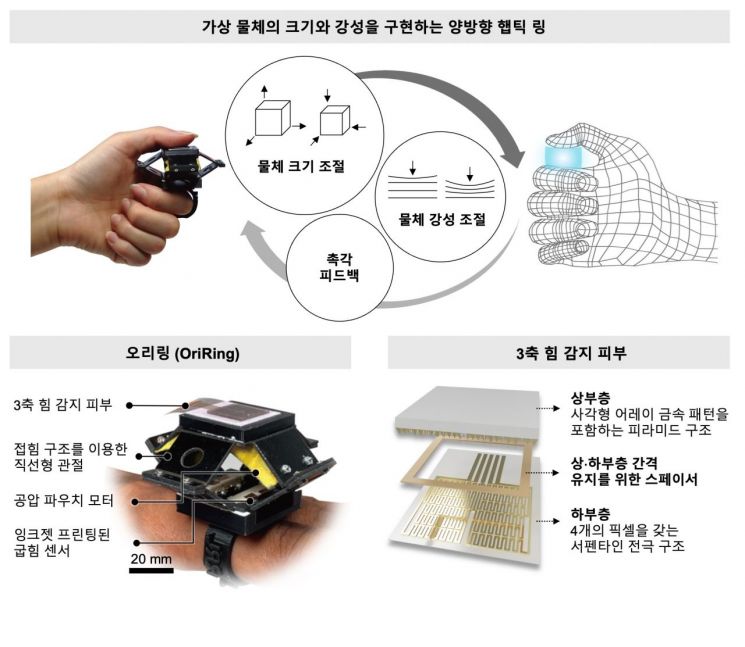
The National Research Foundation of Korea announced on January 12 that a research team led by Professor Kim Seokguk at Sungkyunkwan University, in collaboration with the Swiss Federal Institute of Technology Lausanne (EPFL), has developed a laser-processed three-axis force sensor and applied it to an ultra-lightweight wearable haptic device in the form of a ring, called "OriRing," successfully enabling tactile feedback at the level of individual fingers.
Wearable haptic devices are increasingly being combined with physical artificial intelligence (AI), enhancing their utility in conveying virtual sensations to reality or assisting physical functions. Unlike generative AI, physical AI possesses a body, perceives reality through sensors, and acts physically.
However, conventional haptic devices have relied on skin stimulation methods such as vibration and heat, which are limited in realistically conveying the force and texture of objects. Additionally, haptic devices that deliver force directly at the joint level are structurally heavy and bulky, making them uncomfortable to wear.
To address these issues, the joint research team developed a three-axis force sensor that precisely detects multi-directional forces generated by the user's hand movements and implemented it in the ultra-lightweight wearable haptic device "OriRing."
The three-axis force sensor was developed by using laser processing to form micro-pyramid structures of varying heights on the surface of a polymer, enabling clear differentiation of electrical signals according to the direction and magnitude of the applied force. Designed with a 2×2 pixel structure, this sensor can simultaneously measure both vertical and horizontal forces with a single unit, making three-axis force detection possible.
In particular, the OriRing equipped with this sensor weighs only 18 grams excluding the actuator and provides feedback of up to 6.5N (the force required to lift a 663g object), achieving the highest performance among small wearable devices.
The joint research team confirmed that when actual users wore the OriRing, they could instantly receive tactile feedback on the size and stiffness of virtual objects according to their finger movements. They also proposed a new interaction method that allows users to change the physical properties of virtual objects in real time using only finger movements.
Professor Kim stated, "OriRing maintains the wearability of an accessory while achieving a superior force-to-weight performance compared to conventional glove-type haptic devices. This suggests the potential for expanding its applications beyond virtual reality and gaming to include rehabilitation, healthcare, and remote robot operation in the future."
This research was supported by the BrainLink Program and the Nano Future Materials Fundamental Technology Development Program of the Ministry of Science and ICT and the National Research Foundation of Korea. The research results (paper) were recently published online in the international journal 'Nature Electronics.'
© The Asia Business Daily(www.asiae.co.kr). All rights reserved.

















