[Culture Interview] Sanghoon Jang, Director of the National Folk Museum of Korea
"Yes, even these can be donated"... Expanding the Boundaries of Folklore
Number One for Foreign Visitors, "The Life of Koreans" Resonates
From Donation Culture to North Korean Folklore: The Museum’s Expansion
The Future of Folklore Envisioned by a "Director in the Field"
"Can something like this be donated?"
The National Folk Museum of Korea cherishes even the smallest traces of everyday life.
"Yes, it can!"
 Director Jang actively encourages curators' activities on YouTube and their publishing efforts. Recently, he is taking a commemorative photo holding a book published by a curator. Photo by Seo Mideum
This phrase is written on the back of the business card of Sanghoon Jang, Director of the National Folk Museum of Korea. Since taking office in 2024, Director Jang has included this sentence on his business card as part of an in-house campaign to promote a "culture of donation." When we met him on January 7 at the National Folk Museum of Korea in Jongno-gu, Seoul, he said, "There is still a strong perception that museums only collect expensive, ancient artifacts," adding, "However, whether it is a roof tile from Hwangnyongsa Temple or a tile from a house in a redevelopment area in the 1970s, the difference lies only in their historical context, not in their value or importance."
Director Jang is known as a "director who is out in the field." He personally donated the military uniform he wore during his service in KATUSA, and with the owner's permission, he transported a red standing sign (about 1 meter tall) from a stamp shop in a redevelopment area himself. He said, "If you miss the right moment, it disappears," and expressed regret, "Last year, while preparing for a coffee exhibition, I tried to find a vending machine from the 1980s, but in the end, I couldn't get one."
"As long as there is a story and context, most items can be donated. Even luxury goods like a Gucci shawl or a fox fur scarf are meaningful if they represent the aspirations of Koreans in a certain era." In fact, the Folk Museum actively collects items that reflect the lives and emotions of ordinary people. He said, "There was nothing that better represented the life of the common people than coal briquettes, so I even instructed the staff to collect them myself."
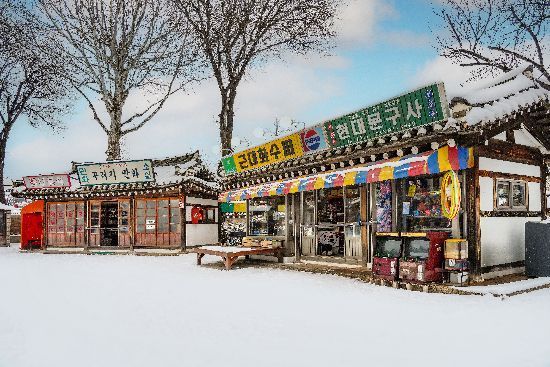 An outdoor exhibition space full of a modern atmosphere, the 7080 Nostalgic Street. Provided by the National Folk Museum of Korea
The response from visitors has been enthusiastic. Last year, the cumulative number of visitors to the National Folk Museum of Korea exceeded 2.28 million, with 1.38 million foreigners, making it the museum with the highest proportion of foreign visitors in the country. In particular, the permanent exhibition "The Life of Koreans" has received the greatest response from foreign visitors. Director Jang said, "Even in France or the United States, it is rare to see exhibitions that systematically cover an individual's life story," and added, "This is the result of accumulation since 1993, and it is an exhibition where a grandfather can hold his grandchild's hand and explain things to them." He further explained, "While exhibitions at the National Museum of Korea require a certain level of understanding, the Folk Museum has the advantage of being easily accessible to everyone."
The museum is also strengthening its merchandise strategy. This year, the museum shop will double in size and plans to introduce customized products that embody the unique identity of the Folk Museum.
Among the planned exhibitions, the most notable is a special exhibition on North Korea. The Folk Museum will hold a special exhibition on North Korea this fall and aims to establish a North Korean Folk Hall at its Paju branch by 2030. Director Jang emphasized, "This will be the first time for both a special exhibition and a permanent exhibition hall dedicated to North Korean folklore," adding, "We are beginning in earnest the work of confirming the cultural homogeneity of our people." Currently, the museum has over 1,500 North Korea-related artifacts in its collection.
"I always regret that oral history surveys of displaced persons were not conducted earlier. Rather than vaguely talking about unification, it is more important to leave thorough records first." He expressed his hope, "I hope this exhibition will serve as an opportunity to raise awareness."
 In an interview conducted on the 7th at the director's office of the National Folk Museum, Director Sanghoon Jang introduced archival materials from his childhood visits to the Folk Museum with his mother. Photo by Seomideum
The National Folk Museum of Korea is scheduled to relocate to Sejong by 2031 in accordance with the Cultural Heritage Administration's "Gyeongbokgung Restoration Master Plan." However, the future use of the Seoul branch has not yet been decided, as the museum building is over 50 years old and is considered a modern cultural heritage, making demolition difficult. Director Jang said, "The Cultural Heritage Administration also recognizes the strategic value of the current location," adding, "It is reasonable to allow the layers of time to remain in a single historic space."
Regarding the new building in Sejong, he explained, "It will be a space that demonstrates the depth of Koreans' understanding of world cultures," and is being planned as a venue where both homogeneity and uniqueness can be confirmed through mutual understanding. "Korea has achieved great success as a trading nation. However, if we only sell products without understanding those societies, it is not sustainable. Cultural leadership is built on a foundation of long-standing understanding and respect."
To this end, a related exhibition will first be held in Seoul in December. Director Jang stated, "The next five years will serve as a testbed as we prepare for the relocation to Sejong in 2031." On Children's Day this year, an event inviting cultural centers from various countries to introduce their traditional games was met with great enthusiasm and is expected to become a regular event.
With his retirement scheduled for the end of next year, Director Jang has clearly set out the museum's long-term direction. "The Paju branch should include an open storage facility and a North Korean folklore space, the Seoul branch should focus on the life of Koreans, Sejong on world cultures, and with the addition of the Yeongnam and Honam branches, we need a structure that encompasses regional cultures as well." He emphasized, "Simply increasing the number of archaeology-focused museums is redundant. We need more museums that offer different perspectives."
When asked if the museum's direction might change when a new director is appointed, he replied with a smile, "The staff also agree with this direction. It won't change easily. Do not underestimate folklore."
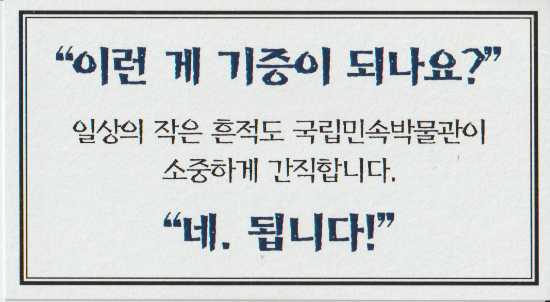 On the back of Sanghoon Jang, Director of the National Folk Museum of Korea's business card, there is a phrase requesting donations. Photo by Seomideum
© The Asia Business Daily(www.asiae.co.kr). All rights reserved.
![Clutching a Stolen Dior Bag, Saying "I Hate Being Poor but Real"... The Grotesque Con of a "Human Knockoff" [Slate]](https://cwcontent.asiae.co.kr/asiaresize/183/2026021902243444107_1771435474.jpg)


















