Ministry of Food and Drug Safety Announces Five-Year Plan for Drug Adverse Reaction Relief
Application Process Simplified and Compensation Decisions Accelerated
Compensation for damages caused by adverse drug reactions will be strengthened, and the application process will become more streamlined. The scope of compensation, previously limited to inpatient medical expenses, will be expanded to include outpatient treatment costs, and the maximum compensation limit for medical bills will be significantly increased from 30 million won to 50 million won.
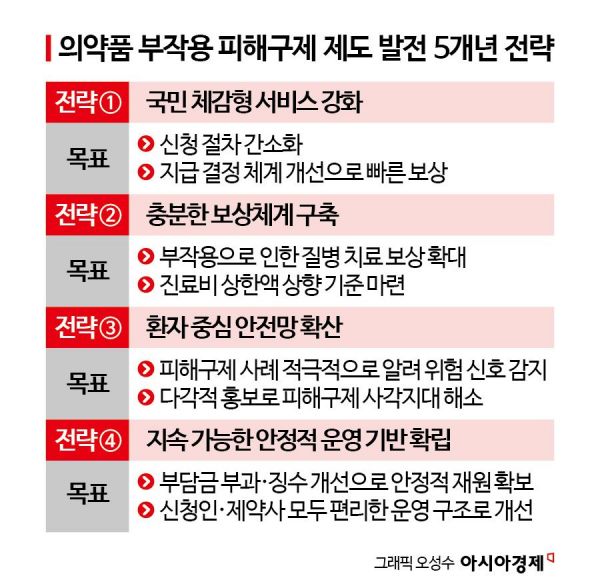
On January 12, the Ministry of Food and Drug Safety announced the "Five-Year Plan for the Advancement of the Drug Adverse Reaction Relief System (2026-2030)" aimed at reducing the economic burden on citizens and improving accessibility.
The drug adverse reaction relief system is a government program that compensates for severe adverse drug reactions that occur unexpectedly despite proper drug use. It has been in place since December 2014. To mark the 10th anniversary of the system, the new plan was developed under the vision of "Reliable Relief for the People-Fast, Sufficient, and Thorough," and consists of four main strategies and ten key initiatives.
The most notable change is the expansion of compensation for adverse drug reaction treatments. Currently, compensation is only provided for inpatient medical expenses in the event of an adverse reaction. Going forward, if a causal relationship is recognized, compensation will also be available for outpatient medical expenses incurred before and after hospitalization. In particular, to protect patients suffering from severe adverse reactions that require expensive treatments, such as toxic epidermal necrolysis, the maximum compensation limit for medical bills will be raised from the current 30 million won to 50 million won. This is expected to substantially reduce the financial burden on patients.
The application process will also be greatly simplified. The three types of consent forms and two types of pledges previously required for relief applications will each be consolidated into a single document. In addition, specialist medical staff will assist patients in preparing application documents at the time of discharge, thereby improving accessibility to the system.
To further expedite compensation decisions, claims for small medical expenses of 2 million won or less, where causality is clear and all expert committee members agree, will be eligible for review and compensation through a written assessment. A system of full-time advisory committee members will also be established to ensure continuous medical consultation during investigations and assessments, significantly reducing the time from application to compensation.
The safety net to prevent recurrence of adverse reactions will also be reinforced. As soon as relief benefits are paid, the relevant information will be linked to the Drug Utilization Review (DUR) system to completely block the risk of the same adverse reaction occurring again. In addition, accumulated relief case data will be analyzed and studied to help prevent future adverse reactions, and relevant laws will be revised to support this effort.
Furthermore, for antibiotics-which are among the most frequently involved in relief cases-educational programs will be conducted in collaboration with medical institutions. On-site awareness campaigns will also target medical professionals treating not only skin allergies but also liver, neurological, and infectious diseases, which have a high incidence of adverse reaction cases, to improve recognition of the relief system.
Additionally, to improve work efficiency, the annual contribution collected from pharmaceutical companies will be consolidated from twice a year to once a year (in July). The legal basis will also be clarified to prevent double compensation for the same damage in cases where civil litigation or settlement payments have already been received, ensuring that duplicate relief payments are not made.
Oh Yoo-kyung, Commissioner of the Ministry of Food and Drug Safety, stated, "This five-year plan is more than simple compensation; it is the government's commitment to fully protect the lives and daily lives of the people." She emphasized, "We will build a robust safety net at a global level to create an environment where people can use medicines with peace of mind."
© The Asia Business Daily(www.asiae.co.kr). All rights reserved.
![Clutching a Stolen Dior Bag, Saying "I Hate Being Poor but Real"... The Grotesque Con of a "Human Knockoff" [Slate]](https://cwcontent.asiae.co.kr/asiaresize/183/2026021902243444107_1771435474.jpg)












