30-Meter Wind-Assisted Device Installed on HMM Tanker
Performance Measured on Actual Routes After Land Verification
'Fuel-Saving Equipment' in Focus Ahead of IMO Regulations
HD Hyundai has begun sea trials of its 'Wind Assisted Propulsion System (WAPS)', which supplements propulsion using wind power, by installing it on an actual vessel. This device, which can simultaneously reduce fuel consumption and carbon emissions, is in the demonstration phase targeting markets where eco-friendly ship regulations are being strengthened.
HD Korea Shipbuilding & Offshore Engineering, the intermediate holding company for HD Hyundai's shipbuilding division, announced that it has installed a prototype of its independently developed 'Wing Sail' on a 50,000-ton class medium-sized oil tanker operated by HMM and has started sea trials. After verifying structural stability and basic performance on land, the device was mounted on an actual operating vessel, and recently completed both trial runs and inspection by the Korean Register (KR).
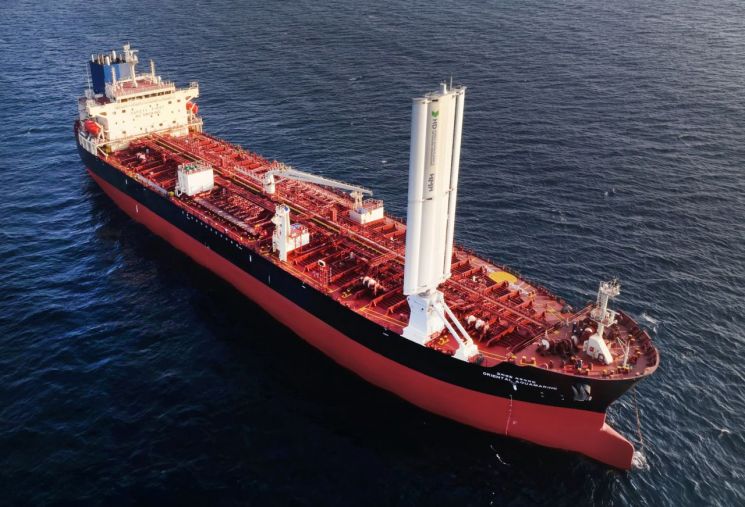 Sea trial image of the prototype 'Wingsail' independently developed by HD Korea Shipbuilding & Offshore Engineering. HD Hyundai
The Wing Sail is a large, wing-shaped structure approximately 30 meters high and 10 meters wide. It operates by harnessing wind to supplement the ship's forward propulsion. HD Korea Shipbuilding & Offshore Engineering expanded the area for wind utilization by attaching auxiliary wings on both sides of the main wing. Additionally, to reduce operational constraints, a tilting structure was applied so that the wings can be folded when passing through high waves, ports, or under bridges.
HD Korea Shipbuilding & Offshore Engineering plans to quantify the improvements in fuel efficiency and the reduction in carbon dioxide emissions based on data obtained from actual routes during this demonstration. Key analysis targets include thrust according to changes in wind direction and speed, changes in operational resistance, and fuel consumption. These results will serve as reference values for developing the Wing Sail into a commercial facility in the future.
This project was carried out as part of the Ministry of Oceans and Fisheries' "Integrated Ship Greenhouse Gas (GHG) Management Technology Development" initiative. HMM, the Korean Register (KR), and HD Hyundai Marine Solution participated, along with Busan-based equipment companies Oriental Precision & Engineering and Human Composite, which contributed to the development of the structure and components.
As the International Maritime Organization (IMO) strengthens carbon emission regulations, shipowners are expanding their interest not only in engine modifications and fuel conversion but also in fuel-saving methods. Wind assisted propulsion systems are attracting attention for their potential use not only in new ships but also in the retrofit market, since they can be installed on existing vessels as well.
A representative from HD Korea Shipbuilding & Offshore Engineering stated, "We are currently securing actual reduction effects and operational data through sea trials," and added, "Based on this, we are verifying the feasibility of commercial application."
© The Asia Business Daily(www.asiae.co.kr). All rights reserved.
![Clutching a Stolen Dior Bag, Saying "I Hate Being Poor but Real"... The Grotesque Con of a "Human Knockoff" [Slate]](https://cwcontent.asiae.co.kr/asiaresize/183/2026021902243444107_1771435474.jpg)










