Reuters: Dissatisfaction Over Lack of Progress Since Last Year's Agreement
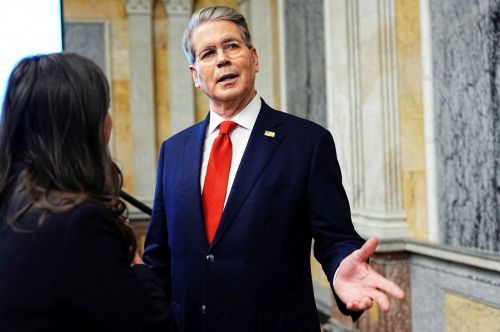 Scott Bessent, U.S. Secretary of the Treasury, is holding a press conference at the Treasury Department headquarters building in Washington DC, USA, on December 17 last year (local time). Photo by Reuters Yonhap News
At the ministerial summit being held in Washington, D.C., USA, on January 11-12 (local time), which is attended by the Group of Seven (G7) nations as well as major countries including South Korea, the U.S. government is expected to urge participating countries to take swift action to reduce their reliance on Chinese rare earth elements.
On January 11, Reuters reported, citing a senior U.S. government official, that U.S. Treasury Secretary Scott Bessent is scheduled to convey this policy to the participating countries.
In addition to the G7 countries, the European Union (EU), Australia, South Korea, India, and Mexico, among other major nations, are expected to attend the meeting. From South Korea, Deputy Prime Minister and Minister of Economy and Finance Koo Yooncheol will participate.
The United States maintains that more concrete efforts are required from each country regarding the issue of Chinese rare earth elements. According to a government official quoted by Reuters, Secretary Bessent reached an agreement on this matter at the G7 summit held in Canada last June, but has expressed dissatisfaction with the lack of progress among the countries.
This meeting takes place as China has recently strengthened its export sanctions on rare earth elements to Japan. According to the Wall Street Journal, after remarks made by Japanese Prime Minister Sanae Takaichi in November last year regarding “intervention in Taiwan in an emergency,” which heightened tensions between China and Japan, China has recently begun to restrict exports of certain dual-use rare earth-related items. The restricted items reportedly include seven major rare earth elements such as samarium (Sm), dysprosium (Dy), and terbium (Tb).
Meanwhile, Japan plans to share its expertise in diversifying supply chain risks beyond China. Japanese Finance Minister Satsuki Katayama stated at a press conference on January 9, “Japan has experience in risk diversification beyond China.” Citing data from the Japanese Ministry of Economy, Trade and Industry, Kyodo News reported that the proportion of Japan’s rare earth imports from China fell from 85% in 2009 to 58% in 2020.
© The Asia Business Daily(www.asiae.co.kr). All rights reserved.
![Clutching a Stolen Dior Bag, Saying "I Hate Being Poor but Real"... The Grotesque Con of a "Human Knockoff" [Slate]](https://cwcontent.asiae.co.kr/asiaresize/183/2026021902243444107_1771435474.jpg)
















