Corporate Bond Issuance Rises to Fund AI Investments
Corporate Debt Unaffected by Venezuela Developments
Corporate Bond Yield Spreads at Record Lows
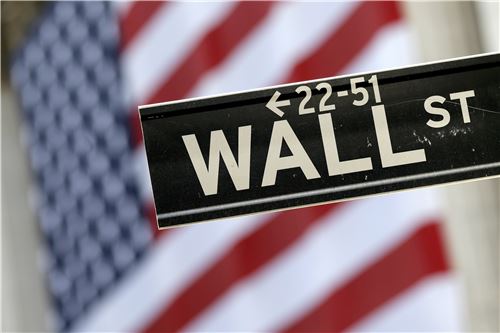 Wall Street Sign (The Asia Business Daily = Yonhap News)
From the very beginning of the new year, both American and international companies have been actively issuing corporate bonds in the United States to fund investments in artificial intelligence (AI) and other initiatives.
According to data analyzed by the Financial Times (FT) from the London Stock Exchange Group (LSEG) on January 11 (local time), the total issuance of investment-grade corporate bonds in the first week of January amounted to at least 95 billion dollars (approximately 138 trillion won). This marks the highest weekly volume since May 2020.
Teddy Hodgson, Global Co-Head of Fixed Income Syndicate at Morgan Stanley, explained, "January is typically a very active month for new bond issuance," adding, "This year, in particular, many companies are moving earlier than usual to issue corporate bonds, as they consider increasing the scale of bond offerings to finance AI infrastructure and large-scale mergers and acquisitions."
This trend is expected to continue throughout the year. Morgan Stanley forecasts that investment-grade corporate bond issuance will reach 2.25 trillion dollars in 2026, significantly surpassing the 1.9 trillion dollars issued in 2020.
Looking at the issuers in the first week of January, financial institutions and European companies were also included. France's telecommunications company Orange secured subscription orders exceeding 34 billion dollars across five maturities (tranches), ultimately raising 6 billion dollars. Japan's Sumitomo Mitsui Financial Group and U.S. semiconductor company Broadcom also raised 5 billion dollars and 4.5 billion dollars, respectively. All of these issuances recorded higher-than-expected subscription rates.
Despite the U.S. government's arrest of Venezuelan President Nicolas Maduro at the beginning of the year, the corporate bond market has remained favorable. The spread between investment-grade corporate bonds and U.S. Treasuries is at 0.79 percentage points, which is near a record low. This indicates that the market is applying almost no additional risk premium for U.S. corporate debt or external variables. In other words, corporate bond issuance is advantageous from a borrowing cost perspective, and strong demand for dollar-denominated bonds has also contributed to the increase in bond issuance volume, according to the FT.
Insurance companies and pension funds are also actively investing in highly rated corporate bonds. This is interpreted as an effort to secure higher long-term yields, as the U.S. is expected to further cut its benchmark interest rate this year.
However, some investors are taking a wait-and-see approach to the corporate bond market, as the additional yield (spread) over U.S. Treasuries is minimal. Neil Sun, a manager at RBC BlueBay Asset Management, said, "There are so many (corporate bond) deals that investors will eventually experience fatigue," adding, "We are holding cash to seize opportunities for wider credit spreads."
© The Asia Business Daily(www.asiae.co.kr). All rights reserved.
![Clutching a Stolen Dior Bag, Saying "I Hate Being Poor but Real"... The Grotesque Con of a "Human Knockoff" [Slate]](https://cwcontent.asiae.co.kr/asiaresize/183/2026021902243444107_1771435474.jpg)















