Dysadherin Involved in Metastatic Process
Inhibition Reduces Tumor Growth and Metastasis
"New Therapeutic Possibilities Through Drug Development"
 (From left) Professor Nam Jungseok, Department of Life Sciences, GIST; Professor Kim Hyungsik, Pusan National University; Jang Taeyoung, Integrated MS-PhD Program Student, GIST; Jeon Soel, Integrated MS-PhD Program Student, GIST.
Gwangju Institute of Science and Technology (GIST) announced on January 12 that a research team led by Professor Nam Jungseok of the Department of Life Sciences has identified the protein 'Dysadherin' as a key factor that simultaneously induces drug resistance and immune evasion in liver cancer, and has also proposed the potential for therapeutic strategies targeting this protein. This study is significant as it reveals a common mechanism underlying recurrence and therapeutic resistance, which have been the greatest challenges in liver cancer treatment.
Liver cancer is one of the deadliest cancers worldwide, with frequent recurrences after treatment and often limited responses to conventional chemotherapy or immunotherapy. Cancer stem cells, which survive anticancer treatment and can regenerate tumors, exist within the tumor mass, and the tumor microenvironment forms an immunosuppressive state that blocks immune cell attacks, thereby reducing treatment effectiveness.
However, until now, it has not been clearly understood how cancer stem cell formation and immune evasion occur simultaneously. Identifying this link could lead to the discovery of new therapeutic targets to overcome drug resistance, metastasis, and recurrence.
Against this backdrop, the research team focused on Dysadherin. Dysadherin is a glycoprotein located on the cell membrane and has been known to be involved in cancer progression and metastasis. Previous clinical studies have shown that Dysadherin expression is increased in various types of cancer cells, while it is rarely observed in normal cells.
The research team confirmed, through analysis of clinical patient data, mouse tumor models, and humanized mouse models, that when Dysadherin is expressed in liver cancer, the cancer progresses more rapidly, becomes more aggressive, and the risk of recurrence increases significantly.
Furthermore, the team elucidated the mechanism by which Dysadherin simultaneously drives cancer stem cell formation and immune evasion in liver cancer, and demonstrated in preclinical animal models that blocking this signaling pathway effectively suppresses tumor growth.
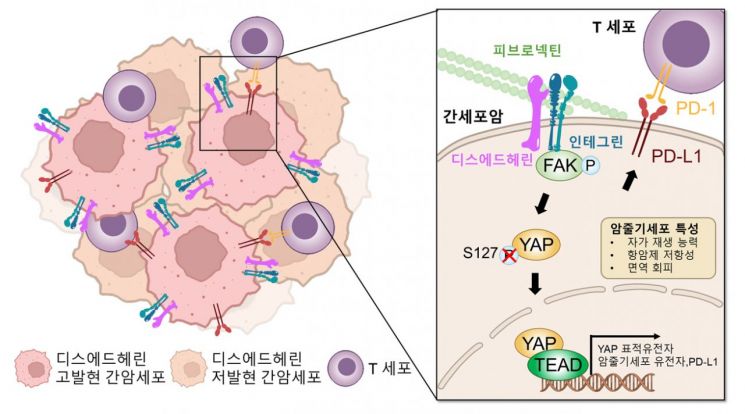 Schematic diagram of hepatocellular carcinoma malignancy and immune evasion mechanisms induced by Disadherein.
Analysis of the genomic data of liver cancer patients revealed that those with high Dysadherin expression levels had a markedly higher risk of rapid tumor progression and a poorer prognosis. In particular, higher Dysadherin levels were associated with increased amounts of OCT4 protein, which is closely related to the aggressiveness of liver cancer cells, and with strong activation of the YAP signaling pathway, which regulates cell growth and proliferation. This suggests that Dysadherin plays a critical role in making liver cancer cells more aggressive and less responsive to therapy. This trend was also observed in real patient data, confirming that high Dysadherin expression is associated with faster cancer progression and lower survival rates.
The research team also proposed the potential for new therapeutic strategies targeting Dysadherin. When liver cancer cells with suppressed Dysadherin activity were transplanted into humanized mouse models, the stemness properties of the cancer cells decreased, and previously ineffective immune cells were reactivated, resulting in a marked reduction in tumor growth and metastasis to other organs. Additionally, administration of a Dysadherin-inhibiting peptide to tumor model mice significantly reduced cancer stem cell properties, tumor growth, and metastasis, demonstrating that therapeutic strategies targeting Dysadherin could translate into real treatment effects.
This study identified Dysadherin as a key regulatory factor that connects cancer stem cell properties, immune evasion, and resistance to anticancer therapies in liver cancer.
The research team discovered that Dysadherin activates an intracellular signaling cascade known as the FAK-YAP axis, increasing the production of genes related to cancer stem cells (such as OCT4) and molecules (such as PD-L1) that allow cancer cells to evade immune cell attacks. Furthermore, inhibition of Dysadherin or the FAK-YAP signaling pathway not only reduced tumor growth and metastasis but also normalized the immune environment surrounding the tumor, as confirmed in preclinical models.
Professor Nam Jungseok stated, "This study is significant in that it reveals how drug resistance and immune evasion-the most challenging issues in liver cancer treatment-are closely interconnected via the Dysadherin-YAP signaling axis. Since inhibition strategies targeting Dysadherin have been shown to alleviate tumor growth, metastasis, and the immunosuppressive microenvironment, we expect that future drug development could offer new therapeutic options for patients with advanced liver cancer who do not respond to existing treatments."
© The Asia Business Daily(www.asiae.co.kr). All rights reserved.
![Clutching a Stolen Dior Bag, Saying "I Hate Being Poor but Real"... The Grotesque Con of a "Human Knockoff" [Slate]](https://cwcontent.asiae.co.kr/asiaresize/183/2026021902243444107_1771435474.jpg)

















