"Set Manufacturers Cite Supply Challenges"
"Display Expansion in the Era of Edge AI"
"China's OLED Technology Gap Will Remain"
Lee Chung, President of Samsung Display, identified "semiconductor supply and pricing" as the biggest variable for this year's business. He analyzed that the boom in memory semiconductors could directly impact set manufacturers (finished product companies) that purchase displays, leading to increased manufacturing costs and supply instability, which could ultimately have a negative effect on the display component industry as well.
On January 7 (local time), at the Wynn Hotel in Las Vegas during CES 2026, Lee Chung met with reporters and discussed the variables and risks in the display market this year. He stated, "From an electronics standpoint, the memory semiconductor situation is favorable, but from the perspective of our clients (set manufacturers), rising prices and supply difficulties are often cited as risks," adding, "As a component supplier, we cannot avoid being affected."
He explained that if semiconductor prices rise, the profitability of set manufacturers producing smartphones, TVs, and home appliances will deteriorate, which could then lead to pressure on display suppliers to lower unit prices or a decrease in order volumes. Lee Chung remarked, "Some companies have no choice but to raise prices, and if prices go up, it will inevitably affect sales," indicating that when prices rise in one area, it is only natural to make cuts elsewhere, suggesting there is pressure for price adjustments.
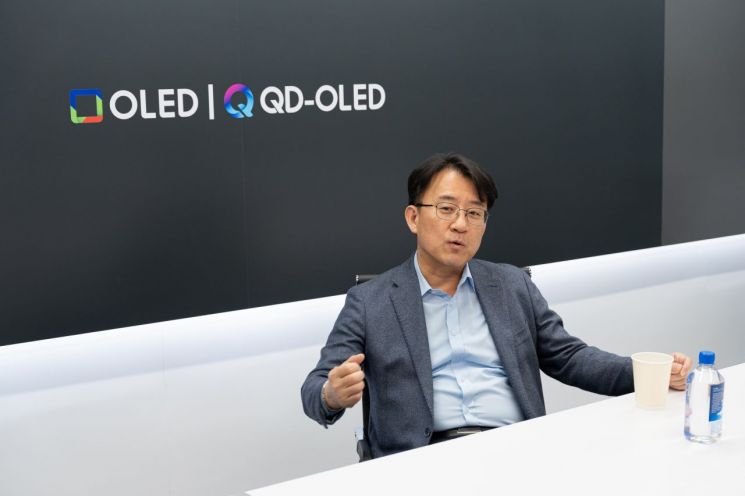 Lee Chung, President of Samsung Display, is being interviewed by the press after touring Samsung Electronics' exclusive exhibition hall at the Wynn Hotel in Las Vegas during CES 2026 on the 7th (local time). Photo by Joint Press Corps.
Despite these circumstances, he expressed confidence in the future growth potential of the display market. He said, "Although there is a tendency to reduce displays in the era of edge device AI, displays are also being emphasized more than ever," adding, "According to market research firms, the number of displays to be used will increase significantly, potentially by tenfold."
Regarding the outcome of participating in CES, he said, "The results were positive," and revealed that he also met with major U.S. AI-related big tech companies to discuss potential collaboration. He added, "There were discussions regarding edge AI devices, but it is difficult to disclose specific details."
On this year's exhibition trends, he analyzed, "While the overall direction with AI is similar to last year, the actual implementation and operation have become much deeper and more user-friendly," noting, "There is a stronger trend among companies to offer total solutions." Regarding business strategy in the era of robotics, he said, "We do not manufacture robots; we provide displays for robots," and predicted, "In the era of edge AI, demand for displays will increase significantly."
In particular, regarding new form factors, he stated, "We will develop displays that naturally fit and adapt to the changed designs of the products people already use," expressing his ambition by saying, "We dream of providing displays for everything-watches, glasses, pendant necklaces, and more."
He offered a cool-headed assessment of Chinese companies that have recently been accelerating investments in 8.6th-generation OLED (organic light-emitting diode) technology. He commented, "China is working very hard, but the gap in OLED technology remains significant." Citing specific technological capabilities, he explained, "While technology may be saturated in some areas, our 8.6th-generation uses all-oxide technology. I do not know how deeply Chinese companies are advancing internally, but based on what is publicly available, I believe there is still a technological gap."
Regarding additional investment plans, he took a cautious stance. Lee Chung said, "For now, it is important to ensure the success of the 8.6th-generation, in which we have made large-scale investments. If we succeed, further expansion will follow naturally," adding, "Production capacity should continue to grow, but it is important to expand at the right time and pace," indicating a measured approach to investment speed.
He also forecasted "continuous evolution" in the foldable market. Lee Chung said, "The three most important factors are thickness, durability, and eliminating creases," noting, "Foldable technology continues to improve."
He expressed confidence in the rapidly growing automotive display market, saying, "We are performing well." He explained, "Automotive manufacturers are increasingly recognizing the advantages of OLED. Adoption has started mainly with high-end luxury vehicles, and the market share for automotive OLEDs is about 70%."
He stated his intention to continuously expand market share and increase influence in the overall display market. At the same time, he emphasized, "The TV market is going through a difficult period, but I believe we can widen the gap by working even harder."
© The Asia Business Daily(www.asiae.co.kr). All rights reserved.

















