Only 13.4% Cite Labor Cost Savings
More Than Three Years Needed to Ensure Productivity
"Minimum Employment Period for Foreign Workers Must Be Guaranteed"
The majority of small and medium-sized enterprises (SMEs) cited "difficulty in recruiting domestic workers" as the main reason for hiring foreign workers. However, a significant number of companies were unable to employ foreign workers up to the maximum allowed limit due to decreased initial productivity and the burden of high employment costs.
On January 11, the Korea Federation of SMEs announced the results of the "2025 Comprehensive Survey on Employment Challenges Related to Foreign Workers." The survey was conducted with 1,223 SMEs that currently employ foreign workers.
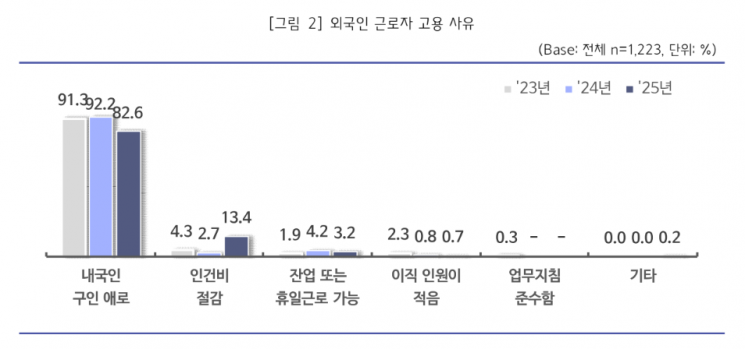 Excerpt from the Korea Federation of SMEs' "2025 Comprehensive Survey on Employment Challenges Related to Foreign Workers." Korea Federation of SMEs
When asked about the reasons for hiring foreign workers, 82.6% of respondents pointed to difficulties in recruiting domestic workers, far surpassing the 13.4% who cited labor cost savings. In fact, SMEs were found to be unable to utilize foreign workers up to the maximum employment limit due to high salaries and employment costs.
Foreign workers who had been employed for less than three months demonstrated only 66.8% of the productivity of their domestic counterparts. Among companies that agreed on the necessity of a probationary period (97.1%), the average required probationary period was 3.4 months. Most respondent companies stated that a minimum employment period of more than three years was necessary to ensure adequate productivity.
The most important factors considered when hiring foreign workers were: ▲ country of origin (59.4%), ▲ Korean language proficiency (56.3%), and ▲ physical condition (32.9%), in that order. For business owners, the biggest challenge in managing foreign workers was "communication (low proficiency in Korean)," accounting for a majority (52.1%).
Regarding improvements to the current employment permit system, the most common response (41%) was the need for disciplinary measures against unfaithful foreign workers, such as those engaging in work slowdowns. This was followed by ▲ extension of foreign workers' stay (31.5%) and ▲ the establishment of a wage system that takes into account the productivity of foreign workers (25.6%).
Yang Okseok, Director of the Human Resources Policy Division at the Korea Federation of SMEs, stated, "The reason SMEs endure the low initial productivity and high labor costs of foreign workers is because they view it as an investment in and expectation for long-term skill development. Therefore, it is necessary to sufficiently guarantee the minimum employment period for foreign workers so that businesses can manage their workforce stably."
© The Asia Business Daily(www.asiae.co.kr). All rights reserved.
![Clutching a Stolen Dior Bag, Saying "I Hate Being Poor but Real"... The Grotesque Con of a "Human Knockoff" [Slate]](https://cwcontent.asiae.co.kr/asiaresize/183/2026021902243444107_1771435474.jpg)
















